PHOTO
64090.0
A colourful mural symbolising travel through landscape, a sculpture celebrating rail workers and a three-piece sculpture from a celebrated first nations artist have been installed at the Wangaratta railway station precinct as part of the Inland Rail transformation.
Inland Rail commissioned the three public art pieces at the state heritage listed station to meet state heritage planning requirements to acknowledge the cultural heritage and historical operation of the railway station.
The selected works reflect the cultural and heritage values of the local area.
The successful artists and installations, include ‘Mirring Leerpeen’ in the pedestrian underpass mural, ‘Journey’ at the Norton St entrance to pedestrian underpass, and ‘The Lifters’ in the rail yard garden.
Yorta Yorta artist Tommy Day’s colourful mural ‘Mirring Leerpeen’ for the underpass embodies the theme of travel through its depiction of movement across the landscape, symbolising the journeys taken by those who pass through the underpass.
The design reflects the colours of the country familiar to the area and reflects the sun rising and setting.
‘Journey’ created by artists Aunty Kim Wandin and Chris Joy – who make up Murrup Biik – consists of three white bronze discs mounted on steel poles of various heights and sizes and representing Aboriginal people’s journeys across Country as trade routes which became the transport routes of the colony.
Their form references signage or signals, symbolising arrival, welcome to place and a site of gathering.
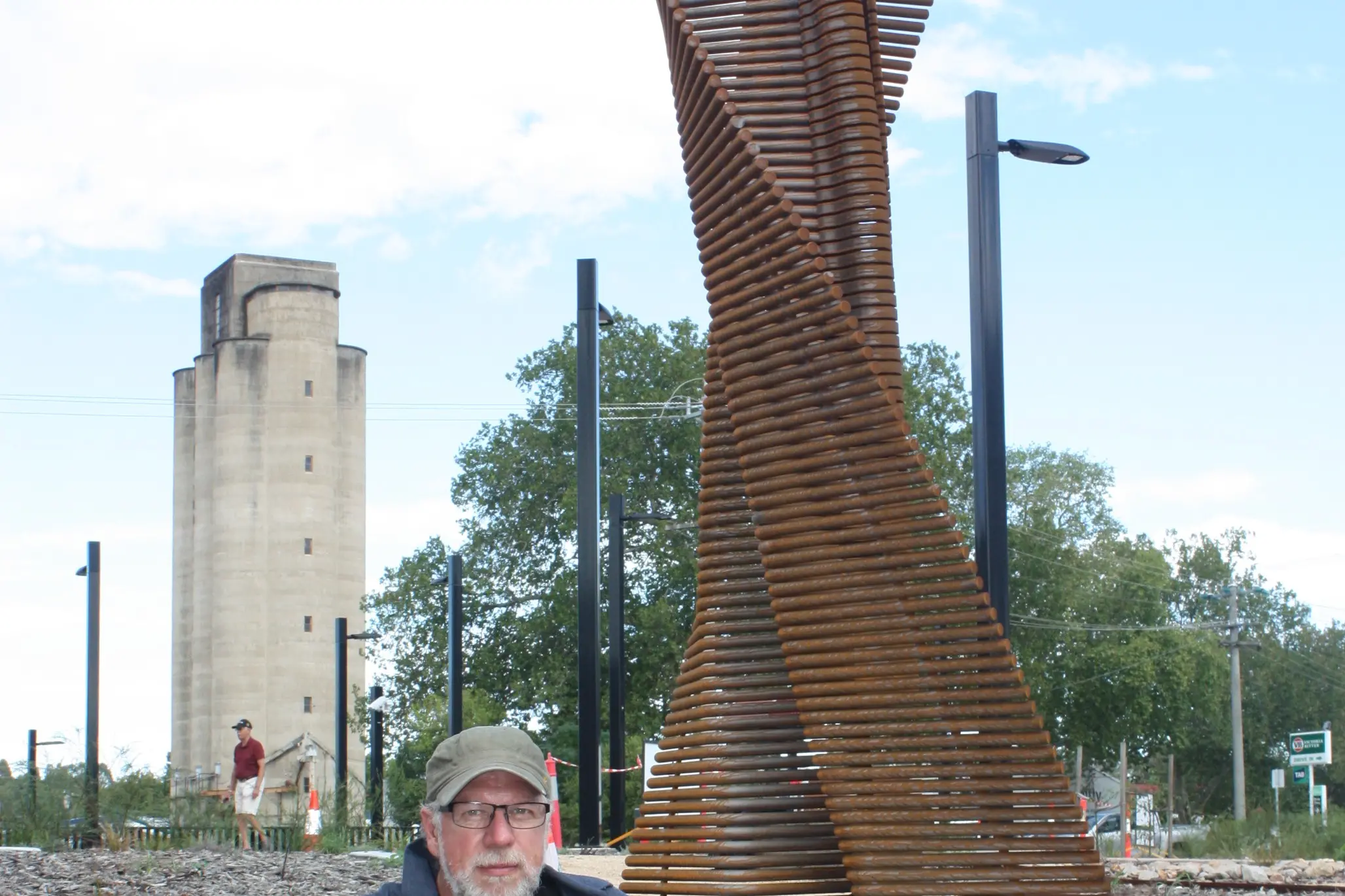
Wangaratta’s rail history is commemorated in Melbourne artist, Robbie Rowlands’s sculpture for the rail yard garden ‘The Lifters’.
It celebrates rail workers and railway infrastructure by linking the worker and the infrastructure through the specialised tool, the rail tong.
Stacked on top of each other, the tongs create a structure that reflects the human body, with the repetitive form appearing spine-like.
Robbie said 'The Lifters' has been a long journey, having been commissioned over a year ago.
“The work is made up of 86 replica rail tongs — tools traditionally used by teams of workers to lift and position rail track," he said.
"I wanted the sculpture to act as a memorial to rail workers and the infrastructure we often take for granted, particularly the migrant workers who carried out this difficult labour in the early days of the railways.
“Although the materials reference heavy industry, the sculpture has a softness to it.
"The stacked tongs form a spine‑like, human shape, linking the physical body of the worker to the infrastructure they built.
"I’m really excited by how that bodily quality came through once the work was physically made.”
The art installations were selected by the Wangaratta Arts and Culture Advisory Committee and representatives from Inland Rail, with contributions from Yorta Yorta National Aboriginal Corporation and local first nations stakeholders.
An Inland Rail spokesperson said Wangaratta’s cultural and historical significance are celebrated in three very different artistic interpretations.
“The artwork will reflect the community story and strengthen the local connection with the transformed station site,” they said.
“They provide another great reason to visit Wangaratta.”