PHOTO
65051.0
Living in the mountainous eucalypt forests and woodlands of south-eastern Australia, the Gang-gang Cockatoo occurs on the edge of its range in the Wangaratta region of North East Victoria.
These rather inconspicuous cockatoos are a touch smaller than a Galah and their short tails give them a somewhat stocky appearance.
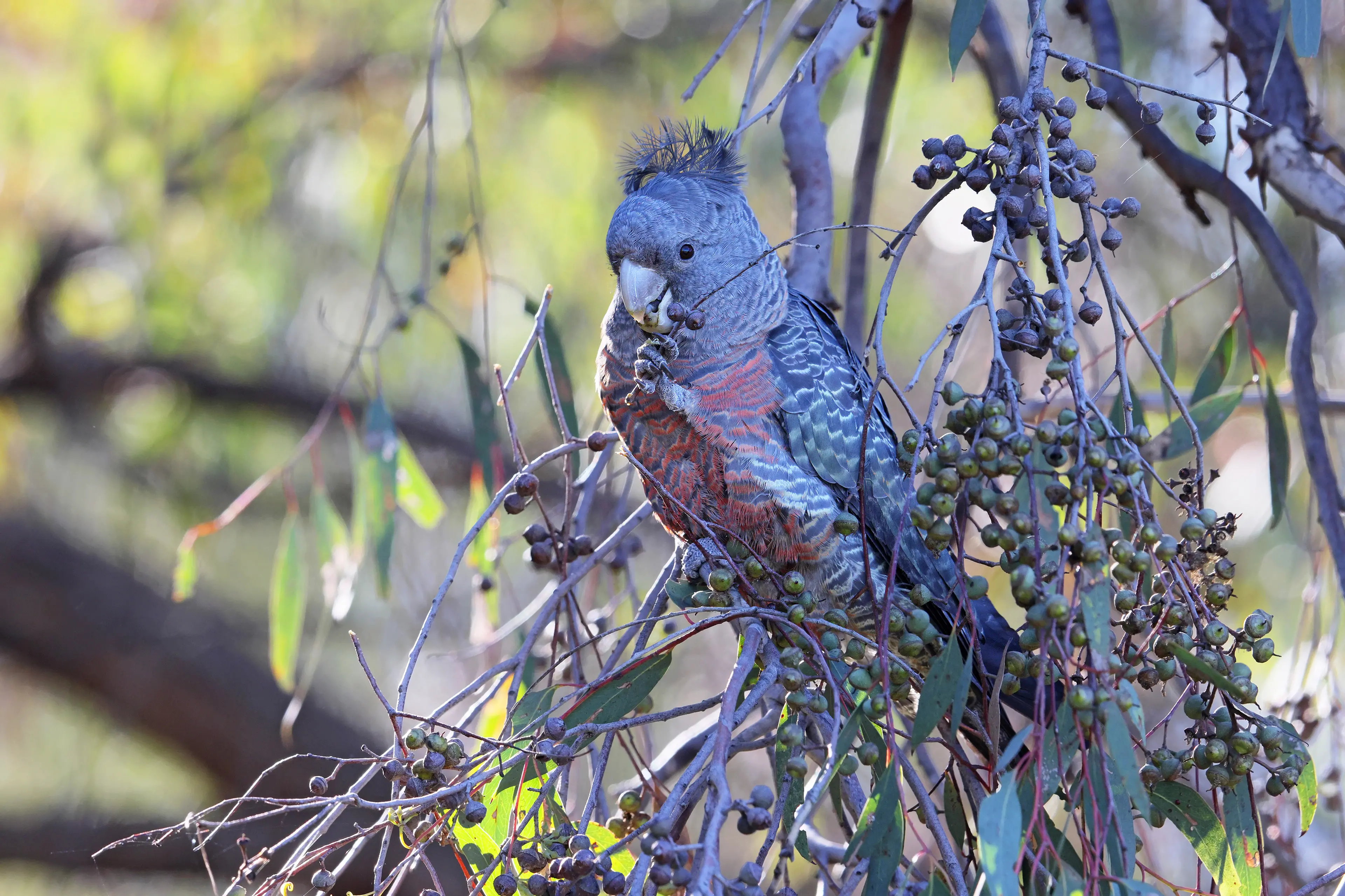
They are predominantly dark grey in colour, with paler grey-white edges to their feathers which contribute to a scaly effect to their plumage.
Males have a conspicuous bright red head and wispy forward curling crest, whereas females are identified by their grey head and orange-red barring on their chest and breast.
Gang-gang Cockatoos are often first detected by their distinctive creaking calls, typically given as they take flight.
Otherwise, these mostly quiet birds forage in pairs or small family parties amongst the eucalypt canopy.
At times, you may hear them as they feed – their small but robust bills cracking into their preferred food of gum nuts.
Eucalypt buds and fruits, particularly from Red Stringybark and to a lesser extent, Long-leaf Box form the majority of their diet.
They also feed on the dry cones of native-pines, and in wattles where they forage on seed pods and gnaw into the soft timber to extract insect larvae.
Sometimes, they also feed among introduced Hawthorn and Cotoneaster bushes, where they gorge themselves on the fleshy red berries.
The birds will return to the same trees or bushes until the food there is depleted.
For a small cockatoo, their flight is heavy and laboring with deep wing beats, but they are nonetheless competent fliers and very capable at negotiating a forested environment, twisting and turning tightly between the trees.
Though Gang-gangs have traditionally been known to breed in mountain forests of the Great Divide, in recent years there has been some evidence to suggest they breed more locally, namely in the Warby Ranges, with birds inspecting tree hollows in spring and juvenile birds being observed in summer.
Typically, however, they nest at higher altitudes during spring-summer and come down the King and Ovens valleys to lower elevations for the winter, where several family groups may combine to form flocks of up to 20 birds.
Recent catastrophic bushfires that have blackened huge swathes of forest throughout the Great Divide have most certainly impacted the Gang-gang Cockatoo through the destruction of old hollow-bearing trees, used as nest sites, and large areas of stringybark-dominated forest, important for foraging.
It has been estimated that in the past two years, the Gang-gang population has declined by over 20 per cent and the conservation status of the species has changed from being secure to endangered.
Predicted increases in fire frequency and severity will place the Gang-gang Cockatoo at risk of ongoing population decline.
Areas of suitable habitat such as the Warby Ranges, isolated from the expansive forests of the Great Divide, might become increasingly important refuges for these delightful birds in the future.