
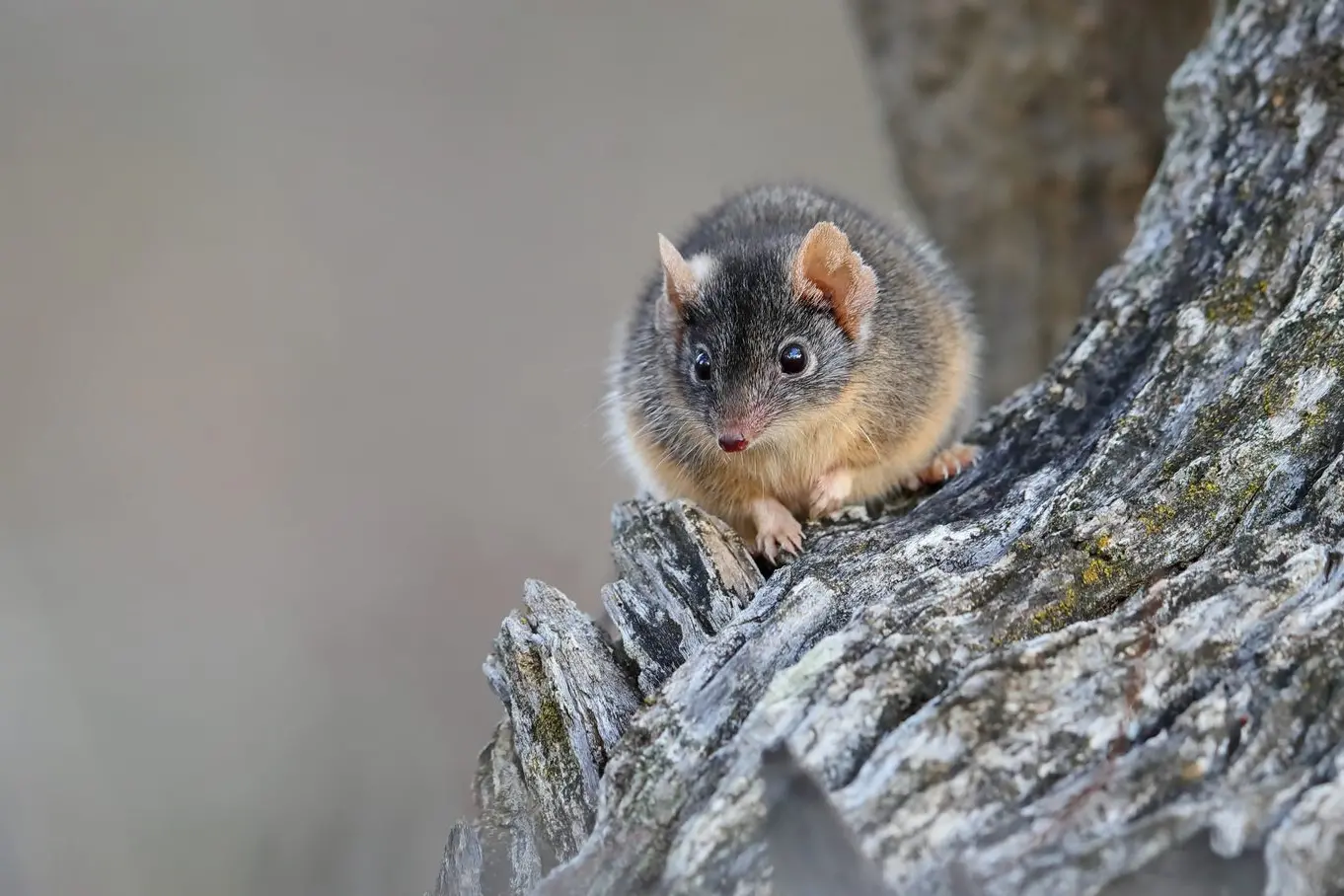
PHOTO
THE Yellow-footed Antechinus is often mistaken for a mouse, however, there are several distinct features which separates them.
Although a mouse is somewhat similar in general appearance, antechinus have a pointier muzzle, shorter ears and shorter hind feet.
Being marsupials, they also differ from rodents in that they have a very different dental structure, with sharp teeth developed to cater for their predatory and carnivorous lifestyle, and they do not give birth to well-developed young like mice do.
Females give birth to very incompletely-developed young - bearing little resemblance to what they grow into - and continue to grow inside their mothers pouch or under a special flap of skin, where they feed on their mother’s milk.
In North East Victoria, a reasonably common but rather shy and rarely seen species of marsupial is the Yellow-footed Antechinus, or what was known for many years as a ‘marsupial mouse’.
They are active both by day and night, but they are most often observed during the morning and late afternoon, when they energetically forage over stumps and logs in search of prey which may range from spiders, beetles and moths to small reptiles, birds and their eggs.
They are voracious predators and may take on much larger animals including mice.
Antechinus have an extremely unusual reproductive system.
Females have only one short two-week breeding period each year.
Mating is intense and can last up to 12 hours, with the males mating with many females; thus the litters have multiple fathers.
During the short breeding window, males expand their home range and are often active night and day, finding and mating with as females as possible.
Males have an increase in hormones during this time, allowing them to use extra energy to maximise reproductive output.
A side-effect, however, is this also shuts-down their immune system.
After a couple of weeks, all males experience mass mortality and die off.
Death of males is caused by a low immunity to various stress-related diseases as a result of highly energetic mating.
A couple of weeks later, all females in the population give birth to a litter of young within a period of a few days of one another.
At this time, there are no males surviving at all and the females are left to raise their young, which become independent after around 90 days.
Why the male die-off strategy occurs is not fully understood, but it may be that it is far better for males to put all their reproductive efforts into one short breeding season, rather than attempt to survive to the next one.
It may also be to ensure that females produce as many offspring as possible within a very short time period, which may potentially swamp predators – some may be taken but others may survive.
Another explanation may be, in the absence of all males, young animals face less competition for food and shelter.
Nonetheless, it is a fascinating evolutionary phenomenon.
As mating occurs over winter, the next couple of months are the best time to see Antechinus during the day.
A walk through the bush in the Warby Ranges, Killawarra and the hills around Chiltern and Eldorado can provide rewarding sightings.