
PHOTO
MANY people are aware of owls and most are familiar with frogmouths, but among Australia's nocturnal birds, nightjars would be the most poorly known and rarely encountered species.
Despite having large eyes and exceptional night vision, and their habit of sleeping through the day, nightjars are not related to owls or frogmouths; rather they belong to their own distinct family and are most closely related to the nighthawks of Africa and the Americas.
Three species of nightjar occur in Australia, the White–throated Nightjar being widespread in the ranges of eastern Australia, from around Melbourne, through New South Wales and right up to the tip of Cape York in Queensland.
Locally, White–throated Nightjars occur at many locations, such as the Killawarra and Chiltern forests, the Mt Pilot range and the drier hills around Whitfield and Carboor, but due to their incredibly secretive habits and ultra–camouflaged appearance, records are few and far between.
Their preferred habitat is dry open forest and woodland, especially ironbark and stringybark–dominated vegetation on dry, stony slopes and gentle rises, particularly where there are sparse low shrubs and an open ground layer of dry leaves and sticks.
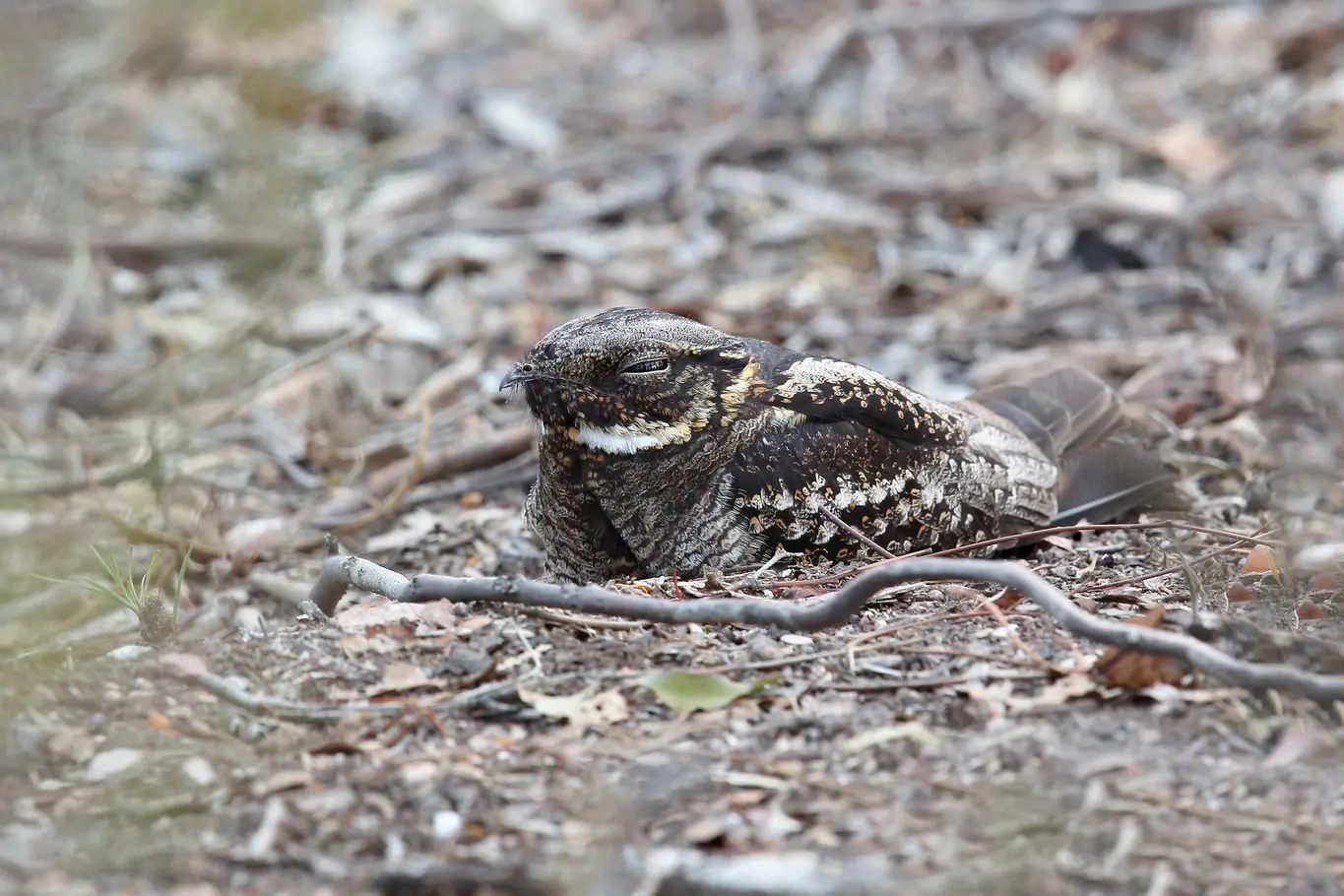
Their intricate plumage pattern and neutral colours, combined with their cryptic behaviour of lying completely still with their eyes only slightly open, render them very hard to see among the leaf litter.
Upon approach by an intruder or potential threat, these birds flush abruptly from the ground without warning, rising quickly on long flat wings and flying some distance away, returning to the ground and quickly assuming a secretive position.
As well as roosting on the ground, these birds also nest on the ground, laying one or two eggs among debris.
Probably the only thing distinctive about the White–throated Nightjar is their unusual wacky call, a loud accelerating laugh given as they become active at dusk and then intermittently throughout the night.
Once they become active, they are majestic creatures to observe in the twilight, expertly flying above and between the forest canopy in pursuit of aerial insects such as moths and winged ants.
They fly buoyantly and can forage for long periods, occasionally returning to the ground or landing on a high perch to rest and call, before resume hunting again.