PHOTO
71489.0
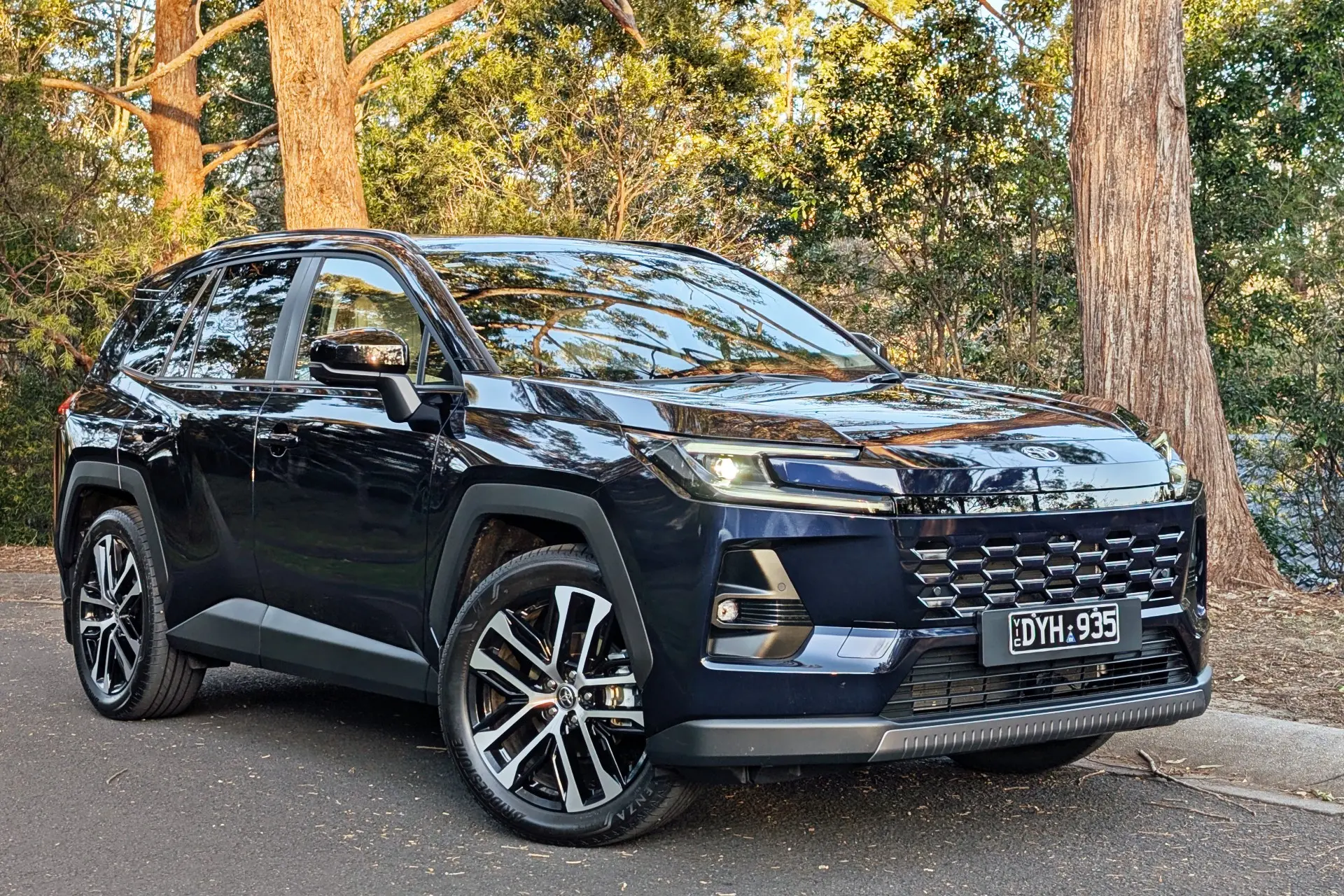
The all-new Toyota RAV4 made its debut down under in April.
As one of its bestselling models, the RAV has an important role to play in the continued success of the world's number one automotive manufacturer.
But as the RAV sits on the same platform as its predecessor, is the same size and is powered by the same basic hybrid setup - it's not all new really.
Certainly, it represents a generational change for the popular five-seat SUV, but we are yet to meet a new model that isn't larger and more powerful than its predecessor.
Rather the sixth generation, RAV4 is a cleverly re-engineered and repackaged version of the previous model.
One thing's for sure, the new RAV is the first Toyota to be offered as a plug-in hybrid (PHEV for short) and it is this version that has been rebadged and is sold as the Suzuki across the European market.
Warranty remains the Toyota standard five years/unlimited kilometres.
First five services are pegged at $325, or 20 per cent more than the $270 for the previous model, which comes to $1625 over five years or 75,000km.
STYLING
The new RAV looks like it came out of the same design studio as the Land Cruiser Prado, with exterior design by Daisuke Iguchi and Junya Furuta.
Our test vehicle was the all-wheel drive Cruiser, which sits at the top of the hybrid range at $60,340 plus on-roads - that's almost $6000 more than it would have cost 12 months ago.
Standard kit includes two-zone climate control with rear vents, fabric upholstery with manual adjustment for the seats, smart entry and start, electric park brake, auto-dimming view mirror, plus auto power-folding and heated exterior mirrors.
There's also 17-inch dark grey alloys, twin tailpipes, LED headlights, auto high beam, road-sign assist (speed signs only), roof rails and acoustic front windshield glass.
By the time you get to the Cruiser, there's 20-inch alloys, larger 12.9-inch touchscreen, cloth with real leather accents, heated, powered-adjust front seats, heated rear seats, head-up display, digital rear-view mirror, two wireless chargers, panoramic sunroof, power-operated tailgate and nine-speaker JBL audio.
SAFETY
Toyota sought to delay testing until it had a chance to implement changes that are likely to bring a five-star result under ANCAP new testing regime, due to be introduced in the second half of the year.
The latest RAV debuts Toyota Safety Sense 4.0, which adds front cross-traffic alert, lane-change assist, and predictive curve speed control (to be delivered via over-the-air updates).
The pre-collision system with autonomous emergency braking has been expanded to include the detection of vehicles crossing perpendicularly at intersections, while also introducing acceleration suppression at low speed and active support for the emergency steering assist functions.
There are eight airbags, a reversing camera with guidelines, emergency steering assist, full-speed active cruise control, front and rear cross traffic alert, lane trace assist, proactive driving assist, automatic high beam, parking support brake and blind spot monitor with safe exit assist.
ENGINES / TRANSMISSIONS
RAV4’s 2.5-litre petrol hybrid develops 143kW of combined power at 4800 rpm and 221Nm of torque from 3200-3600 rpm.
It drives to all four wheels in AWD models or to the front wheels in 2WDs, channelled through a continuously variable automatic transmission.
DRIVING
Technically, this RAV is all-new, but it actually sits on the same TNGA: GA‑K platform as its predecessor.
But it sure looks and feels new.
Dimensions largely carry over, but the platform receives additional structural adhesive, braced suspension towers, and revised sub-frames to improve rigidity and NVH.
There's a 5mm difference in the height compared to its predecessor, but that's about it.
While the numbers suggest it is the same size, it feels somewhat snugger inside but in a good way.
Luggage capacity has increased, claiming up to 705 litres, depending on grade and configuration (measured to the roof).
Cabin storage is excellent with a range of locations provided to stow the detritus of life.
A clever reversible console lid opens towards the driver as well as in the opposite direction, or can be removed completely and flipped over to become a shelf.
Analogue gauges have given way to a customisable digital instrument cluster.
A physical volume control sits below the touchscreen, along with temperature and demister buttons - but fan speed, seat heating and other climate functions have been moved to the touchscreen.
Big chunky push buttons provide access to EV and other drive modes.
All hybrids (HEV) in the new RAV4 range are powered by Toyota’s 5th generation hybrid system that generates a maximum combined power output of 143kW.
There's a new motor for the front and an updated lithium-ion battery that replaces the previous nickel-metal hydride unit.
As before it is a series/parallel setup, so it can operate in either mode.
In Series mode, the engine’s main job is to spin a generator (MG1) to produce electricity, which then drives the main traction motor (MG2) and/or charges the battery.
In that state, the wheels are effectively driven electrically, and the engine isn’t mechanically “pulling” the car in the traditional sense.
In Parallel mode, the engine’s torque is also sent mechanically to the wheels through the planetary gearset, at the same time as MG2 provides electric drive.
Both engine and motor contribute directly to propulsion.
Toyota’s power‑split device lets it blend continuously between these behaviours, so in practice you just get smooth, optimised operation.
However, the overall power output is actually down, at least for the all-wheel drive variant that we tested.
It's dropped from 163kW back to 143kW and just to rub salt into the wound, now takes premium 95 unleaded (instead of 91 RON).
Peak torque remains unchanged at 221Nm but is available lower in the rev range.
Fuel consumption has dropped from a combined 6.5 to 4.6L/100km.
In simple terms the “all‑new” hybrid is cleaner and more economical to meet evolving Euro emissions standards, but you give up some power and a cheap 91 in exchange.
In our week of driving the car, we recorded 5.9L/100km after about 400km of mixed driving.
In terms of the drive experience, the new RAV felt a bit lethargic initially, as though the handbrake was on.
Then we found Sport mode and that is pretty much where it stayed.
Accelerating hard off the line it was able to keep pace with a Tesla dual motor sedan, which is not an easy thing to do.
The dash from 0-100km/h reportedly takes a reasonable 7.7 seconds.
The transition from electric to petrol power is smooth, but the engine becomes loud and raucous under hard acceleration.
Ride and handling are sublime, even on 20-inch 235/50 series low profile rubber.
The tires were Bridgestone, instead of the terrible Yokohamas they used to fit.
The shocks and springs soak up just about everything in their path, with barely a twitch.
Steering is direct and accurate, but a little heavy.
Slam on the brakes and they bite hard.
SUMMING UP
The RAV4 is a master class in how to do it right.
It's not the most powerful five-seat hybrid, it's not the roomiest example either, nor does it boast the lowest fuel consumption - but put it all together and the RAV is one slick, well-oiled machine.
Yes, it's more expensive than its Chinese competitors, but as one punter puts it so succinctly - "It's a Toyota isn't it, so people will buy it anyway?"
But for how long, that's the real question.
RATINGS:
Looks: 7.5
Performance: 7
Safety: 6
Thirst: 7.5
Practicality: 8
Comfort: 7.5
Tech: 7.5
Value: 7
Overall: 7.3
AT A GLANCE
MODEL LINE-UP
HEV
GX 2WD, $45,990
GX AWD, $49,340
GXL 2WD, $48,990
GXL AWD, $52,340
Edge AWD, $55,340
XSE AWD, $58,340
Cruiser 2WD, $56,990
Cruiser AWD, $60,340
PHEV
XSE 2WD, $58,840
XSE AWD, $63,340
GR Sport AWD, $66,340
Note: These prices do not include government or dealer delivery charges.
Contact your local Toyota dealer for drive-away prices.
SPECIFICATIONS (Toyota RAV4 Cruiser 2.5-litre petrol / electric hybrid five-door wagon)
ENGINE:
Capacity: 2.5 litres
Configuration: Four cylinders in line, Series-parallel hybrid
Maximum Power: 143 kW @ 4800 rpm
Maximum Torque: 221 Nm @ 3200-3600 rpm
Fuel Type: 95 RON
Combined Fuel Cycle (ADR 81/02): 4.6L/100km
CO2 Emissions: 105g/km
DRIVELINE: Continuously variable transmission (eCVT)
DIMENSIONS, WEIGHT, AND CAPACITIES
Length: 4600mm
Width: 1855mm
Height: 1680mm
Wheelbase: 2690mm
Kerb weight: 1775kg
Turning circle: 12.1m
Fuel tank: 55L
BRAKES
Front: Ventilated disc
Rear: Sold disc
STANDARD WARRANTY
Five years / unlimited kilometres