PHOTO
After a string of hybrid and fully-electric vehicles, including a full-blown electric ute, it was kind of refreshing to get behind the wheel of a no-frills turbo-diesel 4x4 ute like they used to make (and obviously still do).
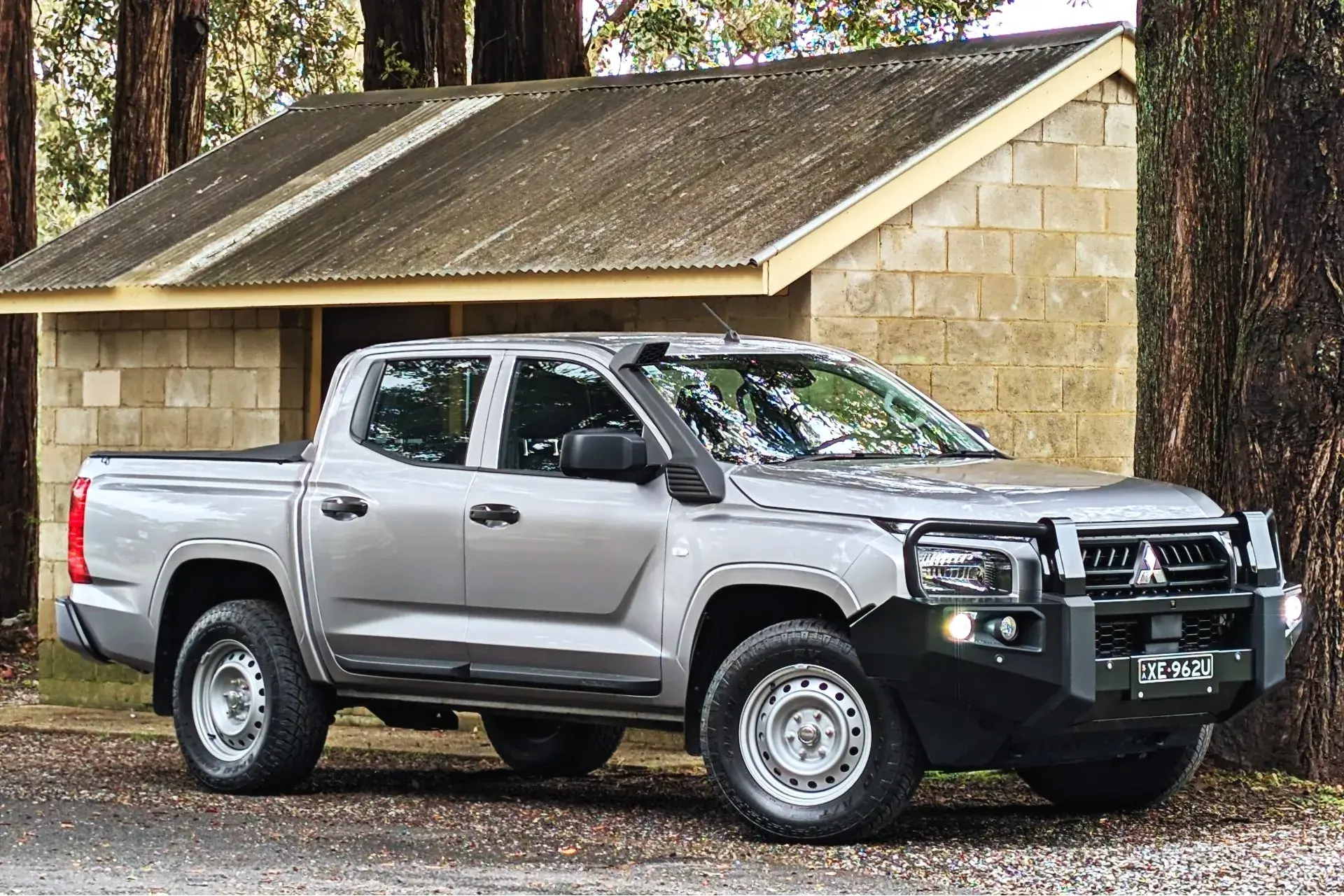
The five-seat Mitsubishi Triton GLX double cab “pick up” (somewhere along the line they became pickups) , in either 4x2 or 4x4 configuration, is just such a beast, complete with good old-fashioned steel wheels.
Mitsubishi describes the GLX as everything you want in a tough, reliable and durable ute; whether it’s the 4x2 for work or the 4x4 for play, they will get the job done anytime, every time.
The entry model to the Triton range retails for $44,090 in two-wheel drive form and $51,440 for the 4x4.
Our test vehicle was the GLX 4x4 double cab, Easy Select low and high range 4WD and all terrain tyres.
Firmly focused on work capability, it’s offered with a voice of six-speed manual or six-speed automatic transmissions.
GLX is covered by a 10-year warranty, along with 10 years capped price servicing and 10 years roadside assistance.
STYLING
Our vehicle was fitted with almost $10,000 worth of accessories, including premium silver paint ($790), soft tonneau ($918), tray liner ($308), bull bar ($3779), snorkel ($1175), under front guard ($422), high-edge rubber mats ($154), plus a tow bar ($1551) with REDARC electric brake controller and harness ($865).
The Terrain pack includes some of these items and saves you $991.
The bull bar completely changes the look of the vehicle.
Vinyl flooring and cloth trim is of course de rigueur, with automatic air conditioning, ceiling-mounted rear air circulator and electric lumbar support for the driver.
Entry is keyless but you need to insert the key in the ignition to start the ute, something of a rarity these days.
GLX is however quite sophisticated for an entry level model, with adaptive cruise control, intelligent speed limiter, auto high beam, traffic sign recognition, auto lights and wipers, front and rear parking sensors, and tyre pressure monitoring.
SAFETY
Triton was the first dual-cab ute to be awarded a five-star ANCAP safety rating against the current criteria.
ANCAP notes the Triton demonstrated high levels of protection for occupants in crash tests.
Triton scored 86 per cent for Adult Occupant Protection, 89 per cent for Child Occupant Protection, 73 per cent for Vulnerable Road User Protection and 70 per cent for Safety Assist.
It comes with a 360-degree camera and a total of eight airbags, including a centre airbag,
Autonomous emergency braking (Car-to-Car, Vulnerable Road User and Junction) as well as a lane support system with lane keep assist (LKA), lane departure warning (LDW) and emergency lane keeping (ELK), and a speed sign recognition system are standard.
Autonomous emergency braking (Backover) is standard on utility variants, but is not available on cab-chassis variants introduced from March, 2025.
Two ISOFix and two top tether child seat anchor points are provided in the rear, requiring the seat belt to be threaded through a cloth loop.
But it says installation of child restraints in the centre seating position of the second row in dual cab variants is not recommended as there is no top tether anchorage.
Installation of child restraints in single and club cab variants is also not recommended as there are no top tether anchorages.
Child Occupant Protection scores therefore do not apply to the single and club cab variants.
ENGINES / TRANSMISSIONS
The 2.4-litre bi-turbo diesel produces 150kW of power at 3500 rpm and 470Nm of torque from 1500-2750 rpm, and in our test vehicle, it was paired with a six-speed automatic, together with part-time four-wheel drive.
DRIVING
GLX stands long and tall, at 5320 x 1795mm, with a 3130mm wheelbase and 12.4-metre turning circle.
Ground clearance is 228mm but without side steps fitted, it can be a challenge to get in and out, especially for small children.
At least a grab handle is provided for each of the four doors to provide some assistance.
The high ride height also makes it difficult to reach in and fit a child seat, off balance and without any leverage.
The 17-inch steel wheels are shod with chunkier 265/65 series Toyo all-terrain tyres designed for off-road use.
At 30.4 degrees the approach angle is pretty good, but that long tail tends to drag, reducing the exit angle to 22.8 degrees which could present problems.
Drive under normal circumstances is to the rear wheels with the ability to change gears with the shifter and auto engine stop-start to save burning unnecessary fuel.
However, the GLX cannot be driven in four-wheel drive on dry bitumen -- it requires some slippage to stop the diff binding.
With a 75-litre tank, fuel consumption is a claimed 7.7L/100km.
There’s also a secondary AdBlue tank that needs filling from time to time, but easily accessed sitting side by side with the fuel filler.
In our week behind the wheel the trip computer showed 8.3L/100km after almost 400km of driving, not quite as good as the maker’s claim, but not bad all the same.
Heavy duty rear suspension is fitted, with ventilated disc brakes at front and drums at the rear.
As expected, the ride is very much old school given the stiff suspension and unladen mass; bumpy, jiggly and at times shuddery.
Put a bit of weight in the back and it is likely to settle down.
Likewise, we wouldn’t go chucking the ute into any fast corners, but it’s certainly no slouch in traffic, with light easy on the arms steering.
Payload capacity is 1083kg in this configuration, with a tub that measures 1555mm x 1545mm x 526mm, with 1135mm between the wheel arches.
Alas, it bucketed down in Sydney during the week we had the Triton and we were unable to take it off road.
But we’ve taken this vehicle off road before and can report it is a quite competent, medium-duty vehicle.
Other points of note include the touchscreen which is really too small to accommodate both overhead and rear camera views at the same time when reversing.
Our major criticism however concerns the horrible, nagging, annoying driver monitoring system which is right up there with anything offered by the Chinese.
Maybe that’s where Mitsu got it?
SUMMING UP
GLX is what it is, a purpose-built work vehicle without any of the fancy stuff found in sports utes.
It’s surprisingly well equipped and presents as a solid, value for money investment at this end of the market.
But many of the features that buyers will be looking for remain accessories, so the sticker price is somewhat misleading.
The main problem is that the same figure buys you a larger chunk of a Chinese ute and this is probably the main reason the Triton carries a 10-year warranty, provided you get the car serviced with Mitsubishi.
RATINGS:
Looks: 7
Performance: 7.5
Safety: 7.5
Thirst: 7
Practicality: 7.5
Comfort: 7
Tech: 7
Value: 7.5
Overall: 7.3
SPECIFICATIONS (Mitsubishi Triton GLX 2.4-litre 4-cyl turbodiesel, 6sp auto, 4×4 double cab utility)
STANDARD WARRANTY
10 years / 200,000km warranty (if serviced by Mitsubishi), otherwise 5 years /100,000km