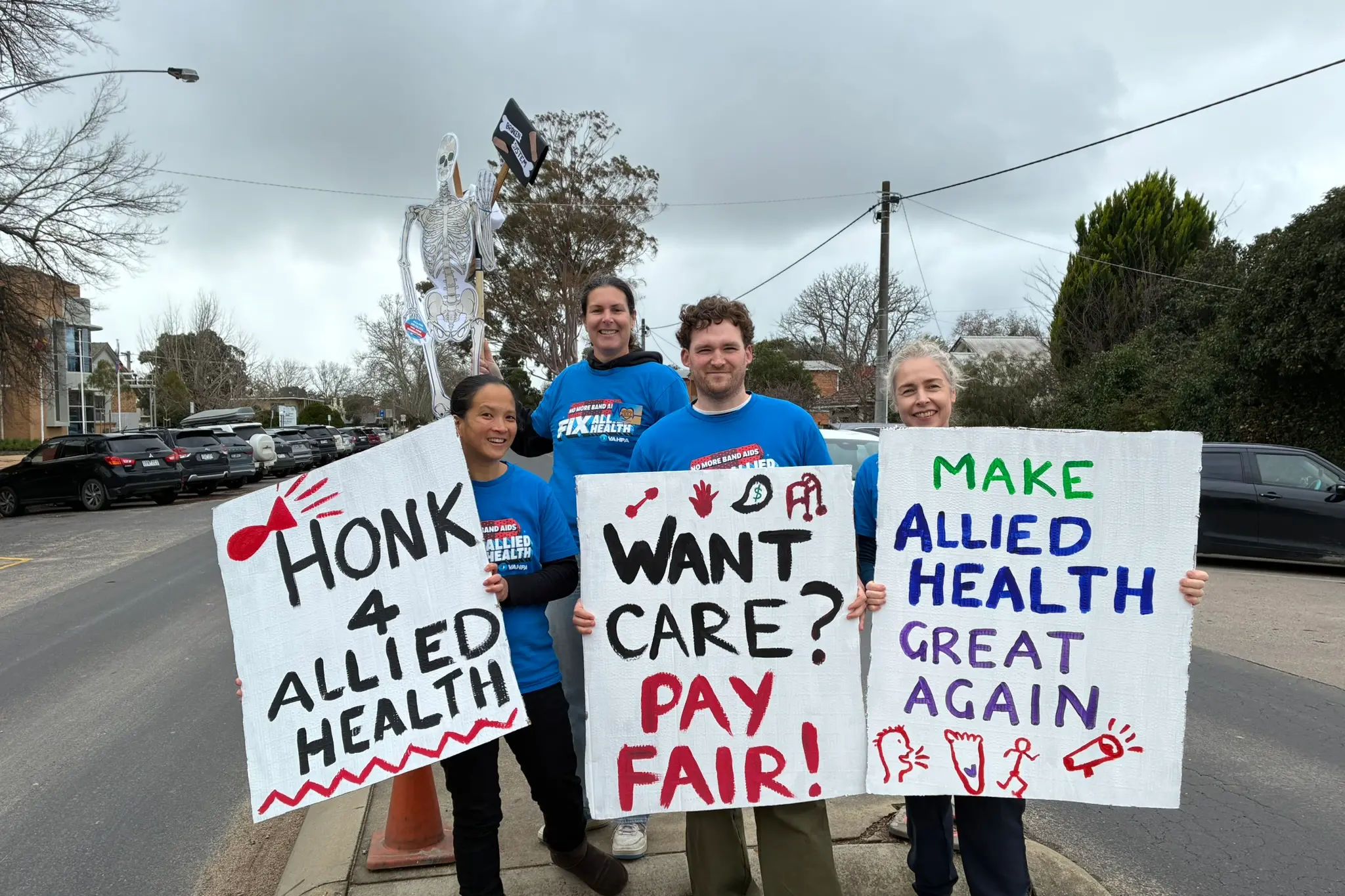
A chorus of chants and car horns could be heard echoing throughout Green Street at lunchtime on Tuesday 11 August as allied health staff undertook 24 hours of strike action, with some 30 staff members rallying out the front of Northeast Health Wangaratta (NHW) in a revolving door fashion throughout their breaks as they continued to campaign for a 36.18 per cent wage increase, changes to workload management and support for staff retention.

The protected industrial action was part of a state-wide ongoing bargaining campaign by members of the Health Services Union Victoria No. 3 Branch, the Victorian Allied Health Professionals Association (VAHPA), including radiographers, physiotherapists, social workers and pathology workers.

The dispute centres on wages and workforce conditions after a Fair Work Commission finding recognised the historical gender-based undervaluation of allied health work.

The government’s latest offer delivered most professions increases of between 19 and 21 per cent, which VAHPA said still falls significantly short of properly correcting that undervaluation.

Wangaratta radiographer and clinical educator Chris Parsons said members were taking part in a second stop work action after about 11 months of bargaining.

Mr Parsons said not all allied health workers were able to stop work for the full 24 hours, with some distributing campaign material or striking during lunch breaks because of their responsibility to patients.

“A lot of the allied health professionals are essential workers,” he said.

“They can’t really leave their patients and nor would they want to because they really do care for them.”

Mr Parsons said regional workers held a smaller local rally outside NHW while the main strike action took place in Melbourne at the Peter MacCallum Cancer Centre.

“I can’t recall a time where allied health rallied in front of Northeast Health,” he said.

“It’s a big moment, but I think this is the point that the regional practitioners would really like to make is that they should have a voice too, they should be heard.

“Distance shouldn’t be a barrier to people being able to advocate for care for patients,” he said.

The Wangaratta rally was planned for lunchtime, from about noon until 1.30pm, so staff could attend without interrupting the care they were providing.

Mr Parsons said allied health workers had seen their wages fall behind inflation over the past five years while continuing to face workforce shortages and increasing workloads.

He said the 36.18 per cent wage increase being sought reflected what workers believed was needed after years of undervaluation.

“Our wages have been going back steadily against inflation,” he said.

Mr Parsons said workloads were also a major issue, particularly in regional areas where it could be harder to retain staff.

“One of the issues is it’s harder to keep people in, therefore it’s harder to provide care, which means that there’s more workload on fewer people,” he said.

Mr Parsons said allied health professionals wanted a historic change in how their work and the care they provided to Wangaratta and surrounding communities were valued.

“This is really quite a historic point for us,” he said.

“It’s time for the government to step up and give us an offer that reflects that value and respects us.”

VAHPA executive officer Andrew Hewat said members had reached the point where another state-wide stoppage was unavoidable.

“For months our members have reluctantly taken action in the hope the government would finally come back with an offer that properly recognises the value of their work,” he said.

“Allied health professionals across Victoria are saying with one voice that they cannot accept another agreement that locks in the historic undervaluation of their professions.

“These are the people who help patients walk again after surgery, diagnose disease, treat cancer, get people safely home from hospital and keep critical parts of the health system functioning every day.

“They do not take a 24-hour stoppage lightly.

“But after a clear Fair Work Commission finding and months of industrial action, the government cannot keep asking this predominantly female workforce to settle for less than their work is worth.”

Last week NHW executive director of people and corporate operations, Kim Bennetts, said the hospital has made efforts to plan around the proposed industrial action.

“Strategies are in place to minimise the patient impact of the stop work action through the utilisation of allied health professionals not participating in the stop work action and if this is not possible, rescheduling of non-urgent appointments in affected areas,” she said.

“The protected industrial action extends on other actions being undertaken in relation to the current bargaining of the new Allied Health Professional Enterprise Agreement.

“NHW recognises the key roles and functions allied health professionals take in providing holistic care to our community.”