
PHOTO
73324.0
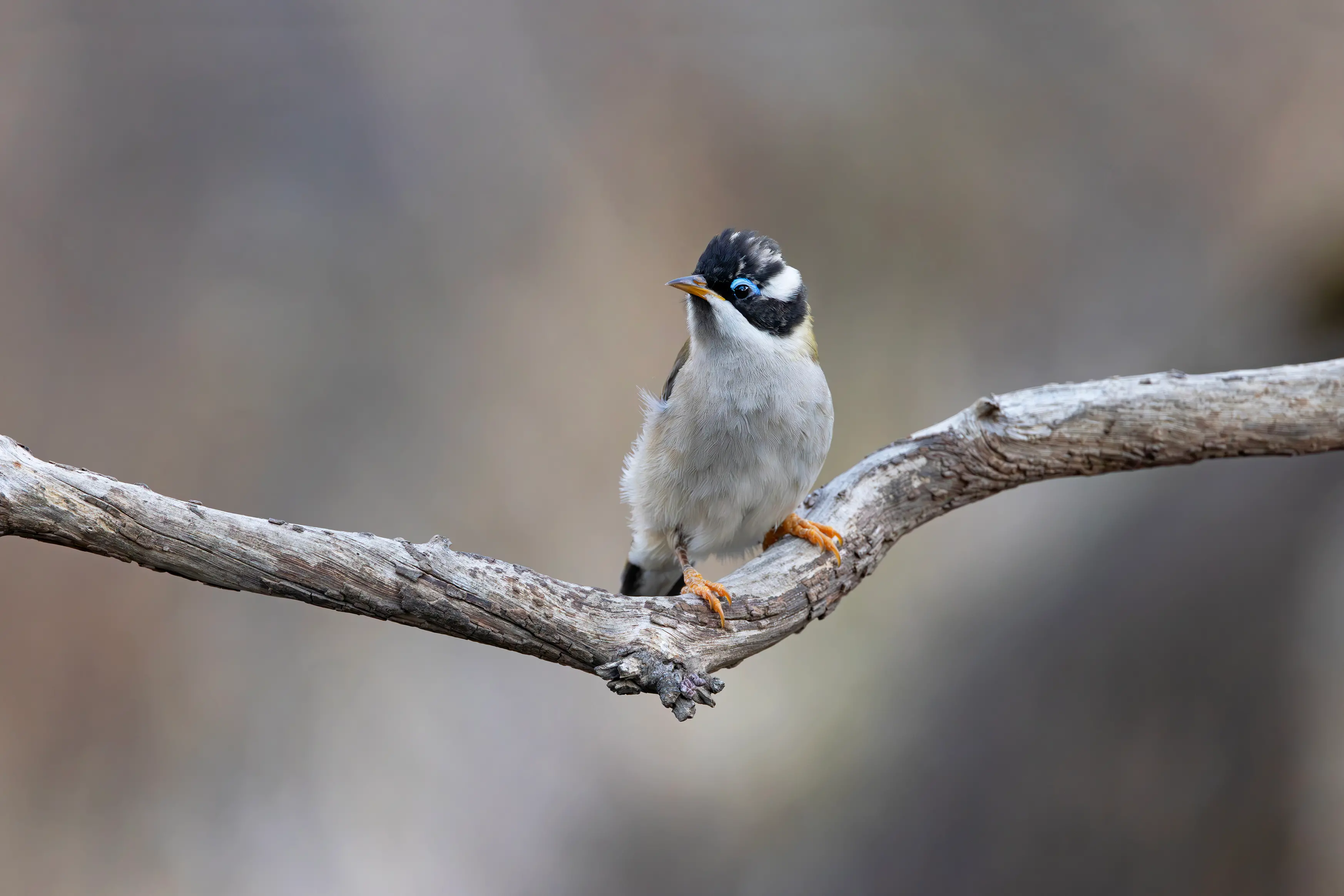
Unlike many of the other more common smaller honeyeaters, such as the White-plumed, Fuscous and Yellow-tufted, Black-chinned Honeyeaters occur sparsely throughout our local forests and woodlands and never in great numbers.
They go about their lives without the fuss and hyper-activity typical of the other small honeyeaters, instead being rather unobtrusive and only calling periodically.
When they do call, however, it is quite a conspicuous and pleasant song, and upon tracking down the sound, the observer will usually find a small family group of between three and six birds.
Although they do feed on nectar and pollen from a variety of our local eucalypts, namely Grey Box, Mugga Ironbark and Yellow Box, Black-chinned Honeyeaters are typically insect feeders, foraging acrobatically among the outer foliage in the tree canopy and amongst taller saplings, clambering and often hanging upside-down in search of food.
They also probe for insects among peeling bark on tree branches and trunks.
When trees are flowering and producing a good supply of nectar, this species will opportunistically feed on the sweet smorgasbord on offer, often joining with other small nectar-feeding birds such as the various other honeyeaters, Little Lorikeets and Swift Parrots.
Like these other species, Black-chinned Honeyeaters are often bullied by the larger and more aggressive nectar-feeders such as wattlebirds, miners and friarbirds, and as such they are usually found around the edges of any flowering patch within a forest.
Typically, Black-chinned Honeyeaters occur in dry forests and woodlands, with box-ironbark communities being their favoured habitat type.
Within these areas, they often occur along gullies and small drainage lines, and in warmer weather, they are particularly found around water points such as small forest dams.
In the spring breeding season, Black-chinned Honeyeaters build a tightly woven deep nest of dry grasses and fine bark strips, bound together with cobweb, suspended high in the outer foliage of a eucalypt.
Two eggs are usually laid, which take just over two weeks to hatch.
Locally, this species is best seen in the Killawarra and Chiltern forests, but also in many other well-treed areas such as the Ovens River and along creeklines throughout the district.