
PHOTO
63457.0
The Australian Wood Duck is probably our region’s most commonly observed duck in autumn, as it’s a typically dry time of year and this duck is less dependent on wetlands than other waterfowl.
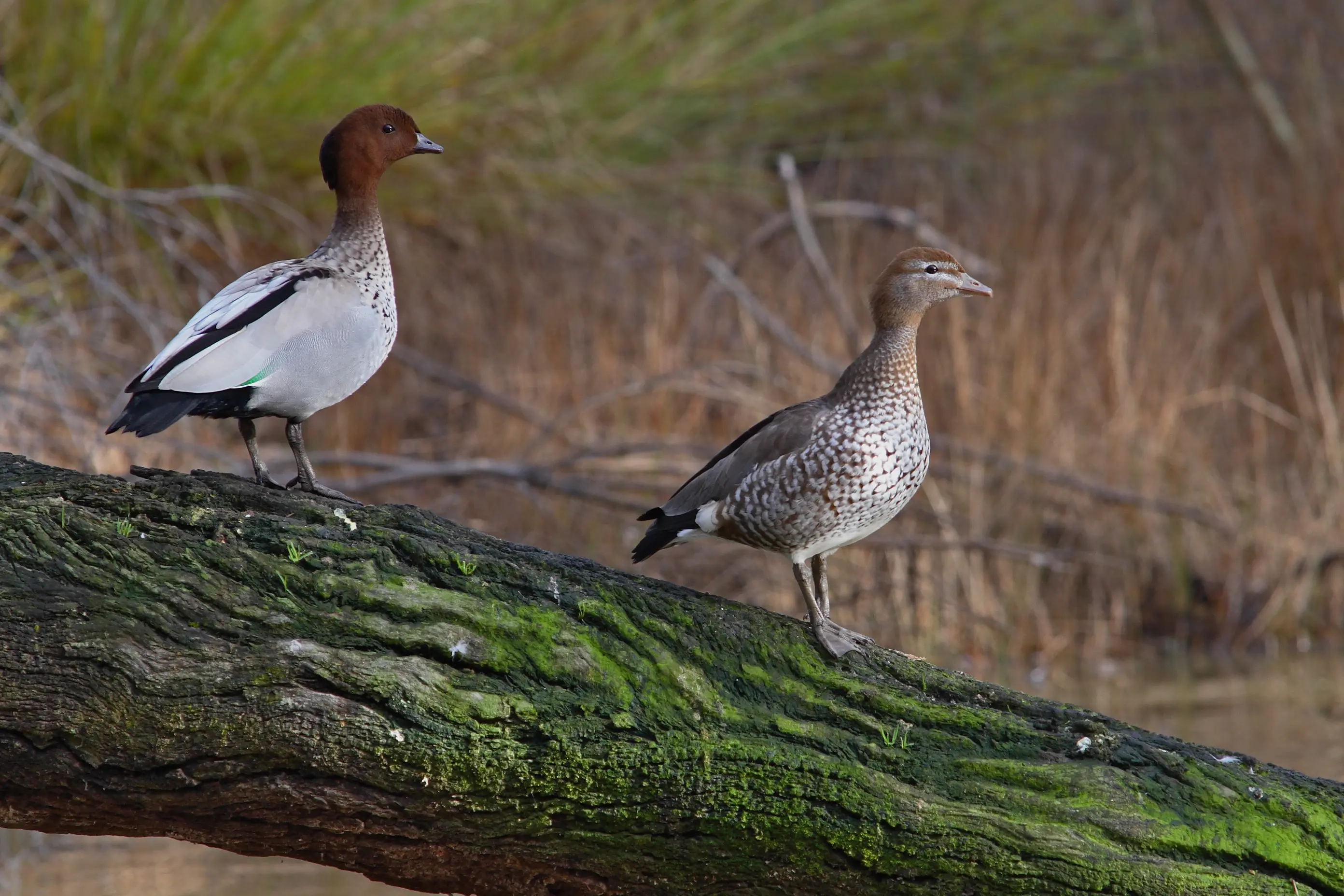
It’s a medium-sized 'goose-like' duck with a dark brown head and a pale grey body with two black stripes along the back.
Males have the darker head and a small dark mane, with a speckled brown-grey breast and a black lower belly and undertail.
The females have a paler head with two white stripes, above and below the eye, a speckled breast and flanks, with a white lower belly and undertail.
In flight, the wings are pale grey above, contrasting with black wingtips, and have a noticeable white bar on the underside (the secondaries).
This species is also known as the Maned Duck or the Maned Goose and is called Gnaroo in the local Bangerang culture.
The Australian Wood Duck is found in grasslands, wetlands and flooded pastures.
They are also common on farmland with dams, as well as around sewage ponds, watered ovals and in urban parks.
They walk easily on land and may be seen perching on logs and in trees.
This duck eats grasses, clover and other herbs, and sometimes insects.
They are rarely seen on open water, except when they are disturbed, preferring to forage by dabbling in shallow water, or in grasslands and crops.
The female calls with a long, loud, rising 'gnow' while male calls are shorter and higher pitched.
Flocks often chatter when feeding.
The Australian Wood Duck forms breeding pairs that stay together year-round.
They nest in tree holes, above or near water, often re-using the same site.
Both parents feed young and young birds remain with them up to a month after fledging.
Like other waterbirds, the Australian Wood Duck hatches with a covering of waterproof down meaning that chicks can enter the water almost straight away.
Breeding usually occurs in spring in our region, when 8-10 eggs can be laid.
Chicks hatch roughly four weeks later, when they may spend a further eight weeks in the nest.
These attractive waterfowl have benefited from the creation of dams and pasture on farmlands.
The Australian Wood Duck can sometimes damage crops and pastures and, in built up areas, may heavily graze on watered grassy areas like golf-courses and parks in summer.