PHOTO
72317.0
The Grey Butcherbird is the smaller of the two butcherbird species found in our region.
Despite its lovely, lilting song, it is not a bird to underestimate, with its strong hooked beak and fierce stare.
During nesting, or when protecting newly fledged chicks, a butcherbird may swoop if you come too close, flying straight at your face and sometimes striking, all while giving a loud, maniacal cackle.
The Bangerang know it as Wooratu.
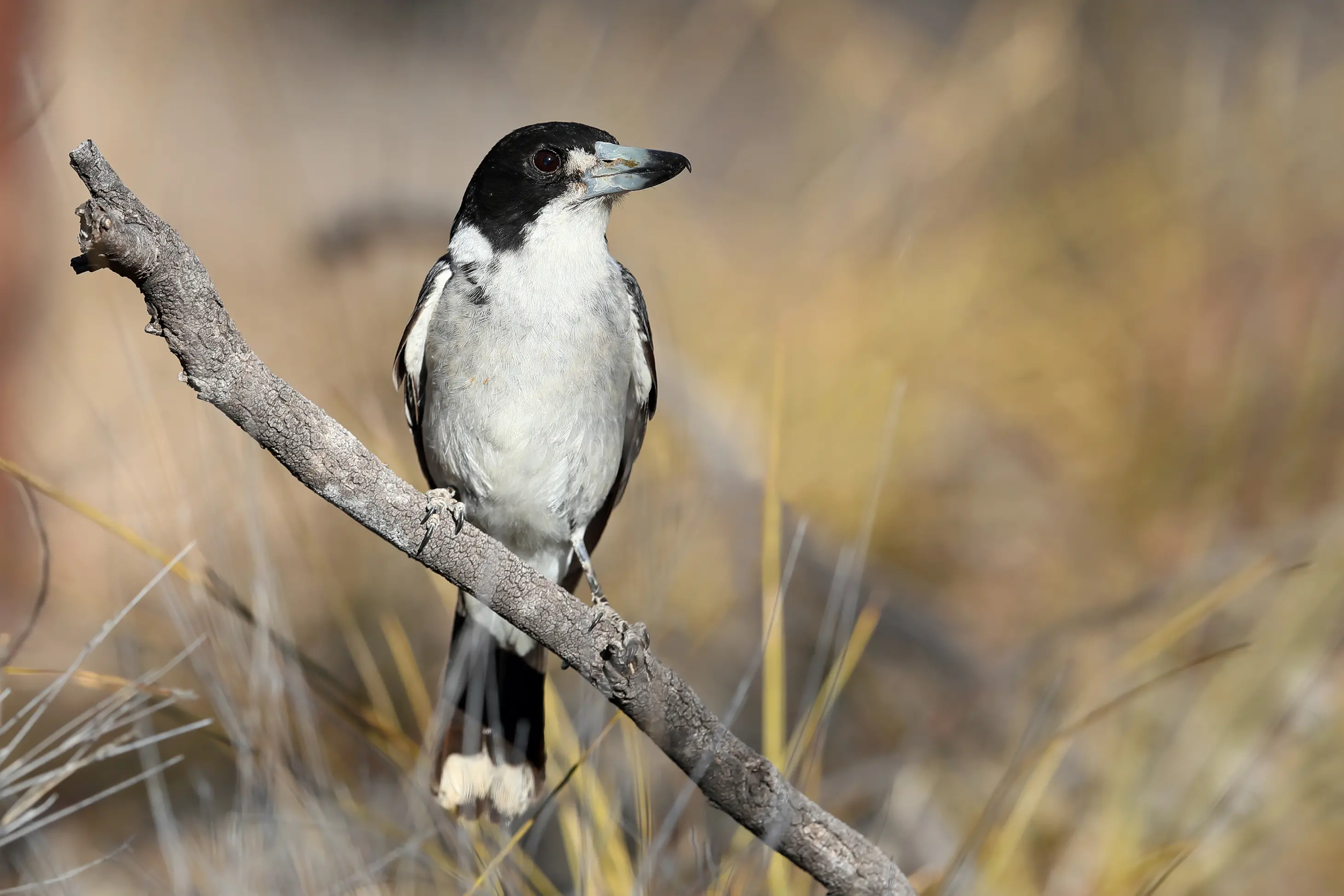
Adult Grey Butcherbirds have a black crown and face, a grey back, and a narrow white collar.
Their wings are grey with large white patches, and their underparts are white.
The large grey-and-black bill has a small hook at the tip of the upper mandible.
The eyes are dark brown, and the legs and feet are dark grey.
Males and females look alike, although females are slightly smaller.
Young birds resemble adults, but their black markings are replaced by olive-brown, and the white areas have a brownish wash.
Their bills are entirely dark grey and often lack a clear hook.
The only similar local species is the Pied Butcherbird, described in a recent article, which is larger and more boldly patterned in black and white.
Grey Butcherbirds range from mid-eastern Queensland, through southern Australia, including Tasmania, to northern Western Australia.
They prefer wooded habitats, including urban areas and are found locally in pairs dotted on larger bush edges, timbered roadsides and in treed parkland.
Grey Butcherbirds are aggressive predators preying on small animals, including birds, lizards and insects, as well as some fruits and seeds.
Uneaten food may be stored in the fork or a branch of a tree, hence the name butcherbird.
They sit on an open perch seeking prey which, once sighted, they pounce on.
Most prey is caught on the ground, though small birds and insects may be caught in flight.
The Grey Butcherbird's bowl-shaped nest is made of sticks and twigs and lined with grasses and other soft fibres, normally located within 10 m of the ground.
The female incubates the eggs and the young birds are fed by both parents.
The young birds will remain in the breeding territory for about a year and help the parents raise the young of the following season.
Their song is a lovely rich piping and is the easiest way to locate Grey Butcherbirds.