PHOTO
70052.0
“The world is your oyster.”
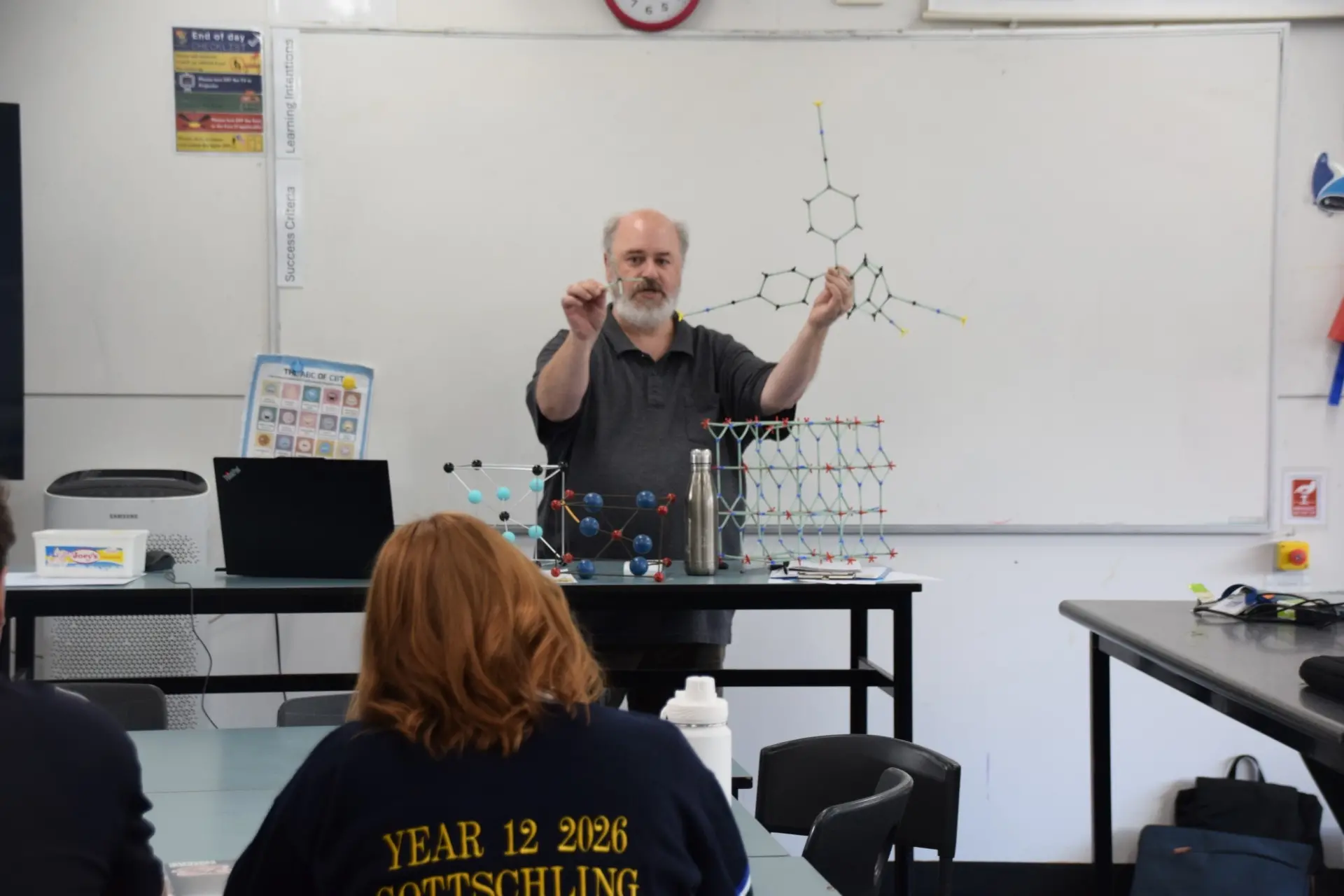
It's an all-too-familiar sentiment, one Wangaratta High School alumnus Stuart Batten has echoed to aspiring young academics after his recent visit to his old high school.
Reflecting on his career, it was only a few decades ago Professor Batten was in their position - yet to unlock the possibilities pursuable through science.
Graduating alongside the class of 1986 as the school Dux, Professor Batten has thrived within his practice.
He has collaborated in groundbreaking, award-winning research, won awards, and even has his own research group since becoming a professor of Chemistry at Monash University.
He was the first student in Richard Robson’s research group to work on what is now known as metal-organic frameworks (MOFs), and thus was a key contributor to much of the foundational work that created this new field of chemistry (for which Robson received the Nobel Prize last year).
He can trace his love of chemistry back to one simple element; or rather, 118.
“I was always interested in science and the way the world works and why,” he said.
“But chemistry really took my interest because I was always fascinated with the periodic table.
“The fact that all matter is made up simply of components from the periodic table… that was what really piqued my interest.
“How things differ and how things are the same all depends on the way you arrange those little atoms in the period table.
“That always fascinated me because it seemed like if you can control the periodic table, you can control matter.”
Though his visit to Wangaratta High was facilitated by the school's alumni program, frequenting schools to talk about science is his "passion project".
In particular, he hopes to give students from regional and rural schools a more equal footing into a science career, as someone who knows what the challenges in these areas are like.
“We’ve had a number of projects that have sent resources to schools all around Australia," he said.
“Having come from the country, I’m very conscious that country kids don’t get that same access to resources.
“So, I deliberately try to focus on programs and things that I do that can reach remote schools, where its much more needed than a suburban high school that’s just around the corner from Monash.
“It’s a very different equation if you’re in Wangaratta or Tennant Creek, getting access to that.”
Aside from teaching undergraduate students and supporting regional schools, Professor Batten also has his own research group revolving around the study of solid-state chemistry.
“Being an academic, you have lots of balls in the air,” he said.
“We’re particularly looking at how molecules come together to form solids.
“One of our focus areas is on trying to make materials that are very porous on a molecular scale… a bit like a sponge.”
Professor Batten's visit was more than just absorbing the nostalgia of his high school years.
It was about showing regional students that despite the hurdles of being in a geographically less accessible area, anyone can climb their way into a career they're passionate about.