PHOTO
65683.0
The Eastern Spinebill stands out among Australian honeyeaters as the only species that hovers like a hummingbird while feeding on nectar from flowers.
In contrast, most other honeyeaters feed while perched.
This hovering behavior, along with its distinctive physical features, makes the Eastern Spinebill easy to recognize.
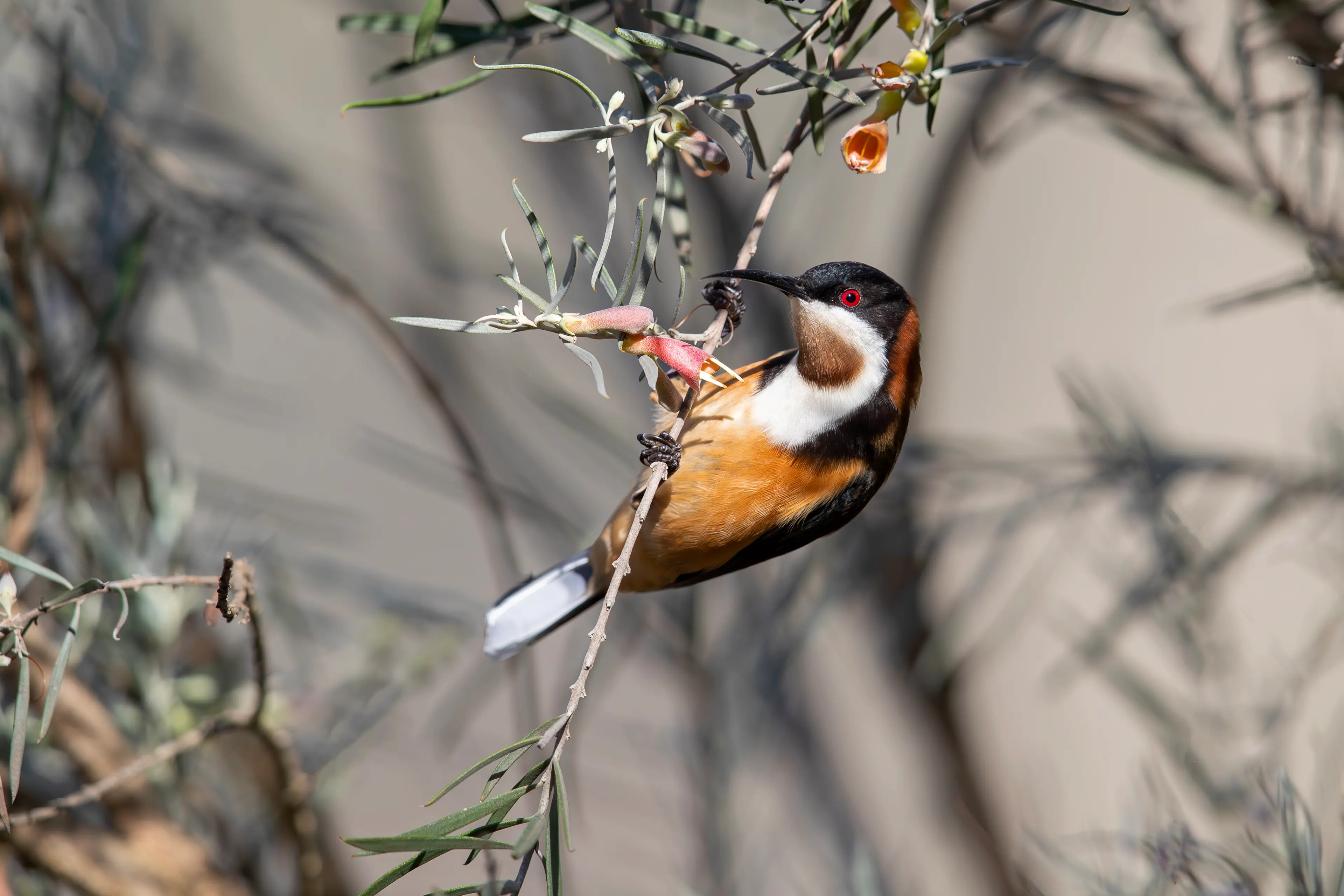
It has a very long, slender, down-curved beak and a lively flight style during which its white outer tail feathers are especially noticeable.
Male Eastern Spinebills are marked by a grey-black crown that extends in a black line on either side of the breast.
Their breast and throat are white, accented by a rufous patch in the center of the throat.
The wings and lower back are dark grey, while the underparts and upper back are buff-colored.
Females resemble males but their markings are less distinct, and young birds lack the sharp color contrasts seen in adults.
Eastern Spinebills prefer forests, woodland, and heathland habitats, ranging from Cooktown in Queensland to the Flinders Ranges in South Australia, and throughout Tasmania.
They are mainly found along coastal regions and on the inland slopes of the Great Dividing Range.
These birds are generally sedentary, although some local movements occur, especially when they leave mountain forests during autumn and winter.
Their diet consists of both insects and nectar.
Eastern Spinebills feed while perched or hovering, and they obtain nectar from a wide variety of flowers, including grevilleas.
Their beaks are particularly adapted for extracting nectar from tubular flowers such as heath, mistletoe, and emubush.
The nest of the Eastern Spinebill is a small cup made from twigs, grass, and bark, bound together with hair and spider's web.
It is typically built in a tree fork, at a height of between one and five metres above the ground.
Only the female builds the nest and incubates the eggs, but both parents participate in feeding the young.
The breeding season generally occurs from spring to early summer.
The typical clutch consists of two eggs, which hatch after about two weeks.
The chicks fledge approximately two weeks after hatching.
Eastern Spinebills are sometimes seen in well-vegetated urban gardens, especially where tubular flowers such as fuchsias are present.
They tend to be more common in towns during autumn and winter, likely due to a shortage of flowering plants in the surrounding bushland at these times.
Observers can spot them by watching for their short, erratic flights with flashes of white tail feathers and listening for their long, tinkling, clipped calls.