
PHOTO
79503.0
A mid-sized SUV, the Haval H6 is the best-selling model from Great Wall Motors (now GWM).
Originally powered by a 2.0-litre turbocharged petrol engine, a 1.5-litre turb-petrol/electric hybrid was added in April 2022 with a new plug-inn (PHEV) hybrid variant as part of an upgrade in mid-2016.
The PHEV is this week’s review.
H6 PHEV comes in three variants: Ultra FWD PHEV priced at $47,990, Ultra AWD at $50,990 and Ultra GT AWD PHEV, $52,990.
All are driveaway prices.
STYLING
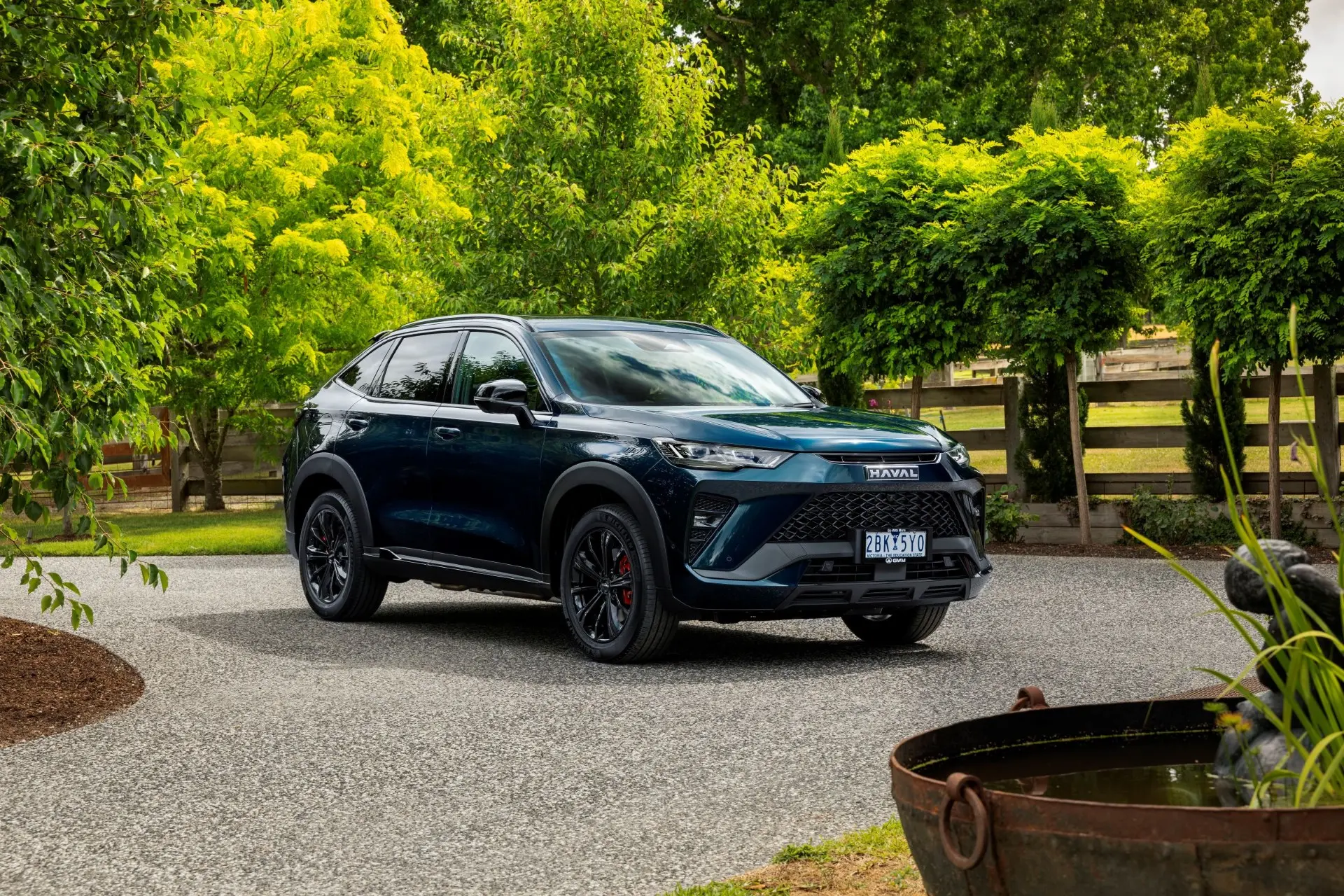
The H6 PHEV GT streamlines the body to the extent that GWM tag it as an SUV Coupe, in line with the recent trend adopted by other brands to escape from the traditional boxy profile.
It certainly works, and combined with the other styling elements such as body-coloured side panels that extend the grille to the edge of the vehicle, LED lighting and a full-width lighting panel, gives it a real premium look that could easily pass much more expensive European SUVs.
There are 19-inch alloy wheels with red brake calipers.
Up front, the cascading grille carries the Haval logo, thankfully no longer in garish red.
INTERIOR
It’s hard to fault anything inside the H6 Hybrid Ultra PHEV with a real feeling of quality throughout.
Comfortek front artificial leather seats are heated and ventilated with the driver having an eight-way power adjustment, heated leather steering wheel and a head-up display.
PHEVs get a new two-spoke steering wheel with a simplified control button on either side.
There’s good storage space with adjustable twin drink holders and a large storage bin in the centre console.
At the back there’s a powered tailgate which opens out to a 600-litre boot, expandable to 1485 litres with the rear seatbacks folded.
The batteries are located beneath the false floor taking up the space where a spare wheel would otherwise be.
POWERTRAIN
Haval H6 PHEV AWD comes with a new Hi4 hybrid system that uses front and rear-mounted motors (ie. four-wheel drive), combining three power sources and nine adaptive operating modes.
It uses intelligent torque vectoring control (iTVC) to automatically adjust power distribution across varying road conditions.
The FWD variant uses a dedicated hybrid setup with a two-speed or three-speed hybrid transmission that generates a combined output of 240 kW and 540 Nm.
Its 19-kWh battery can be charged from 30-80 per cent in 28 mins using a DC charger (at a rate of 34kW), or from 15-100 per cent using an AC charger in under three hours (at 6.6kW).
The AWD models, using the Hi4 system lifts these up to 268 kW and a whopping 760 Nm of torque.
The battery is a 19.0 kWh unit that provides a claimed EV only range of 100 km in the AWD using the NEDC testing system but drops down to 80 km under the more realistic WLTP system.
Towing capacity in either model is 750 kg unbraked and 1500 kg braked.
SAFETY
All Haval H6 variants from February 2021 onwards come with the maximum five-star ANCAP rating.
Seven airbags are standard, including a centre airbag which provides added protection to front seat occupants in side impact crashes.
Not everyone agrees but we love the feature where driver’s seatbelt must be locked in before the brakes will release and the vehicle can move off.
DRIVING
Haval H6 is at the larger end of its segment making entry relatively easy.
While the seats are adjustable in most directions the base can’t be tilted and we found them a little uncomfortable as did the absence of sliding thigh support.
Take-off is by battery only with the instant acceleration that we love.
The zero to 100 km/h sprint can be done in just 4.9 seconds.
There are two different EV modes that both default to electric only driving and only switch to the engine when needed for hard acceleration or when the battery charge is low.
The combination of the smaller turbo engine and batteries mean that the H6 PHEV cruises quietly.
Brake regeneration can be adjusted and monitored on the driver’s display.
The column-mounted gear selector frees up space on the centre console for additional storage and provides space for the wireless phone charger.
Out in the rural segment of our test route the drive is enjoyable with plenty of punch when needed.
The ride was a bit spongy at times and handling was typical of most SUVs.
Steering is well-weighted and ride is firm but comfortable.
Fuel consumption is listed at 5.2 litres per 100km, we average just under 6.0 L/100 km during our test.
Following the lead of Kia and Hyundai, GWM has recruited Australian experts to work on adjusting its vehicles to suit local conditions.
When compared to the FWD PHEV the AT-1 version in the AWD delivers a significantly better ride with improved body control and steering.
It feels lighter when cruising but on twisty roads it comes to life, with braking and handling that is superior to its Chinese compatriots.
There are also the usual drive mode options: Normal, Eco, Sport or Snow.
Steering weight can be adjusted, with comfortable, sport or light settings.
Adjustable regenerative braking comes with the option of one-pedal driving – although the latter does not bring the vehicle to a complete stop.
Handling is safe, predictable and planted, with strong mid-range throttle response and impressive braking.
Head-up display as usual is almost invisible with polarised sunglasses and the power-operated tailgate often refused to respond to the key fob.
SUMMING UP
Fuel consumption from the AWD PHEV is listed at 1.6 litres per 100 kilometres.
However, to achieve anywhere near that number on a trip in excess of 100 kms the battery must be recharged every time the it’s depleted.
So, based on the H6 PHEV’s expected range of 80 km, the petrol/hybrid powertrain will take it the extra 20 km which is how the 1.6 L/100km is achieved.
In GWM’s defence, every other manufacturer of PHEVs uses the same formula.
The biggest attraction for potential PHEV buyers is that they get much of the benefit of an electric vehicle but without the lingering stress of range anxiety.
For someone with a typically daily commute of less than 100 km and access to a home/workplace charging facility it certainly makes sense.
Cost savings there can subsidise a couple of annual longer distance holiday trips.
RATINGS:
Looks: 7
Performance: 7
Safety: 8
Thirst: 7
Practicality: 7
Comfort: 7
Tech: 8
Value: 8
AT A GLANCE
MODEL LINE-UP
H6 Ultra FWD PHEV: $47,990
H6 Ultra AWD PHEV: $50,990
H6 Ultra GT AWD PHEV: $52,990
Note: These are all driveway prices and include government and dealer delivery charges.
SPECIFICATIONS: Haval H6 Ultra AWD PHEV five-door wagon
STANDARD WARRANTY
Seven-year unlimited kilometres (eight-year unlimited kilometres on battery)