PHOTO
72694.0
Jeep Wrangler needs no introduction.
If you're into off-roading, it's up there with the best of them.
In fact, out of the box, Wrangler probably delivers more 4x4 capability than just about anything, with plenty of room for further customisation.
But this ability comes at a cost, because it's not the most comfortable car to drive and these days it is available only with a petrol engine, which is a major drawback.
STYLING
The Jeep Wrangler is very much a lifestyle choice, with the focus on play rather than work.
It's about going bush for the weekend, with the fam or your mates and maybe dirt bikes.
When we started driving Jeeps, they had two doors and a cramped, emergency rear seat.
Then the four-door Unlimited came along, opening up a whole new world.
Since then, the market for 4x4 dual cab utes has exploded and they account for three of the top 10 selling vehicles in Australia.
Jeep saw this coming and in June 2020, they added the Gladiator (great name) to the mix, based on the four-door model, with a proper ladder chassis.
Fast forward and we suspect Jeep is doing it tough, not off-road but in the showrooms with sales well and truly down.
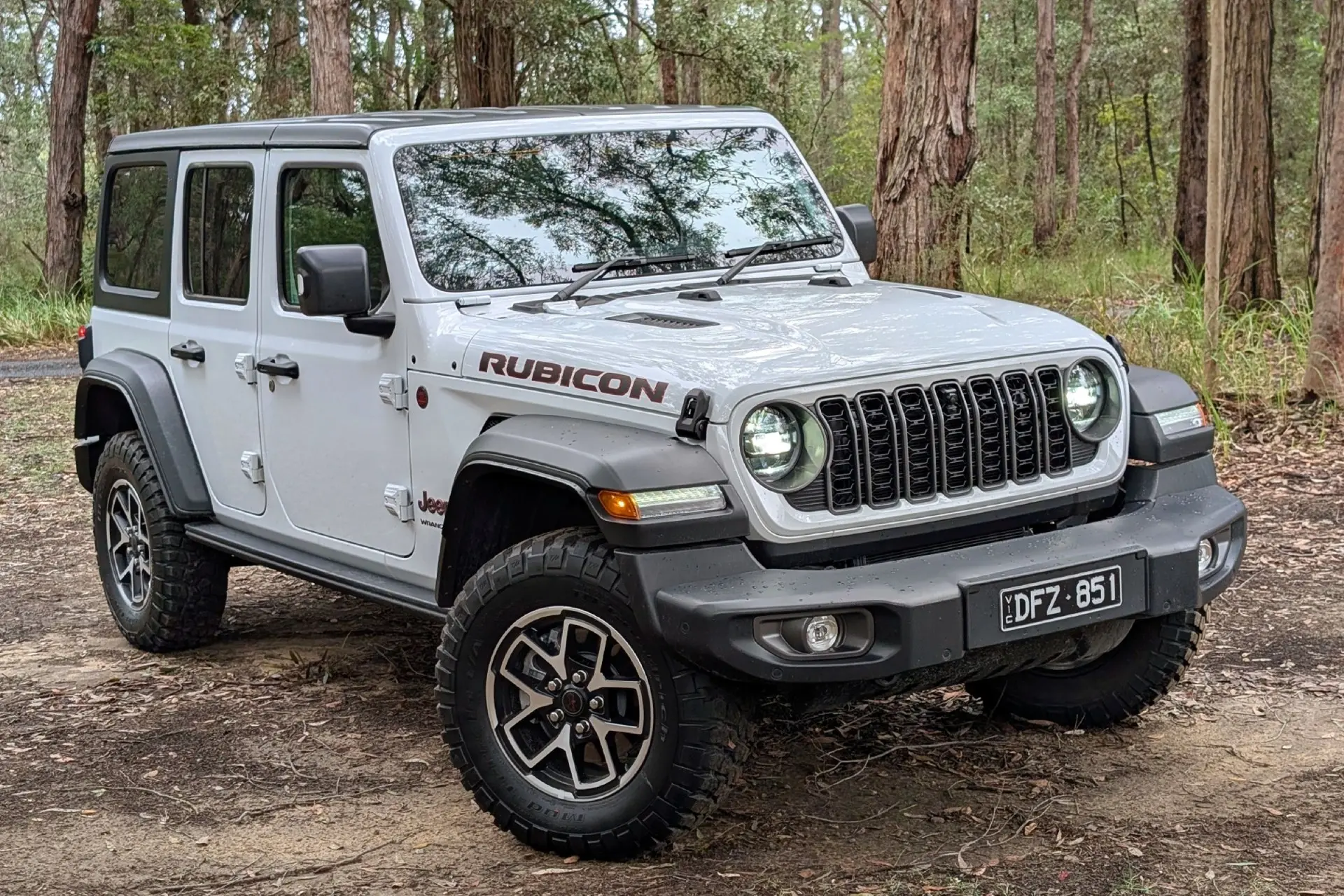
You want a Wrangler, the lineup has been rationalised to just the one top-spec Rubicon grade, available in two- or four-door form with the occasional special edition thrown in to spice things up.
There's Wrangler Rubicon two-door ($81,990) and Wrangler Unlimited Rubicon four-door ($84,990), along with a four-door 85th Anniversary edition ($88,490).
At the moment, there's also a strictly limited edition four-door Rewind ($73,990) which at this price represents a good deal.
On-road costs must be added to all of these prices.
Premium paint adds $1490 to the cost and the Sky-One-Touch Power Top is a hefty $6450.
With removable roof panels, the Wrangler is billed as a driving experience unlike anything else.
It's just getting these panels off and figuring out how to put them back on (and the time it takes) that is likely to deter the majority of people.
Rubicon features 17-inch alloys with BF Goodrich off-road rubber, dual zone climate air with rear vents and heated leather seats along with a heated steering wheel.
There's also LED lighting front and back, LED daytime running lights, auto lights and wipers, auto dimming rear view mirror, plus front and rear parking sensors.
Wrangler comes with a five-year/100,000km warranty, lifetime roadside assistance if you service the vehicle through Jeep and needs to be serviced every 12 months/12,000km.
SAFETY
Standard safety extends to four airbags (two front and two side), with autonomous emergency braking (city and interurban) and a blind spot monitor.
There's also forward collision warning plus, adaptive cruise control with stop, blind spot monitor and rear cross path detection.
Lane keep assist (LKA) and emergency lane keeping (ELK) systems are not available.
Wrangler is currently unrated for safety.
The previous three-star rating expired in December last year.
ENGINES / TRANSMISSIONS
The 2.0-litre turbo in question generates 200kW of power at 5250 rpm and 400Nm of torque from 3000-4500 rpm.
Transmission is via a ZF eight-speed conventional auto with part-time high and low range four-wheel drive, plus auto engine-stop-start (to save fuel)
DRIVING
What's hurting Jeep more than anything is the demise of the diesel and in the case of Wrangler, its 2.0-litre turbocharged petrol replacement.
It gets along all right but, like the old Pentastar V6, is something of a sinkhole for gas.
And it likes the good stuff - 95 premium unleaded.
With an 81-litre tank, Jeep quotes combined average fuel consumption at 10.2L/100km.
Over the course of a week, we clocked up 940km in our test vehicle at a rate of 10.9L/100km.
To give this some perspective, in previous tests, a two-door Wrangler with the V6 returned 10.4L/100km and a Gladiator with the same engine 14.0L/100km.
At 4882mm in length, Wrangler Unlimited is fairly compact; about 71cm shorter than Gladiator, with an 11.8-metre turning circle.
Weighing in at 2154kg, aluminium is used to reduce weight and boost fuel consumption, including the doors, door hinges, hood, fender flares, windshield frame and tailgate.
Hollow track and stabiliser bars, aluminium engine mounts and steering gear also help to reduce weight.
It has a braked tow rating of 2495kg.
Inside it boasts a traditional flat dash that contains a long 12.3-inch touchscreen that's better suited to the demands of CarPlay and Android Auto.
The dash consists of old-style analogue instrument gauges that flank a 7.0-inch information panel, where speed can be displayed digitally.
Getting in and out of the Wrangler takes some athleticism, due to its ride height and the small doors.
The driver sits close to the wheel and the swap from left to right hand drive hasn't been seamless, with a smaller driver's side footwell that leaves little room for a proper footrest, making it uncomfortable to drive over long distances.
With some negotiation you can slot your left foot to the side of the brake pedal and fold your right leg sideways under it, but after a while even that becomes cramped.
There's not much easily accessible cabin storage either.
There's the netted door pockets, but with so little room for expansion between the doors and seat sides, their capacity is severely limited.
Rear legroom is good and the boot is deep and reasonably sized, with a hidey-hole under the floor, a big Alpine subwoofer built into the side and a 12-volt socket for things like car fridges.
Although the tailgate and window glass open separately, the tailgate must be opened and closed first which kind of negates any practicality.
Fitting a child seat is difficult because the headrests are not removable.
Rubicon features a long list of 4x4 accessories, with a high/low range Rock-Trac active on-demand 4x4 system with a traditional, short stubby transfer lever.
Highlights include heavy duty Dana axles, Tru-Lok front and rear electronic diff locks, electronic front sway-bar disconnect, 77.2:1 crawl ratio and Fox aluminium-bodied two-inch diameter shocks front and back.
With an approach angle of 43.9 degrees, break over angle of 22.6 degrees, departure angle of 37.0 degrees and a ground clearance of 255mm, it has a wading depth of 760mm.
An Off-Road+ Button automatically adjusts throttle, Selec-Speed Control, Traction Control, Transmission Shift Mode.
It has two modes: 4HI for higher speed sand performance and 4LO for very low speed rock hopping manoeuvres.
It's a feisty thing, fun to drive with a decent turn of speed, but we would have preferred a diesel.
The steering is rubbery and it has a tendency to wander if left unchecked, but the ride is surprisingly compliant and unlikely to generate complaints.
The chunky off-road rubber is just what you want for the rough stuff but not so much on the motorway.
SUMMING UP
The iconic styling is a big drawcard as is the Wrangler's prodigious off-road ability.
This is a car designed for roughing it.
For getting scratched and dirty and going back for more the next week.
What it's not, is a car designed for the urban environment.
It might look cool but the novelty will soon wear off and you'll find yourself wanting something with a bit more comfort.
Land Rover has shown you can do this with the new Defender and perhaps it's time Jeep bit the bullet and introduced something safer and more comfortable?
RATINGS:
Looks: 8
Performance: 7
Safety: 5
Thirst: 5
Practicality: 5
Comfort: 5
Tech: 7
Value: 7
Overall: 6.2
AT A GLANCE:
MODEL LINE-UP
Wrangler Rubicon two-door, $81,990
Wrangler Unlimited Rubicon Rewind four-door, $73,990
Wrangler Unlimited Rubicon four-door, $84,990
Wrangler Unlimited Rubicon 85th Anniversary four-door, $88,490
Note: These prices do not include government or dealer delivery charges.
Contact your local Jeep dealer for drive-away prices.
SPECIFICATIONS
(Jeep Wrangler Rubicon Unlimited 2.0L 4-cyl turbo petrol 8sp auto 4WD SUV)
STANDARD WARRANTY
Five years / unlimited kilometres