PHOTO
79691.0
For those who have been living under a rock, the news is that electric vehicles in Australia are selling their socks off.
According to industry analyst VFACTS, EVs outsold petrol, diesel and hybrid new vehicles in August.
Brands such as BYD, Tesla and Omoda Jaecoo helped drive electric vehicles to record market share, up 4.9 per cent on the same month last year.
EVs accounted for almost one quarter of the overall new-vehicle market, at 24.9 per cent – a record level of market share for this powertrain.
A comprehensive study published by the International Council on Clean Transportation in Europe reveals that electric vehicles charged at home cost roughly 33 per cent less to run than their fossil-fuel powered counterparts, even when drivers rely entirely on commercial public chargers, which are notoriously more expensive than domestic rates.
Also, the actual purchase price of an electric vehicle is rapidly plunging toward true mass-market affordability.
A massive price shift is driven by a 35 per cent collapse in the cost of raw battery manufacturing across the global supply chain.
In August, Tesla was top with its Model Y (6414) in Australia, then came the Chinese with BYD Sealion (2213), Geely EX5, Zeekr 7X and Jaecoo J5.
Every one of Australia's eight best-selling EVs in August was manufactured in China.
Tesla, BYD, Geely, Zeekr, and Chery's Jaecoo brand together account for the bulk of Australia's battery electric vehicle sales.
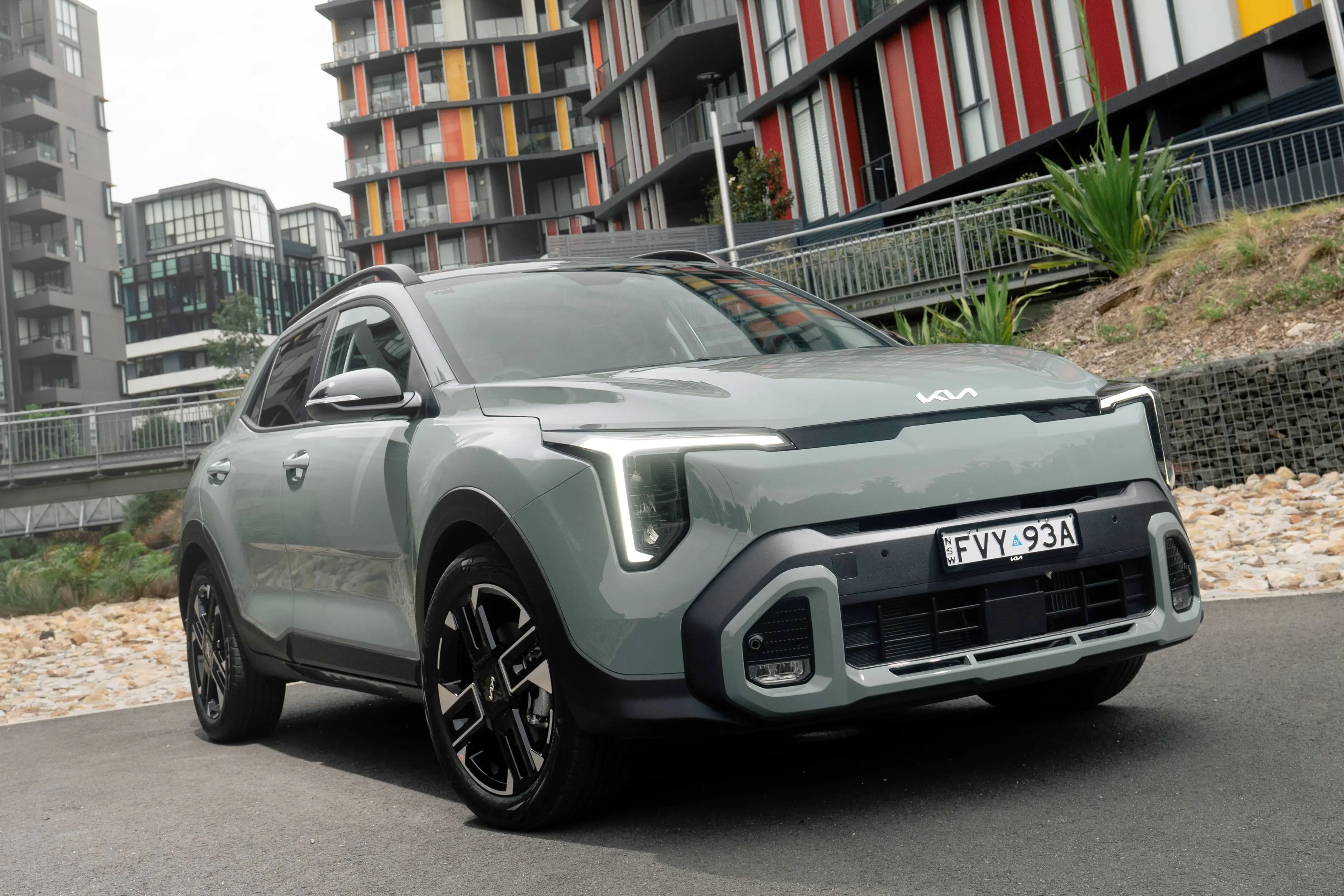
Challenge is coming from the likes of Kia with its MY26 Stonic light SUV, designated PE2, in three models – S, Sport and GT-Line – with its mild hybrid.
The entry-level S is on a special driveaway offer for less than $30,000.
China’s Chery Tiggo 4 Hybrid kicks off from $29,990 drive-away, while the larger MG ZS Hybrid+ can be had from $30,888 drive-away.
The Stonic Hybrid is covered by a seven-year, unlimited-kilometre warranty with capped-price servicing for the same period, and up to eight years of roadside assistance.
STYLING
Now 25mm longer (4165mm), there’s a new angle to the MY26 Stonic Hybrid.
Literally, with the curves being hammered out in a switch to Kia’s new 'Opposites United' design language, following EV3 and K4.
A GT-Line Package consists of front and rear bumpers, front fog light, reverse light and rear reflector, plus tilt-and-slide sunroof and new 17-inch alloy wheels.
INTERIOR
The refreshed cabin features a new steering wheel (now heated) and gearshift, plus premium cloth and artificial upholstery, six-way driver’s seat adjustment, heated front and steering wheel, plus ambient mood lighting.
Cabin storage is generous, highlighted by a front centre console with armrest atop a storage compartment.
Rear seats are 60:40 fold allowing space for cargo of 352 litres with the seat backs up and 1155 litres with them folded flat.
INFOTAINMENT
Added are USB-C outlets, plus Multimode Touch Display, including touch switches switches for climate control and media adjustment, 12.3-inch infotainment display and 12.3-inch instrument cluster.
The phone charger is wireless; Apple CarPlay and Android Auto are not.
ENGINES / TRANSMISSIONS
The Stonic, from 2024, continues to use a turbocharged 1.0-litre three-cylinder petrol engine, but now features a 48V mild-hybrid system.
Peak torque is unchanged at 172Nm, but maximum power has jumped from 74kW to 88kW.
Claimed fuel consumption on the combined cycle is down from 5.4 litres per 100 kilometres to 5.0 litres per 100km, while CO2 emissions are down from 125g/km to 116g/km.
The test car hovered between five and six litres per 100 kilometres over a week of town and country conditions.
SAFETY
Six airbags, including front, front-side and curtain, are standard over the Stonic Hybrid range, while active safety is covered by autonomous emergency braking with vehicle, pedestrian and cyclist detection, blind-spot assist, lane-keep and lane-following assist, lane centring, lead vehicle departure alert, multi-collision brake, parking sensors (front and rear) and a reversing camera.
DRIVING
From a standing start, an identifiable boost from the starter generator is negated somewhat by the petrol engine’s stop/start system.
The seven-speed, double-clutch automatic transmission can hesitate.
Take the pick of three drive modes – Eco, Normal and Sport.
With the car defaulting to Eco on the get-go, there’s an upshift in throttle response from Eco through to Sport, without troubling the ride and handling.
Charitable steering – giving more than it takes – contrasts with the sharp, locally-tuned suspension.
On the open road, road noise is noticeable but is no worse than in most rivals.
The electronic rear-view mirror is easy on the eyes.
SUMMARY
While new-car buyers seek comfort and convenience; polish and performance through deals for product, it is the bargain basement that often wins out.
The Chinese are well aware of this and have made big strides down market.
However, the Chinese elephant in the room, reliability, access to spare parts and unknown resale value, cannot be ignored.
Not so for the Kia Stonic GT-Line from South Korea.
RATINGS
Look: 8
Performance: 7
Safety: 7
Thirst: 6
Practicality: 7
Comfort: 6
Tech: 7
Value: 8
AT A GLANCE
MODEL LINE-UP
Stonic S Hybrid: $29,990
Stonic Sport Hybrid: $34,690
Stonic GT-Line Hybrid: $38,190
Note: these prices are drive-away
SPECIFICATIONS (Kia Stonic GT-Line 1.0-litre FWD Hatchback)
ENGINE
Capacity: 998cc
Configuration: three cylinders inline
Maximum power 88kW @ 6000rpm
Maximum torque: 172Nm @ 1500-4000rpm
Fuel type: Unleaded petrol 91 RON
Combined fuel cycle: (ADR 81/02) 5.0L/100km
CO2 emissions 116g/km
DRIVELINE: Double-clutch automatic, seven speed, FWD
DIMENSIONS, WEIGHT, AND CAPACITIES
Length: 4165m
Width: 1760mm
Height: 1520mm
Wheelbase: 2580mm
Turning circle: 11.1m
Tare weight: 1265kg
Fuel tank: 45L
BRAKES
Front: Ventilated disc
Rear: Solid disc
STANDARD WARRANTY
Seven years / unlimited kilometres (vehicle).
Seven years / 150,000 kilometres (HEV components).
Roadside assist up to eight years.