PHOTO
78432.0
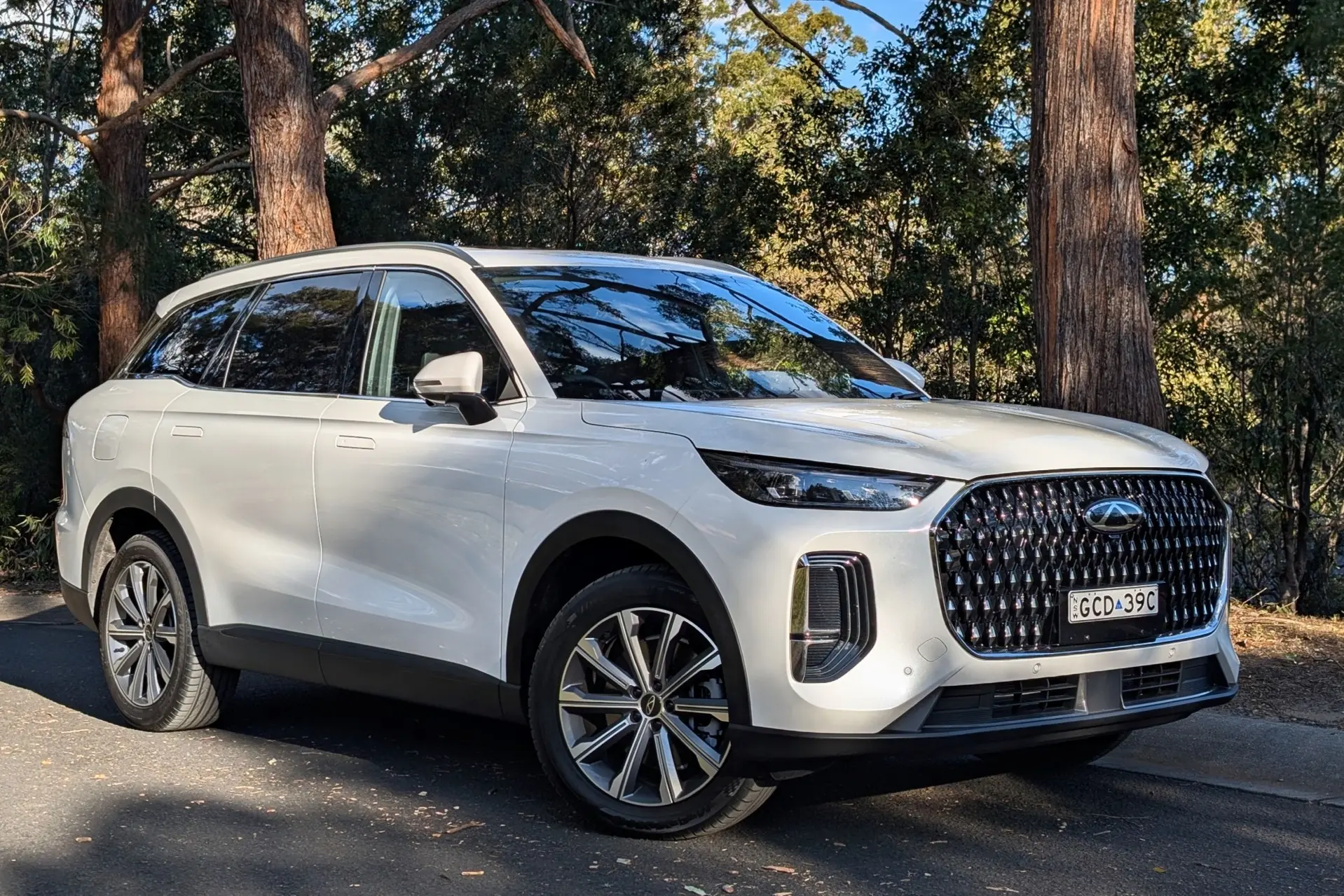
Wheels magazine (is it still a magazine?) recognised the Chery Tiggo 9 as Australia's best value large SUV.
But they're talking about the top of the range Ultimate model, not the entry Elite which is the one most punters will end up buying at this end of the market.
And the Elite is quite a different beast, front-wheel drive, with a smaller battery, less powerful drivetrain, less electric only range and of course less equipment.
But it costs less and it still seats seven.
STYLING
There are two grades, Elite FWD (our test vehicle) priced from $52,990 and Ultimate AWD priced from $59,990.
Although both are described as "super hybrids" with the same 1.5-litre turbocharged petrol engine, Elite has two electric motors, while the Ultimate adds a third motor and larger battery.
This means more power and greater range.
Standard kit for Elite includes synthetic leather trim, two-zone climate air with rear outlets, heated power-adjust front seats, acoustic glass for windscreen and front doors, colour selectable ambient interior lighting, cooled console box, power tailgate and a tilt-slide panoramic sunroof with powered sunshade.
There's also 19-inch alloys, puddle lights, pop-out door handles, walk-away locking, LED head, tail and daytime running lights, auto high beam, auto lights and wipers, and front and rear parking sensors.
Ultimate adds 20-inch wheels, real leather, auto dimming mirror, a heated steering wheel, heated and cooling for both the front and rear seats, massage for the front seats, head-up display, automatic parking assist, additional side parking sensors, and a 14-speaker Sony system.
Tiggo 9 is covered by a seven-year unlimited kilometre warranty, plus an eight-year battery warranty, with capped price servicing and roadside assistance for seven years.
Service is due every 12 months or 15,000km, with servicing capped at a total of $3174 for the first seven years.
SAFETY
Tiggo 9 has not been rated for safety yet but features an array of active and passive safety features.
There are 10 airbags that include front, front side and centre, rear side, driver knee and side curtain airbags.
The advanced driver assistance systems (ADAS) incorporate the likes of Autonomous Emergency Braking (AEB), Emergency Lane Keeping (ELK), Adaptive Cruise Control (ACC) and Forward Collision Warning (FCW), just to mention a few.
ENGINES / TRANSMISSIONS
Powering the Tiggo 9 Elite is a 1.5-litre turbocharged four-cylinder petrol engine, which produces maximum 105kW of power and 215Nm of torque, together with two electric motors, both of which are located at the front - delivering 75/170Nm and 90kW/220Nm apiece.
Combined output is 225kW of power and 315Nm of torque.
With three electric motors, Ultimate, in comparison, delivers 315kW and 580Nm.
Torque is the more significant figure because it's the stuff that gets you moving quickly and makes short work of hills when the car is fully loaded.
In the Elite, driving force is sent to the front wheels via a three-speed dedicated hybrid transmission.
DRIVING
You're buying this car primarily for the seven seats - so let's start there.
The key figures are the length and wheelbase which dictate how much room it has inside.
The Tiggo 9 is 4.8m long with a 2750mm wheelbase.
Getting in and out of the third row presents some challenges.
First, to raise the two third row seats with the straps provided, you need to slide the second row forward to provide clearance for the headrests.
Second, the single, second row, tilt and slide seat that provides access is located on the driver's side of the vehicle, which is not ideal in our neck of the woods where it exposes those getting in and out to the risk of passing traffic.
Third, returning the access seat to its original position proved problematic, requiring the driver's seat to be moved all the way forward before it too could be moved all the way forward.
This unlocks the seat and allows it to be returned to its original position.
With the seats in use there's little room leftover for luggage, as is the norm for most seven-seats SUVs, but at least the third-row packs flat when not required.
Cargo capacity is limited to 143 litres, with 819 litres when the second row is folded, or 2021 litres with both rows folded.
There's no spare under the rear floor either, just a tyre repair kit.
Four driving modes are available, accessed by a large circular control knob in the centre console: pure electric, series, parallel, and energy recovery.
Despite the fact it plays second fiddle to the Ultimate in terms of power, the front-drive Elite with its single electric motor is by no means a slouch.
Chery doesn't provide acceleration figures, but it feels around the 8.0 or 9.0 second mark from 0-100km/h.
Of course, you need some charge to receive assistance from the battery.
With a 70-litre fuel tank, the Tiggo takes premium 95 unleaded and has claimed fuel consumption of 1.5L/100km, but that depends on keeping the battery topped up - otherwise it reverts to normal hybrid operation.
Power consumption is 15.6 kWh/100km.
Driving mainly in normal HEV or hybrid-electric mode, we clocked up just under 400km at a rate of 6.0L/100km.
Access to the car is via walk-up/walk-away locking, with pop-out door handles and a drivetrain that powers up automatically - with no start/stop button - in readiness for departure.
However, before the transmission will engage, you must have your seatbelt fastened.
It sounds like a great idea, but in practice it wears thin fairly quickly.
Surprisingly at this price point the steering wheel is power-adjust, but disappointingly offers very little range of adjustment.
You can also choose between Comfort and Sport settings in the system that alters the amount of steering effort required.
Of note, sometimes the transmission wouldn't go into gear and at other times it jumped out.
This happened on more than one occasion.
Once up and running however the Tiggo is an easy, inoffensive car to drive and that is a compliment.
It accelerates briskly and even handles pretty well as we discovered, pushing hard through a few corners.
Ride and handling is a pleasing balance of comfort and control and it doesn't porpoise the way some SUVs do on undulating roads.
The Tiggo just feels a little disconnected, but that won't be a problem for the majority of drivers.
Three-level regenerative braking is offered, but there doesn't seem to be a way to adjust it that we could find.
On a downhill run you can actually see the battery level begin to rise.
Thankfully, most of the driver assistance stuff isn't too intrusive.
Limited control is accessible via the steering wheel buttons, but these can be difficult to see in strong sunlight.
Once upon a time glitches in test vehicles were rare.
These days they have become commonplace, and point to a lack of research and development.
SUMMING UP
Is the Tiggo 9 value for money? Sure.
Is it cheap?
Not really, not when you consider that it costs almost $60K to put on the road.
When we wonder did this become the price point for a family wagon.
The quality of Chinese vehicles may have come on in leaps and bounds, but so too has the price.
What next?
RATINGS:
Looks: 7
Performance: 7.5
Safety: 7.5
Thirst: 7
Practicality: 6
Comfort: 7.5
Tech: 7.5
Value: 7.5
Overall: 7.2
AT A GLANCE
MODEL LINE-UP
Chery Tiggo 9 PHEV Elite, $52,990
Chery Tiggo 9 PHEV Ultimate, $59,990
Note: These prices do not include government or dealer delivery charges.
Contact your local Chery dealer for driveaway prices.
SPECIFICATIONS:
Chery Tiggo 9 Super Hybrid Elite, 1.5-litre 4-cyl turbo-petrol, 3sp Dedicated Hybrid
Transmission, FWD, 7-seat SUV
STANDARD WARRANTY
7 years / unlimited kilometres