
PHOTO
66108.0
By CHRIS RILEY, MARQUE MOTORING
With the imminent arrival of Suzuki's first fully electric vehicle, the e Vitara, it's easy to see why the company didn't invest much in the hybrid version.
Forgive us for saying so, but it's a shortsighted approach because the company is likely to sell many more hybrids than it will EVs - just look at the experience of other brands.
Really, the hybrid deserved better, because apart from the welcome transition to hybrid power, the changes have been minimal to say the least.
STYLING
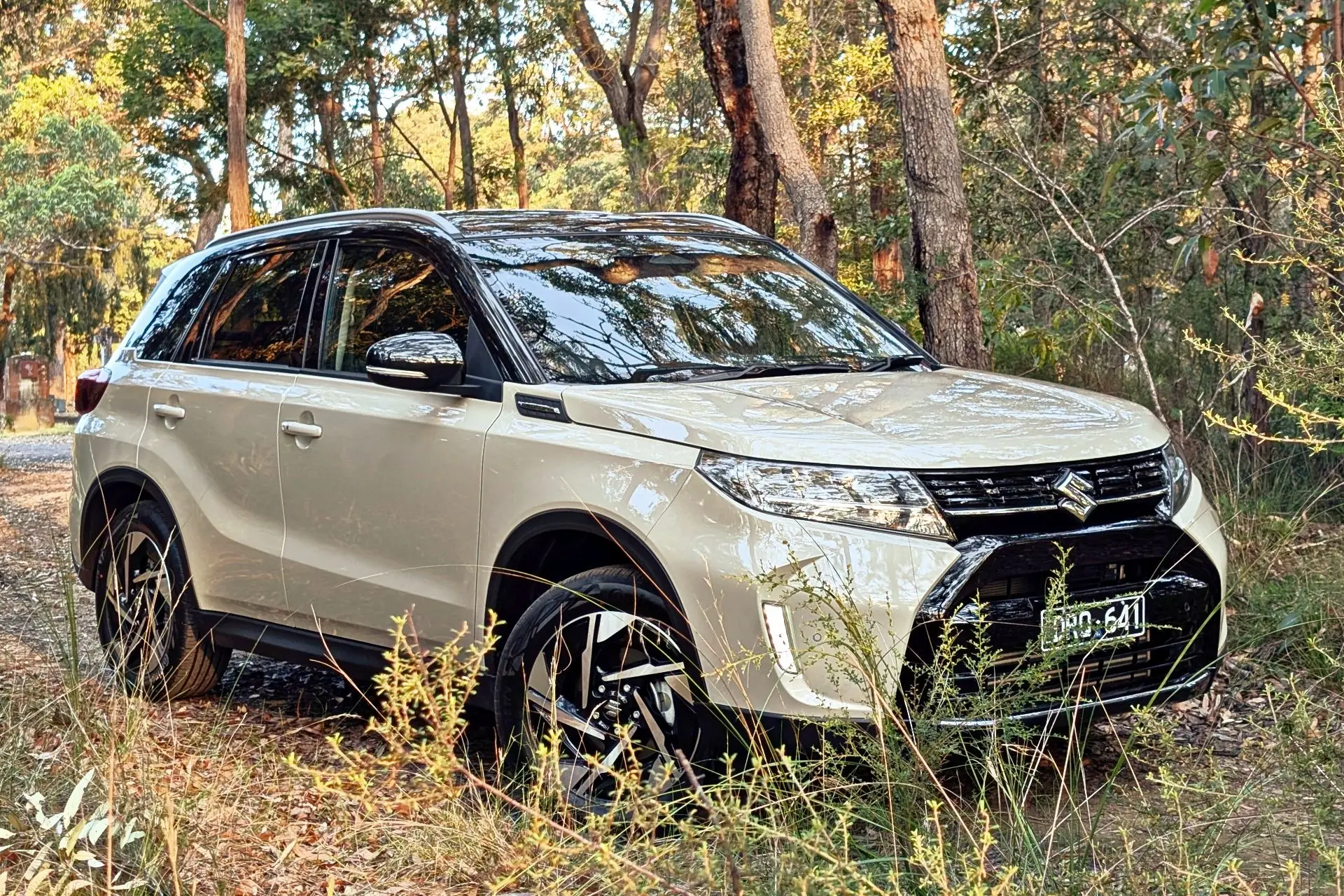
If you think the latest Vitara looks like the previous model, you're right.
The front grille and lights have been redesigned but from the rear it looks almost identical to the previous model.
Believe it or not, the current fourth generation Vitara dates back to 2015.
Yep, it's that old, although it was updated in 2018 and again in 2024.
The hybrid made a local appearance earlier this year, but still years after the debut of the Swift Hybrid.
There are two models from which to choose: Vitara Turbo Hybrid and Vitara Turbo Hybrid Allgrip, priced from $39,990 and $45,990 driveaway, respectively.
Four colours are offered: the colour white is standard, dark grey pearl metallic adds $745 and two-tone blue or ivory with a black roof is $1345.
Our test vehicle was the higher-priced Allgrip in ivory and black which, as its name suggests, adds all-wheel drive, along with a few other features including a sunroof.
The cabin is decked out in a suede and synthetic leather combo stitched with an interesting tyre tread pattern, along with a leather-clad steering wheel and single zone climate control air, minus rear air vents.
Standard kit includes LED headlights with auto high beam, LED daytime running lights, traffic sign recognition, auto wipers, auto-dimming rear-view mirror, keyless entry and start, rear view camera, front and rear parking sensors, 17-inch alloys and a panoramic sunroof.
Vitara is covered by a five-year, unlimited kilometre warranty with capped-price servicing and roadside assistance for the first five years.
Service is due every 12 months or 10,000km.
INFOTAINMENT
Infotainment consists of a 9.0-inch touchscreen, with Bluetooth, built-in navigation, AM/FM and DAB+ digital radio, wired Apple CarPlay and Android Auto, and six-speaker audio.
There's just one USB-A port in the front and no wireless charge pad.
SAFETY
Vitara remains unrated by ANCAP, but comes with seven airbags including a driver's knee bag plus a rear-view camera.
There's also adaptive cruise control, autonomous emergency braking (AEB), blind-spot monitoring, lane departure warning, rear cross-traffic alert and weaving alert.
Two Isofix and three tether style child seat anchor points are provided.
ENGINES / TRANSMISSIONS
Power comes from a 1.4-litre turbocharged four-cylinder engine, with the support of a 48-volt mild hybrid.
The combination produces 81kW of power at 4500 rpm and 235Nm of torque from 2000-2500 rpm, with drive to all four wheels on demand in the Allgrip version.
Transmission is via a six-speed auto, with paddle gear shifters provided.
DRIVING
At 4175mm in length and weighing in at a trim 1315kg, Vitara is a relatively compact, cheap five-seat SUV.
For years, Suzuki has represented the budget alternative for buyers seeking a Japanese vehicle, but who don't want to pay through the nose for one.
However, apart from the long overdue switch to hybrid power, not much else has changed since we last drove this car more than 12 months ago.
The styling remains almost identical, while the cabin and instrumentation continue to look and feel dated.
Gone is the cute analogue clock, replaced by a third air vent at the top and centre of the dashboard.
Older drivers may be attracted by the Vitara's familiarity and simplicity, with its dated layout, gauges and switch gear.
But younger, tech-savvy drivers may be underwhelmed.
Neither will be too impressed by the cheap plastics and generic fabric trim used throughout the cabin.
Rear legroom is okay thanks to scooped out front seat backs, but that's not saying much.
It's still pretty tight back there and lacks rear air outlets, or for that matter any creature comforts of note for the back seat passengers, including access to a USB port.
However, the door bins will accommodate a sports water bottle.
Cargo capacity with the rear seat in use is 375 litres, with a hidden area under the floor which in turn hides a space saver spare, with a 12 volt/120W power outlet in the luggage area.
But the split back seat does not fold flat and the transmission tunnel combined with angle of the open doors make it difficult to stow longer items such as a beach umbrella across the foot of the seat.
The infotainment system is somewhat basic but ticks most of the necessary boxes.
However, it took a frustrating 10 minutes and several failed attempts to connect our late model Pixel mobile phone via Bluetooth.
Connection to either CarPlay or Android Auto is via cable and despite trying a couple of different cables, Android Auto kept disconnecting.
Built-in navigation is provided and DAB+ digital radio has been added to the menu this time around.
But continual, unnecessary alerts about merge points, that is entry and exit motorway ramps , really began to grate.
As documented, yanking the gear selector back for Drive will inadvertently engage manual mode and engine revs will max out before you realise what is going on.
With a 47-litre tank, the hybrid takes premium 95 unleaded and uses a claimed 5.9L/100km in this model, giving it a range of close to 800km.
Suspension is MacPherson strut at the front with a basic, torsion beam rear setup, and it rides on 17-inch alloys with 215/55 profile rubber.
Getting behind the wheel for the first time the Vitara Hybrid impressed from the get-go.
It offers stronger performance than the previous turbocharged model, with a solid, well sorted feel, and is over-engineered if anything.
It corners flat, feels taught and has a firmish ride, and can be driven enthusiastically with confidence.
In fact, the suspension is excellent on secondary, back roads.
Steering is sharp and accurate and the brakes are confident.
But we're not great fans of the Continental Ecocontact 6 tyres that lack grip.
Rated at 5.9L/100km, we were getting 5.5L after 620km of driving, mostly out on the open road over the Easter long weekend with 152km still to go.
In practice we discovered it was best to avoid cruise control, as this prevents the battery from being recharged from recovered energy on long downhill runs - any hills really.
Taking your foot off the throttle sees an icon show up at the top of the instrument cluster, indicating the battery is being charged.
What a shame the rest of the car isn't a match for the superior engineering, but of course that would push up the price and that's a whole new ball game.
SUMMING UP
We're in two minds about this car.
The engineering is rock solid and impressive.
But the technology needs to catch up, with an analogue dash, mechanical handbrake, wired Android Auto, etc.
It also lacks a current safety rating, even though the previous five-star rating expired over two years ago.
It's not the way to win over buyers, let alone retain the ones you have, with Suzuki sales down more than 28 per cent year to date.
If they think the electric e Vitara is going to do the trick, they're sadly mistaken - the Chinese already offer much better options.
Just saying.
RATINGS:
Looks: 7
Performance: 7.5
Safety: 5
Thirst: 7.5
Practicality: 8
Comfort: 7
Tech: 7
Value: 8
Overall: 7.1
AT A GLANCE
MODEL LINE-UP
Vitara Turbo Hybrid, $39,990
Vitara Turbo Hybrid Allgrip, $45,990
Note: These prices are driveaway and include government or dealer delivery charges.
SPECIFICATIONS
Suzuki Vitara Turbo Hybrid Allgrip, 1.4-litre turbocharged four/single electric motor, AWD, five-seat wagon
STANDARD WARRANTY
Five years / unlimited kilometres