PHOTO
By Merlin Tzaros
Merlin, aged 15, has had a keen interest in reptiles for several years and has contributed this week's article.
LOVE them or loathe them, snakes are a fascinating and diverse group of animals that play important roles in our natural ecosystems.
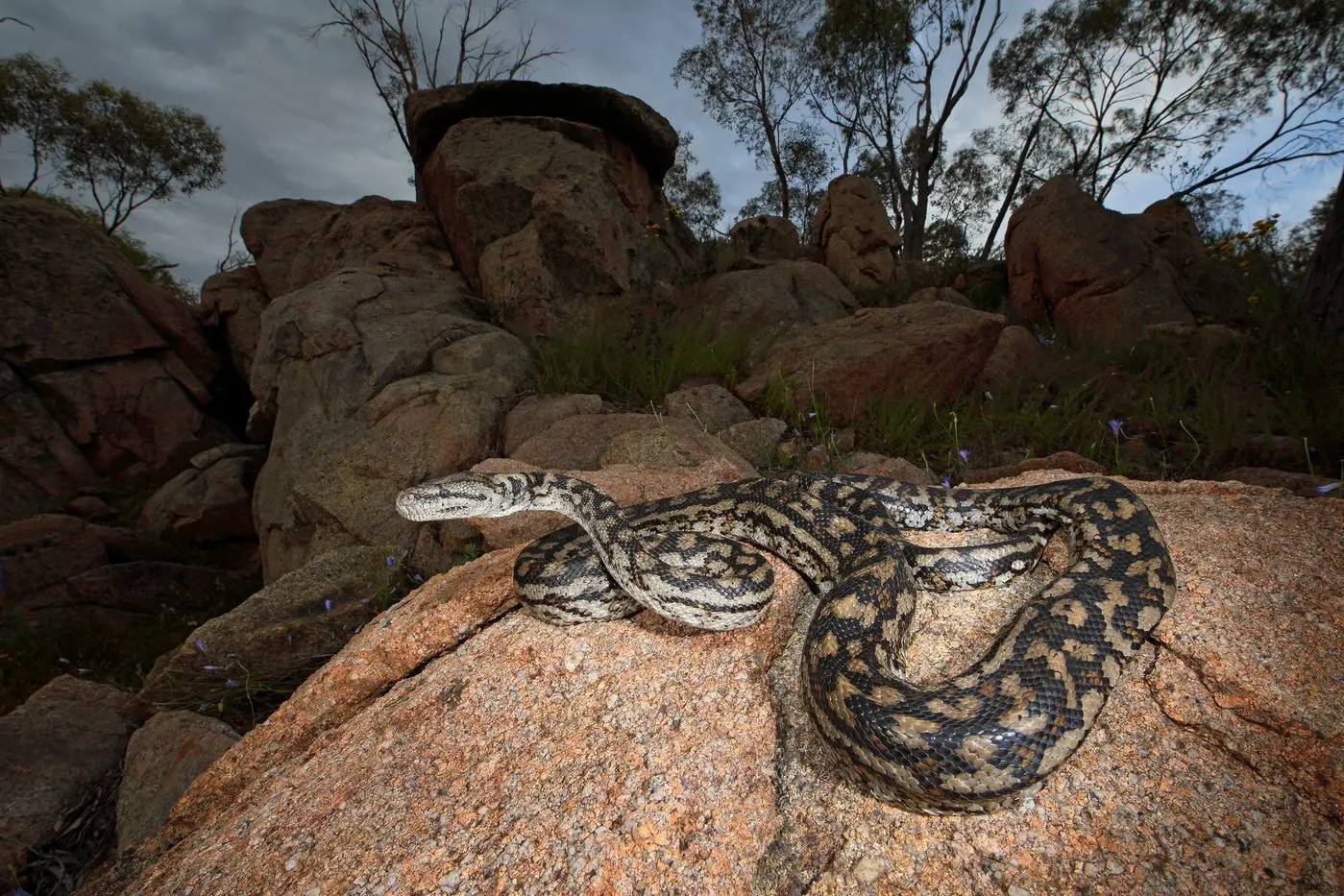
One of the more attractive species locally is the Inland Carpet Python.
This variety of the broader Carpet Python group occurs sparsely across parts of northern Victoria, inland New South Wales and southern Queensland, and differs greatly in colour and pattern from those found in other parts of Australia, especially the darker coastal forms.
They are primarily grey, paler underneath, conspicuously mottled with a complex carpet-like pattern of dark grey, black and brown blotches.
Though they can attain a full size of up to two and a half metres, most individuals found are much smaller.
In this region, Inland Carpet Pythons mainly occupy open woodlands where there are numerous large old hollow-bearing trees with fallen limbs and logs strewn below, especially those around rocky outcrops and granite boulders and slabs with large crevices.
With the assistance of heat sensory pits on their snout and lower lip, Inland Carpet Pythons hunt for warm blooded prey including rats, mice, bats and rabbits.
Large prey items are preferred and though they may be more difficult to swallow, they provide substantial quantities of food, allowing pythons the ability to consume food relatively infrequently.
To swallow large prey, pythons can voluntarily dislocate and re-set their jaw, allowing them to ‘walk’ their mouth over the prey, gradually stretching wider and wider, before eventually the whole animal has been swallowed.
Another evolutionary marvel is their ability to move their heart and windpipe up and forward in their body, almost to the front of their mouth, allowing them to continue breathing throughout the busy and often time-consuming process of feeding.
Female Inland Carpet Pythons usually lay a clutch of between 15 and 20 eggs in late spring to mid-summer, in which she then coils around for 6-10 weeks until the eggs hatch. The mother can regulate the temperature inside the eggs, often by ‘shivering’ to create friction and heat up the young inside.
When the eggs do hatch, the babies are then completely independent, fending for themselves the moment they hatch.
Coming into the cooler winter months, Carpet Pythons, along with many other reptiles, will be encountered much less often, however, they may find the roof cavities of your homes or sheds appealing.
Now being endangered, their populations locally have diminished substantially – their main threats being habitat loss through removal and disturbance to fallen timber and rocks, predation by foxes, dogs and cats, and road mortality.
They can be found in many rocky parts of the Warby Ranges and surrounding roadsides and properties where suitable habitat exists.