PHOTO
72066.0
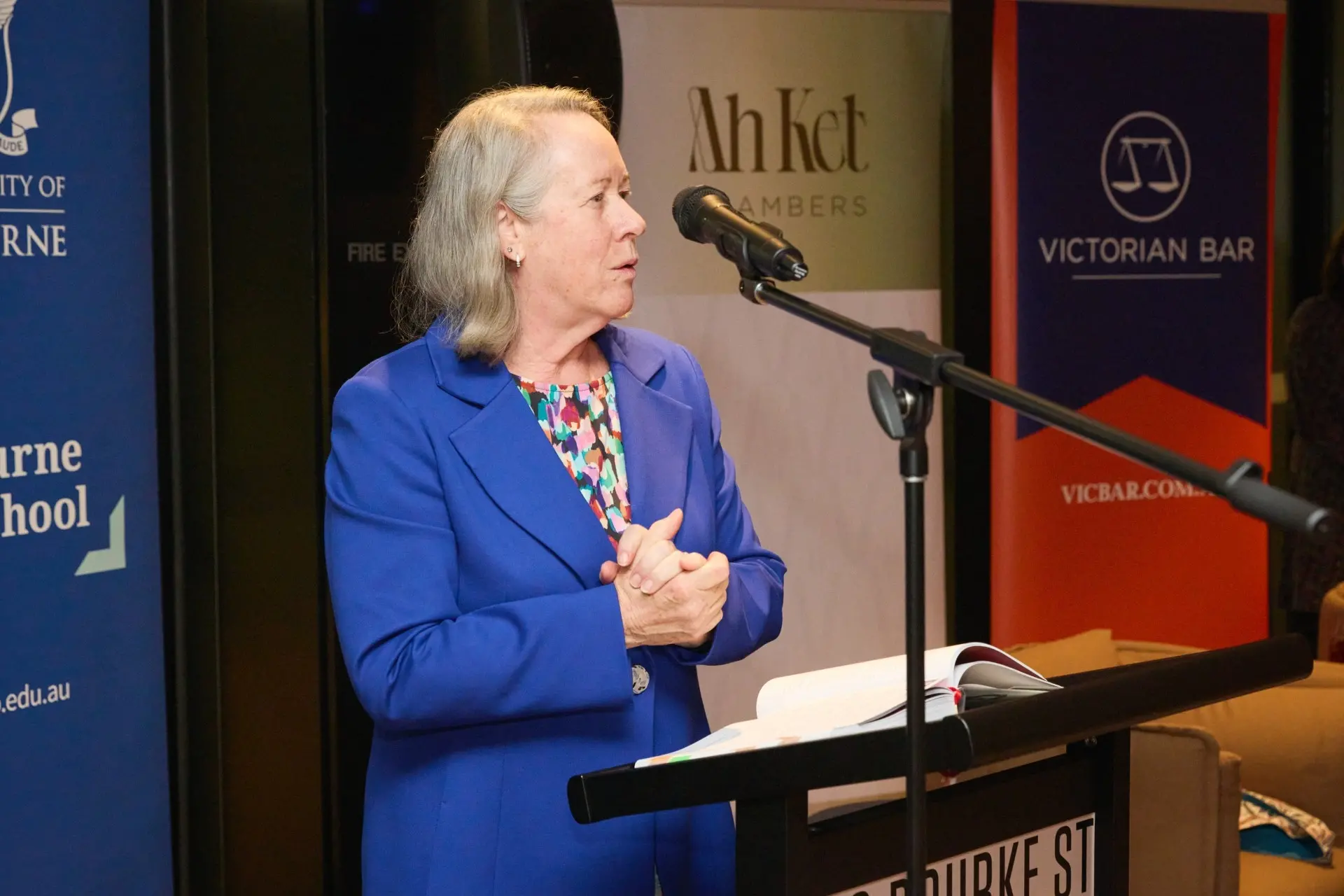
More than 200 people attended the book launch of 'William Ah Ket: His Life and Times' at the recently established William Ah Ket chambers at Melbourne Law School in Bourke Street Melbourne on Thursday 25 June.
Presented by the Honourable Chief Justice Debra Mortimer of the Federal Court of Australia, senior members of Melbourne’s law fraternity, descendants of the Ah Ket family and representatives of the China/Australia friendship society joined together for the event.
The book was authored by William Ah Ket's daughter Toylaan Ah Ket (deceased) and completed through Melbourne University Law School Asian Law Centre associate director professor Andrew Godwin.
The early chapters of the book detail his early life and education in Wangaratta.
His father was a successful tobacco grower and market gardener who had established himself in Faithfull Street where he owned terrace houses and was a familiar face at the local courthouse, where being able to speak English and act as an interpreter was valued.
The Ah Kets had seven girls and one son; two of the daughters died young.
The Australian family was unique in being fully Chinese, which was a rarity at that time.
William and his remaining five sisters attended the Wangaratta public school in Chisholm Street.
His sisters were renowned seamstresses and proprietors of the Gem tea rooms.
The siblings were bilingual, their first language being English and second Chinese.
The siblings' father and mother, Mah Ket and Hing Ung, are buried with a large tombstone in the methodist section of Wangaratta cemetery.
William moved to Melbourne to complete his law studies where he was awarded the Supreme Court Judge’s prize for Articled Clerks in 1902.
He completed his articles with Maddock and Jamieson before signing to the bar roll to practice as a barrister in 1904.
He quickly earned the respect of his peers for his performance in court and his erudite practice of the profession.
Among his many supporters was the late Prime Minister Sir Robert Menzies, who considered him a great friend and modelled many of his political speeches on the court performances of William Ah Ket.
William used his position to improve the lot of the Chinese in Australia following Federation and the introduction of the White Australia Policy.
He challenged many of the laws and policies that discriminated against the Chinese, helped to clean up Little Bourke Street which had become an untidy ramshackle Chinese ghetto, and worked to ban the smoking of opium.
William married Gertrude Bullock from an upper middle-class family in November 1912.
The romance was a difficult one because of the father being vehemently against anything to do with the Asian race.
The courtship proceeded in secret for four years before the couple married, and they went on to have a successful and loving life.
As William's career blossomed and his reputation grew, he was appointed Consul General to China and attended the signing in of the first republic of China following the demise of the Qin dynasty.
He went on to win major court battles and fought strenuously against discrimination and promoted fairness for all.
William was acknowledged as fine example how a Chinese-Australian citizen of humble origins, educated in the rural town of Wangaratta, can rise above discrimination to become a most respected gentlemen moving in upper circles.
He is a role model for aspiring law students and promoted an inclusive, discriminatory-free society which continues to this day.
'William Ah Ket: His Life and Times' can be purchased through the Melbourne Law School or search the title on the internet.