THE Wangaratta Homing Pigeon Club (Inc) will hold a commemorative Anzac Day pigeon race to celebrate the role the Australian Carrier Pigeon Service played in World War Two.

The race will be held this Sunday from Narrandera, a distance of approximately 180 kilometres to lofts in Wangaratta and Myrtleford.

Pigeons have been used for centuries to carry messages and news.

During the First World War the British Army used carrier pigeons during the battles of Ypres when telegraph and telephone communications failed.

During the D-Day invasion of Normandy in the Second World War, England's Prime Minister Winston Churchill imposed a complete radio blackout to maintain security of the mission.

Carrier pigeons released in Normandy and from ships were the only communication to advise British headquarters in England on the progress of the invasion.

In early 1942, the threat of a Japanese invasion of Australia and the Western Pacific became a distinct possibility.

At the time, Australian forms of communication depended on lines or wireless.

However, it was considered that lines were vulnerable to enemy interference and communications could be monitored and messages may be intercepted by the enemy.

Accordingly, a conference was held between prominent homing pigeon owners and some senior Australian Army signals officers.

From this, Captain H. T. (Bert) Cornish, a leading Sydney pigeon flyer, was commissioned to establish The Australian Carrier Pigeon Service as part of the Australian Corps of Signals.

Australian carrier pigeon lofts were organised and by the end of 1942 a complete coverage of the strategic parts of Victoria, New South Wales, Queensland and Western Australia was obtained, linking the various aircraft spotting, small army craft coast watching, and volunteer Defence Corps posts in providing communications.

This service was so successful that as the war in the Western Pacific escalated it was soon realised that the use of pigeons in jungle warfare had vast possibilities.

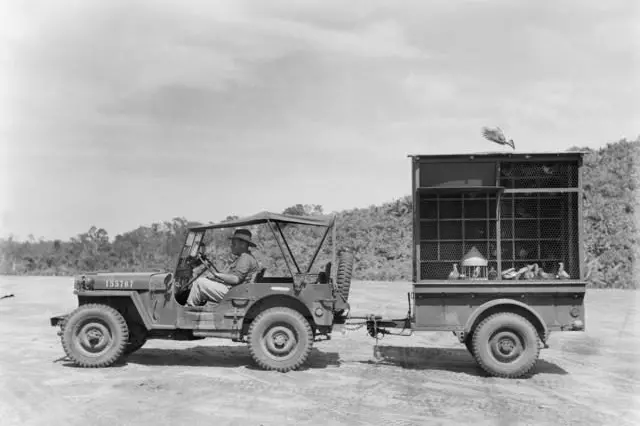
Pigeons were sent to the jungle areas for release carrying their often lifesaving messages back to their unit's lofts.

Pigeon sections were located in many areas of New Guinea including Tarakan, Laubuan, Morotai, Bougainville and New Britain.

Pigeon lofts were also attached to signals schools and infantry training schools.

The flying conditions for the pigeons were extremely difficult in New Guinea and the Western Pacific regions of combat with mountainous topography, tropical rain, mist, high humidity and enemy gunfire proving to be an extreme test of the calibre of the Australian racing pigeons and their handlers.

The pigeons could be trained that once released from their combat position they could fly to their loft position that was often under camouflage miles away.

Often, the mobile lofts would have to be moved at short notice due to enemy movement.

The pigeons could be trained to search up and down the coastal areas until they found their new loft position and deliver their important messages, testament to the determination and intelligence of the birds and the skill of the Carrier Pigeon Service personnel.

During the Western Pacific conflict two Australian pigeons were awarded the Dickin Medal, the animal equivalent of the Victoria Cross, for conspicuous gallantry in delivering lifesaving messages through extreme weather conditions and whilst under heavy enemy gunfire.

A display devoted to the Australian Carrier Pigeon Service at the Australian War Memorial in Canberra is available for visitors to view.

The Wangaratta Homing Pigeon Club (Inc) is proud to honour the role played by The Australian Carrier Pigeon Service during the Second World War in defence of Australia.