PHOTO
Council cash reserves aren't as healthy as Victoria's independent regulator has indicated, according to Rural City of Wangaratta CEO Brendan McGrath.
The Essential Services Commission released its 2025 Local Government Outcomes Report in June, a financial health check on the 79 Victorian councils which it conducts every two years.
In the report it claimed that Victorian councils have reasonable cash reserves.
Mr McGrath had a alternate view about the regulator's appraisal and he highlighted reasons to explain.
"While the Essential Services Commission has noted that councils hold significant cash reserves, this can be misleading," he said.
"Much of this funding is already committed—allocated to specific projects, tied to grant conditions, or reserved for long-term obligations such as landfill rehabilitation.
"Early payments of financial assistance grants can also temporarily inflate our cash position without increasing available funds."
In 2023-24, in the Rural City of Wangaratta, capital expenditure totalled $26.884m, and operating expenditure was $76.105m.
A catalyst for added pressure on councils has been the Fair Go Rate Cap introduced in 2016-17.
In 2025-26 the cap will be 3 per cent, except for Indigo Shire (7.54 per cent) and Hepburn Shire (10 per cent) councils which successfully applied for a higher rate increase.
The ESC said that overall the sector is reporting a tighter financial position than it was during the early years of rate capping, however, low levels of debt and "reasonable cash reserves" suggest most councils remain financially sound.
Spending on waste management is the fastest growing service area across Victorian councils, reflecting changes in the waste market, including the rollout of a four-bin system and increases in the waste levy.
Mr McGrath noted that Wangaratta, like many rural and regional councils, is under increasing pressure to maintain essential services and infrastructure while remaining financially sustainable.
"Rate caps have limited our ability to grow revenue in line with inflation and rising costs, reducing our capacity each year to deliver projects, maintain service levels, and care for community assets," he said.
The report showed that average rates in Wangaratta were $2434 in 2023-24.
Rates and charges in Wangaratta accumulated $40.432 million.
User fees and statutory fees and fines raked in $12.615m, grants totalled $24.246m, while contributions were $1.962m in 2023-24.
Other interesting data showed that kerbside collection bins were missed 8.17 times per 10,000.
Sealed roads were maintained to condition standards 82 per cent of the time.
And there was a 53 per cent satisfaction rate with community consultation and engagement, according to the community survey in 2023-24.
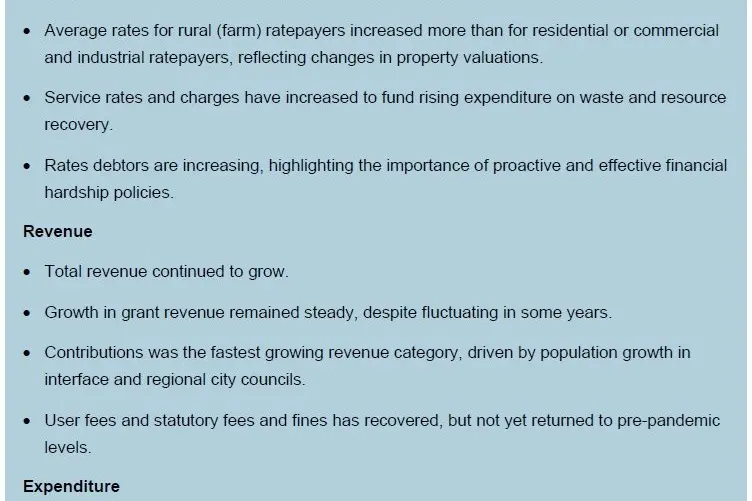
Key observations showed that ratepayers have benefitted from low rate increases and high levels of compliance.
However, service rates and charges (which are not capped) increased at a faster rate than capped rates in 2022–23 and 2023–24, increasing by an annual average of 12 per cent.
These charges are used to recover the cost of waste and resource recovery services.
The report also showed that the growth in employee costs was constrained, as many councils tie their employment agreements to the rate cap.