PHOTO
VOTERS will go to the polls from seven different wards at this October's Wangaratta council election based on an electoral structure review's final report.
The Rural City of Wangaratta will be divided into seven ward represented by seven individual councillors, part of review of 39 local councils.
Instead of the existing city ward and three rural wards, the rural city will be divided into three urban, two rural and two peri-urban wards, which an advisory panel said would better support the mix of housing and land uses.
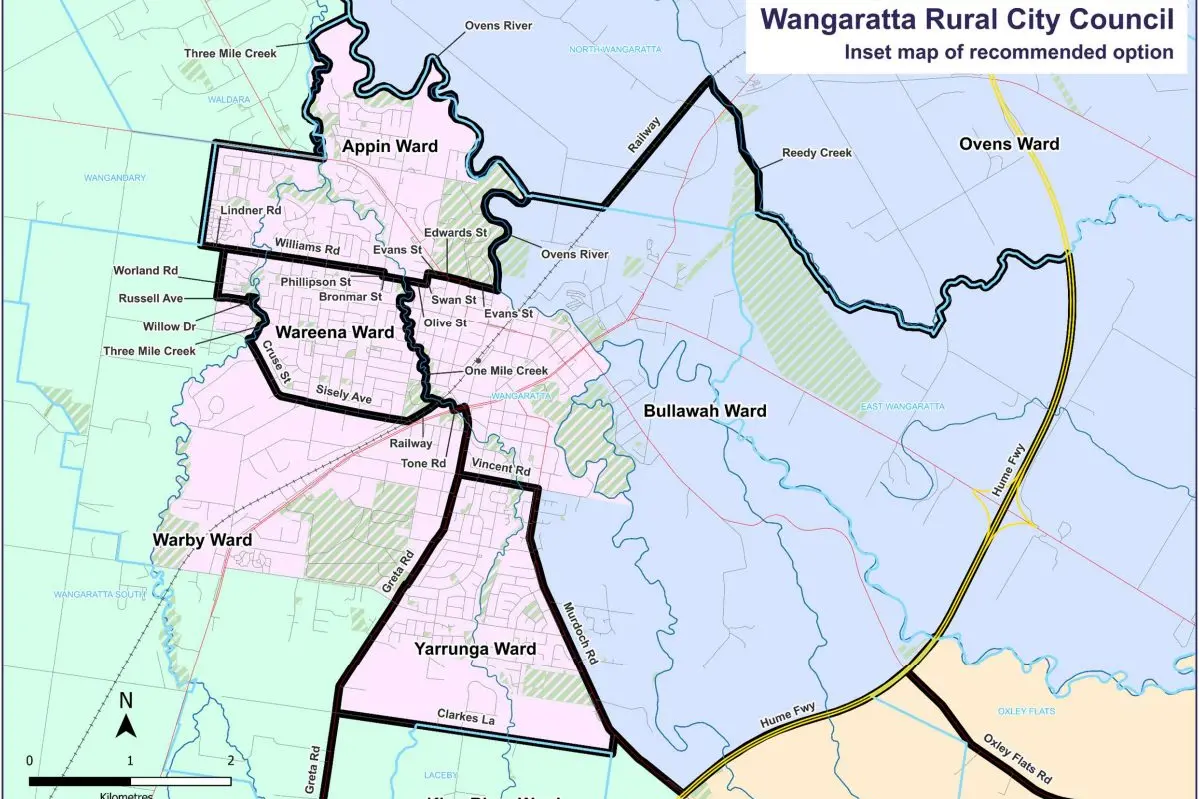
Wangaratta will be divided into seven wards named Appin, Bullawah, King River, Ovens, Warby, Wareena, and Yarrunga wards.
At the time of the review there were a total of 23,904 electors and the population distribution for each ward includes Appin (3562), Bullawah (3507), King River (3512), Ovens (3259), Warby (3096), Wareena (3570) and Yarrunga (3398).
The land area for each ward consists of Appin (5km2), Bullawah (25km2), King River (2360km2), Ovens (1118km2), Warby (131km2), Wareena (2km2), and Yarrunga (4km2).
Appin, Wareena and Yarrunga wards contain predominantly established urban areas.
Wareena Ward will be bordered by Williams Road to the north, One Mile Creek to the east, Sisley Avenue to the North and Worland Road to the west, with Appin Ward extending along Williams Road to its western border at Lindner Road, and east to the Ovens River.
The Yarrunga Ward would retain its previously outlined borders, while the Warby Ward would encompass land west of Worland Road and south of Sisely Avenue and Cruse Street.
Bullawah Ward unites residential and commercial areas in the town of Wangaratta with semi-rural areas to the east of the town.
It will encompass the CBD, bordered by Reedy Creek to the north, Murdoch and Vincent roads to the south and One Mile Creek and Evans Street to the west.
Warby Ward is the most diverse, capturing south-west urban Wangaratta, some growth areas to the north-west, and Waldara, Wangandary, the rural township of Glenrowan and the Warby-Ovens National Park.
It will follow the Hume Freeway to the south, parts of the Ovens River to the east and Sessions Road to the north.
Ovens River ward will encompass land north of Sessions Road, extending along Oxley Flats Road and Snow Road to the south.
King River ward will extend south from Oxley Flats, taking in Glenrowan, Oxley and Milawa, down to Whitfield, Cheshunt, and Rose River.
"On balance the panel felt these peri-urban wards reasonably mixed urban, urban fringe and townships near Wangaratta and provide effective representation to for communities of interest in those areas," the final report read.
"The Ovens and King River wards contained the rural communities of the council area without having to include urban-focused communities.
"The panel considered these wards would provide more dedicated representation to rural interests as a result."
The panel considered changes in population and voter distribution in the town since the last review when the current electoral structure was introduced.
It examined election results for Wangaratta Rural City Council, including numbers of candidates nominating, incidences of uncontested elections and rates of informal voting, and found there were relatively strong candidate numbers across the current wards.
There were four submissions to the panel's preliminary report with council having a strong preference for model one because "the boundaries of three proposed rural wards closely resemble those of the current structure, primarily following waterways and major rural roads.
However, the panel did not find the "least change" argument convincing and noted it would have been useful for council to have discussed the other models in its submission.
The panel considered a potential drawback of both models one and two due to the urban ward boundaries capturing most by not all of the town of Wangaratta.
Submitters generally agreed with the panel’s view that residents east of Murdoch Road should not be in a rural-focused ward because they have strong connections to the town.
The Minister for Local Government assessed the panel's advice and has now gazetted the changes which will be effective for the 2024 election.