
PHOTO
72780.0
A stroll through the bush for many of us will often result in the sighting of many small bush birds, many of which superficially look the same (often referred to as LBJs – little brown jobs!).
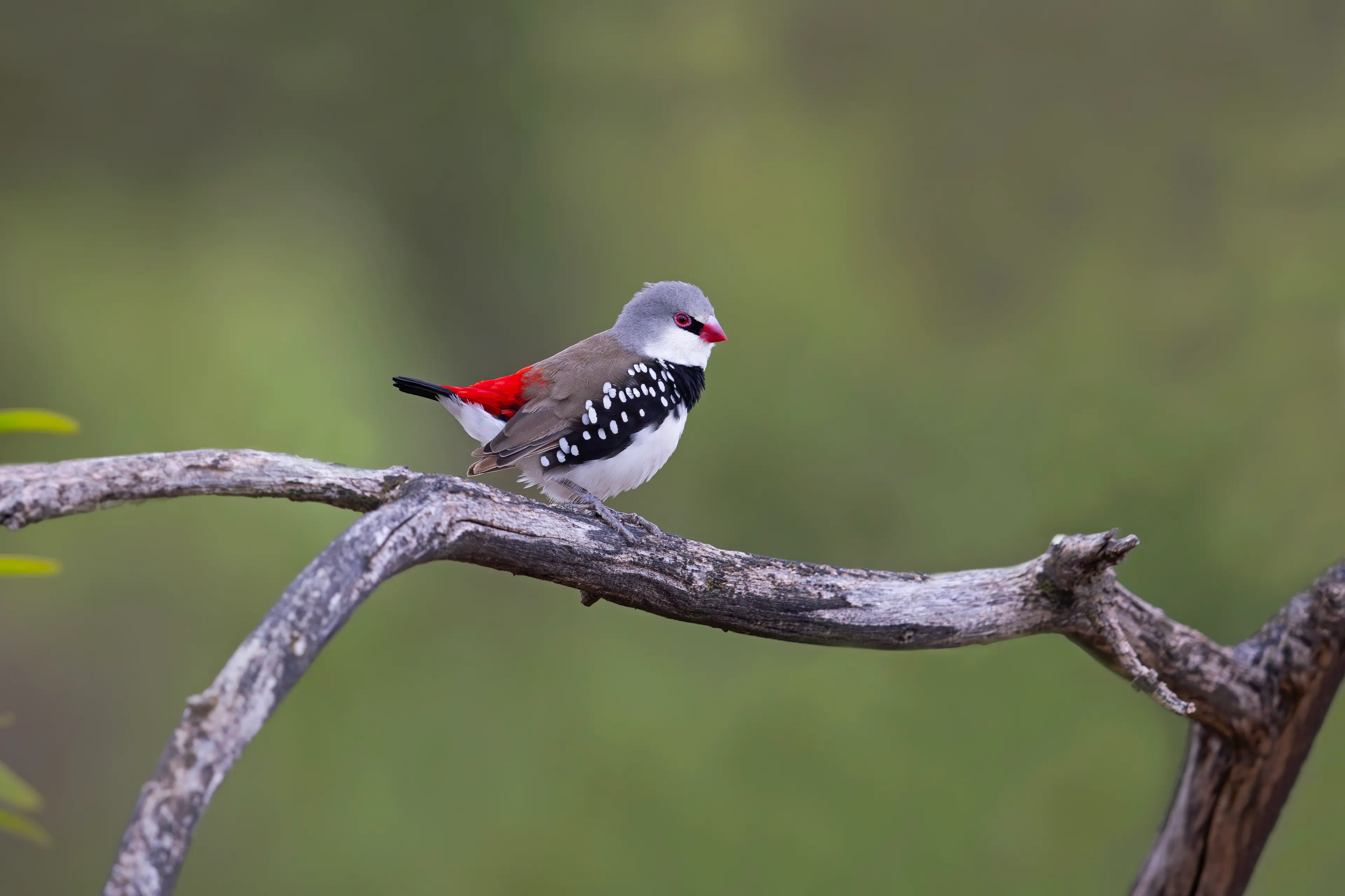
There is one species, however, that is an exception to this rule - the Diamond Firetail.
Upon seeing it flush from the ground, you will almost certainly notice a vivid flash of crimson as the bird flies away.
Usually perching just a short distance away, they often allow the observer to take note of some of its finer details, and when seen up close or through binoculars, the Diamond Firetail appears as one of the most striking little birds occurring in our region.
Appropriately named, Diamond Firetails are a small bird that belong to the family of Australian grass-finches.
They have an intense red rump and base of their tail, which contrasts strongly against their black tail and smokey grey back.
Seen front on, they are crisp white with a distinctive broad black band across their chest.
Along their sides, they have jet black plumage adorned with small white spots, or ‘diamonds’, that almost look as though they have been painted on.
To cap off their distinctive and handsome appearance, they have a candy red pointed beak, a matching red eye, and a black ‘bandit’ stripe through their face.
We may often wonder why birds are coloured or patterned the way they are.
Through evolution and adaptation, species develop attributes to assist in their survival and reproductive success.
Looking at the Diamond Firetail, we may question the function of the white ‘diamonds’ and why these markings are shown off by males to prospective female mates during their courtship displays.
Recent research has investigated this very phenomenon and it was concluded that males with more spots had higher pairing success with females.
Also, males with more spots were found to perform faster and more intense courtship displays, so not only did they look the best, they also had the best dance moves!
This type of ‘alpha-male’, means that the dominant male consistently wins contests over rival males for courtship display sites (the best branch in which to perform a courtship dance), the best pieces of grass to use (males dance with a long piece of grass in their beak to dazzle females), and even the best places to build nests (prime real estate).
Along with so many of our other woodland birds, populations of the Diamond Firetail have been in decline for the past few decades.
In some parts of south-eastern Australia, they have almost completely disappeared due to the loss of their preferred grassy woodland habitat, and the conversion of rough natural areas of native grasses and low herbs, to highly modified cultivated settings of introduced pastures.
This bird feeds on the small seeds of native grasses, herbs and low shrubs, such as saltbushes, often hopping about on the ground around these plants to pick up fallen seed.
Although they have adapted to our changed environment by recognising a number of weeds as food, a reduction of their natural food sources is largely responsible for their decline.
Despite becoming much rarer elsewhere, there are several spots in north-east Victoria where Diamond Firetails are doing quite well, due to the availability and preservation of lightly-timbered open woodland habitats, often in rocky granite areas where there is plenty of food and also patches of dense native shrubs, especially prickly species, which firetails love to build their nests in.
To find the bird listen for their distinct mournful double whistle 'twoo-heeee' call issued from a dead branch in places like the Warby Ranges and the hills around Eldorado.