
PHOTO
68975.0
Koreans don't get to drive the Hyundai Elexio.
They get the Kia equivalent instead -- the EV5.
Built in China, it's the first Hyundai to be manufactured outside of South Korea, no doubt in an endeavour to reduce costs and make the car more competitive.
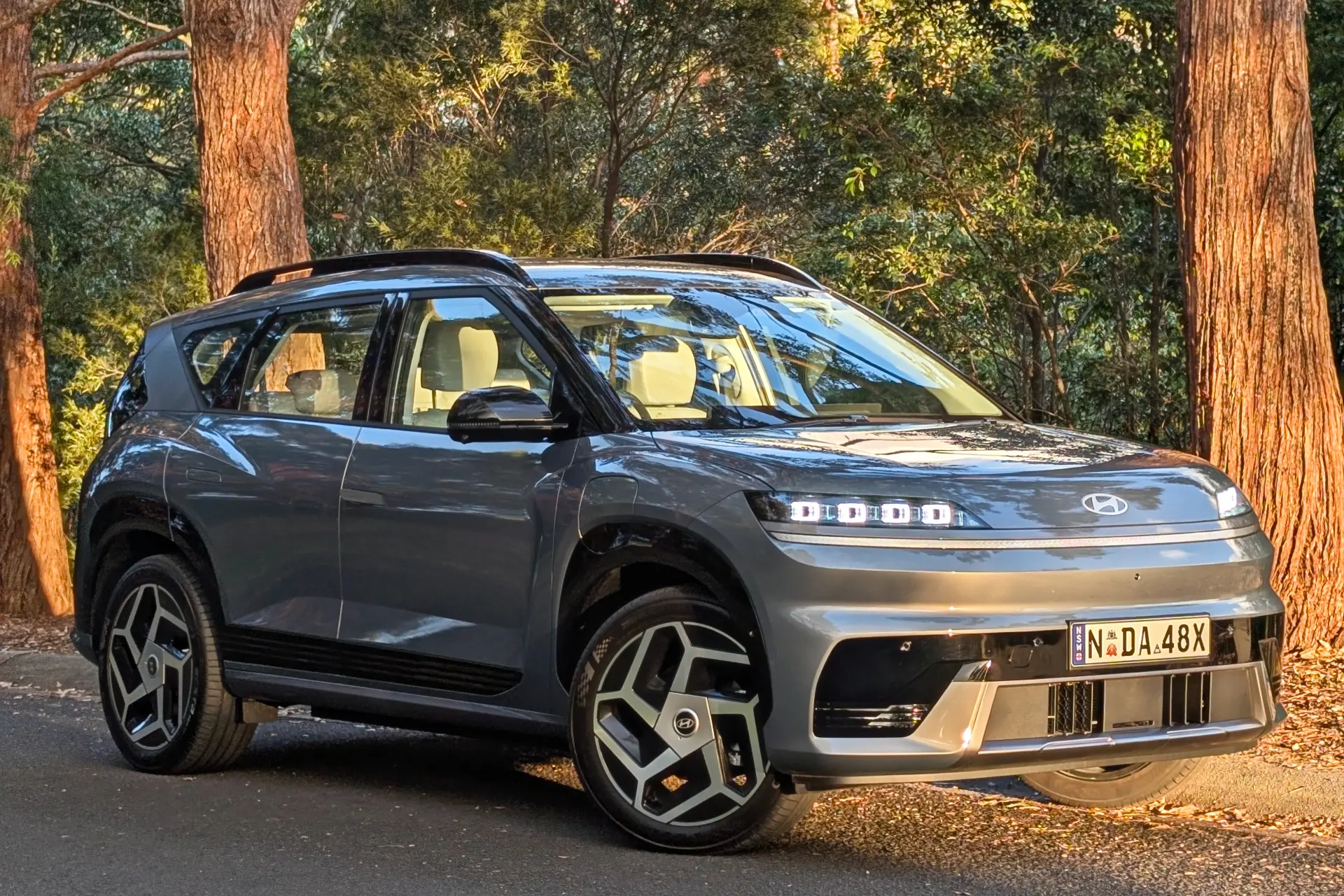
Elexio sits between the Kona Electric and Ioniq 5 in terms of size, but is quite different in design, with a tall boxy body.
It's a made-up name, created especially for the five-seat EV and means nothing in particular -- in fact it has been renamed Eo for the Chinese market.
STYLING
The styling brings to mind the third generation Kia Soul, particularly those Z-shaped rear pillars and tailgate.
The eye-catching headlights incorporate eight crystal cubes, supposedly a nod to the lucky number eight in Chinese culture.
There's just the one grade so far, the front-wheel drive Elite priced from $59,990 driveaway.
A range-opening, entry grade is expected to be added before the end of the second quarter -- that's car-speak for cheaper one.
Elexio, we're told, is a family-focused, perfectly sized EV that is packed with smart features, showcasing a futuristic style inside and out with a sleek, minimalist layout.
Generous interior space combines with intuitive convenience and driver assistance technology to provide a practical and desirable all-electric SUV.
"As the first vehicle exported from our Beijing Hyundai joint venture, it demonstrates how we are leveraging our global manufacturing capabilities to deliver exceptional value to customers," Hyundai CEO José Muñoz said.
That may be so, but the size and placement of the large infotainment screen is confronting.
The long, skinny 27-inch screen stretches from the centre of the dash away from the driver, terminating in front of the passenger.
How this can be described as "practical" is eminently debatable. It does however facilitate the operation of several arcade-style games that can consume the entire screen when opened.
That said they can be played only when the car is stationary and presumably in Park.
After a few minutes the kids quickly lost interest.
The bone-coloured upholstery in our test vehicle is not what we'd call family friendly either.
Sitting at the base of the windscreen, a new-generation, projector-based head-up display replaces a conventional instrument cluster.
With a 30,000:1 high contrast ratio, readability should be exceptional in any lighting conditions.
But like the head-up displays of other manufacturers it is almost totally invisible to anyone who wears polarised sunglasses.
When are they going to recognise and address this issue (or is the problem that it cannot be fixed)?
Elite features the usual assortment of features, including dual-zone climate air, partial leather trim, power-adjust driver and passenger front seats that are both heated and cooled, plus a heated leather steering wheel.
There's also automatic parking using the smart key, auto high beam, LED lights front and rear, adaptive cruise control, traffic sign recognition, auto lights and wipers, auto-dimming rear-view mirror, front, side and rear parking sensors and a power operated tailgate -- but oddly no sign of a sunroof.
Elexio is covered by a 7-year/unlimited kilometre warranty, with 8-year/160,000km cover for the high-voltage battery.
SAFETY
Elexio has been awarded a full five stars for crash safety by the ANCAP organisation, based on testing of the closely-related Kia EV5.
There's a total of nine airbags, with rear side thorax airbags and a centre airbag that gives added protection to front seat occupants in side impact crashes.
A comprehensive suite of Advanced Driver Assistance Systems (ADAS) includes second-generation Collision-avoidance Assist 2, Highway Driving Assist 2 and Lane Following Assist 2 technologies.
There's also Autonomous emergency braking (Car-to-Car, Vulnerable Road User and Junction and Crossing, and Backover) as well as a lane support system with lane keep assist, lane departure warning and emergency lane keeping, blind-spot collision avoidance-assist, and an advanced speed assistance system with a speed sign recognition.
POWERTRAIN
Elexio is powered by a single electric motor with 160kW of power and 310Nm of torque, with drive to the front wheels via a single-speed reduction gear transmission (the electrical equivalent of a CVT).
DRIVING
Built on Hyundai’s dedicated 400-volt E-GMP platform, the five-seat, front-wheel drive EV tips the scales at a hefty 2105kg.
It measures 4615mm long, 1875mm wide and stands 1673mm high, with a 2750mm wheelbase.
Luggage capacity is 506 litres, expanding to 1540 litres with the rear seats folded.
A tyre repair kit is provided in the event of a puncture.
Build quality is first rate, but the ambience feels overly functional and utilitarian.
Running your hands over the cabin surfaces reveals some hard plastics, but thanks to clever design -- nothing is directly in line of sight.
Although the lower console area provides plenty of storage for loose items, two cupholders and two phone chargers dominate the upper area, leaving little space for much at all.
This is Hyundai's first BEV to use lithium iron phosphate (LFP) rather than Nickel Manganese Cobalt Oxide (NMC) technology, with a largish 88.1 kWh battery pack.
With energy consumption cited at 18.2 kWh per 100 kilometres, range for the Elite grade with 20-inch wheels is a claimed 546km.
A heat pump reduces the amount of energy required by the air conditioning, helping to extend the range.
Charging at a rate of up to 150kW using a DC fast charger takes 38 minutes from 10-80 per cent (that's 70 per cent or 382km).
AC charging at a rate of up to 11kW with three-phase wall charger takes 10 hours from 0-100 per cent (15 hours with standard single phase).
Like other Hyundais, the ride and handling have been tuned for Australian road conditions.
This one rides on 20-inch wheels, with 255/45 profile Kumho Ecsta rubber, sacrificing 16km of range.
The ride is on the firm side, but infinitely preferable to some of the soggy fortune cookies we get to drive.
Eco, Normal, Snow and Sport drive modes are provided, along with paddles to modulate the effects of regenerative braking.
While the Elexio goes well, it lacks the excitement that we have come to associate with EVs, especially accelerating away from the lights.
At the same time, it is targeted at families, so this is understandable.
The screen features a rearranged version of the panels found in other Hyundai models.
Instead of climate control, a small 5.0-inch section is devoted to driver information and is located within easy sight at the end closest to the driver.
A 12.3-inch middle section is occupied by Android Auto when it is active while another 12.3-inch section furthest from the driver handles the entertainment -- at least that's the way it looks.
Just about everything is controlled from the screen, which can be challenging when you're in a hurry or simply on the move.
It supports hidden voice-activated tools like horoscopes, calculator, unit converter, currency exchange, date/time in other cities, and flight status checks.
Using what is known as NFC technology, the car can be opened and started using a mobile phone, in the same way that one can pay for things with a phone.
There's no tailgate release in the cabin, but you can ask Google to "open tailgate" -- but not close it.
The sound system, though unbranded as noted previously, delivers quite good sound.
In a minor glitch, the tyre pressure monitoring system reported there was a problem with one of the tyres the entire time we had the car.
But the system showed all tyres with a pressure of 34 psi and a visual inspection revealed none of the tyres appeared to be low.
Rated at 18.2 kWh, we clocked up between 14.9 and 16.7 kWh/100km over the course of the week and almost 300km of mixed driving, with the trip computer showing a long-term average of 18.2kWh/100km after more than 2600km.
SUMMING UP
Not sure what it is about the Hyundai Elexio, but we didn't warm to this model.
The ice cube headlights are pretty cool and the car is certainly practical enough, even for an EV.
Performance is middle of the road but that's okay for a family-focused wagon, it just lacks some character -- some soul perhaps.
RATINGS:
Looks: 7
Performance: 7
Safety: 8
Thirst: 7.5
Practicality: 8
Comfort: 7
Tech: 7.5
Value: 7
Overall: 7.4
AT A GLANCE
MODEL LINE-UP
Elexio Elite, priced from $59,990 driveaway
POWETRAIN:
Electric motor: Single permanent magnet synchronous
Maximum: 160 kW
Maximum torque: 310 Nm
DRIVELINE:
Single-speed automatic transmission, FWD
BATTERY: Lithium iron phosphate
Energy: 88.1 kWh
PERFORMANCE:
Driving range: 546 km
Energy consumption: 18.w kWh/100km
CHARGING:
DC Fast Charge 10-80 % (150kW Charger) Approx. 38 mins
AC Charge 0-100% (11kW charger) 10 hrs
DC connector: CCS type 2
DIMENSIONS, WEIGHT, AND CAPACITIES
Length: 4615mm
Width: 1875mm
Height: 1673mm
Wheelbase: 2750mm
Kerb weight: 2105kg
Turning circle: 11.0 m
BRAKES
Regenerative (paddle adjustment)
Front: Ventilated disc
Rear: Solid disc
STANDARD WARRANTY
7-years /unlimited kilometres (8 years / 160,000km for high-voltage battery)