
PHOTO
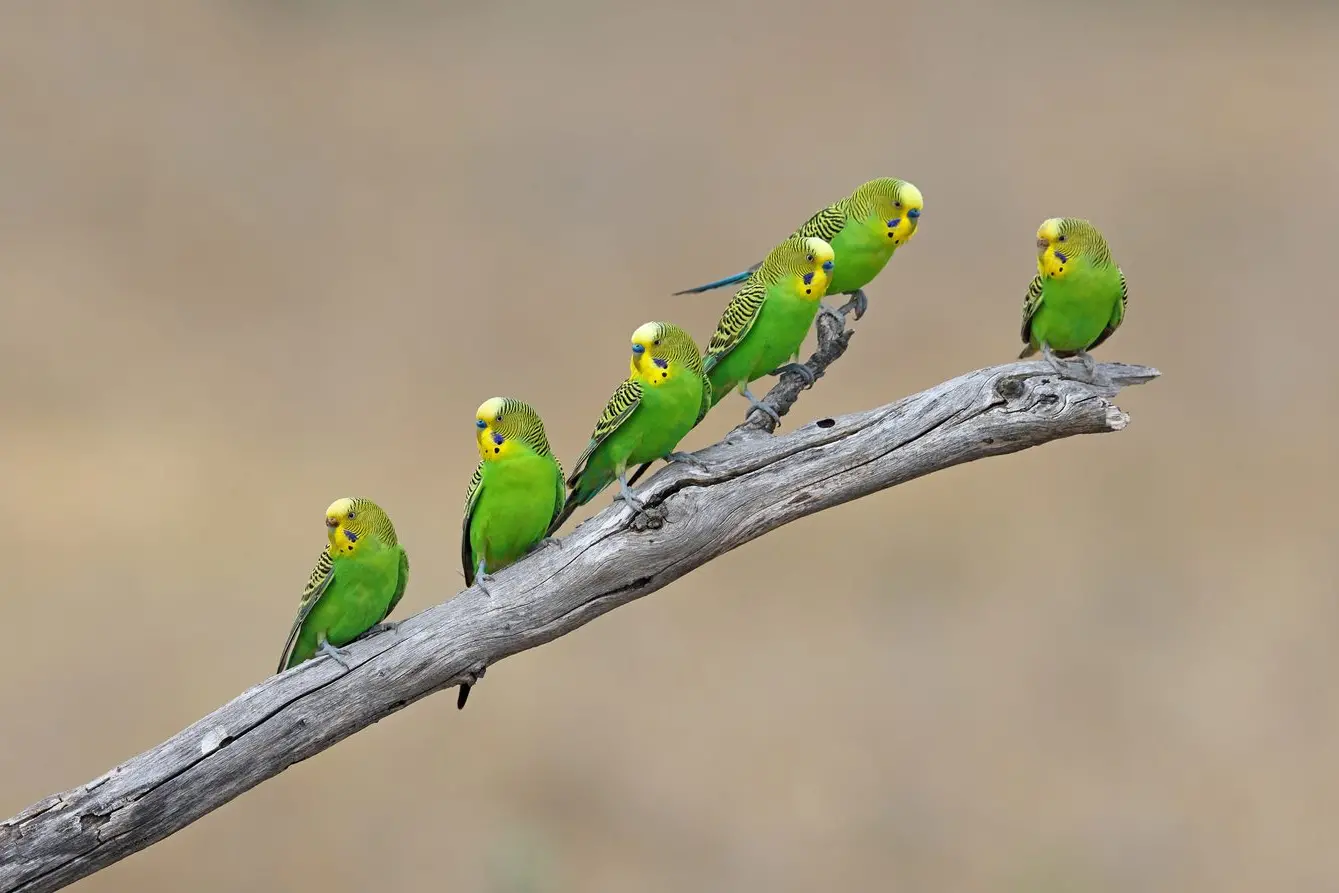
BUDGERIGARS, or Budgies as they are more commonly known, are the world’s most popular caged bird, and though they come in many attractive colour forms, there is no substitute for the natural form – the green and gold wild budgie.
Seeing budgies in the bush, especially huge flocks, is a wonderful spectacle, far more appealing than seeing this highly mobile icon of the Australian inland couped-up in a tiny cage chattering to itself in a mirror.
In the wild, Budgies predominantly occur through Australia’s dry interior, including our harshest deserts, but they are highly nomadic and have the ability to move large distances rapidly in response to changing environmental conditions.
In arid country, if good rainfall has created the perfect breeding scenario with prolific seeding grasses and the availability of surface water, immense flocks can form where they will use any available tree hollows for nesting, sometimes forming large breeding colonies.
Their breeding cycle is fast – established pairs can find a nest site, lay eggs and raise chicks within just 6-7 weeks.
After breeding, depending on conditions, they may remain in the area or rapidly depart to find suitable conditions elsewhere.
At times of inland drought, when food and water is scarce, Budgies depart those affected areas and head for greener pastures, often to more temperate regions such as here in the north-east.
Recently, a small flock was seen on the edge of the Warby Ranges at Killawarra, a sign that perhaps others could descend on the region as we progress towards summer and as the inland dries out.
Budgies feed exclusively on small seeds, mainly from native grasses and herbs, but they may also feed on a variety of weeds and introduced pasture grasses where available. They often perch on long grass, ‘riding’ the stems to the ground to then feed on the seeding heads.
They prefer open habitat, and in this region, they will generally avoid forests and occur throughout farming country and lightly timbered woodlands.
It is rare for Budgies to breed in this region – this only really occurs during severe inland droughts.
However, they were reportedly more common in the early 1900s where, together with Cockatiels, they bred in areas with numerous dead standing trees that contained small hollows for nesting – habitat that is now mostly gone.