PHOTO
By ANDY KIMBER
OUR local national park is well known to many, “discovered” by some during COVID, and a mystery to others – even though the Warby–Ovens National Park (WONP) is on Wangaratta’s doorstep.
This is the second of a series of regular articles about the WONP by members of the area’s newest Landcare group – Friends of Warby Ovens National Park (FOWONP).
FRIENDS of Warby Ovens National Park's (FOWONP) logo and our banner has our Grey Grass tree featured strongly.
Xanthorrhoea glauca subs angustifolia, our local specie, is found on several local club logos such as the Warby Range Bushwalkers, Jubilee Golf Club, Wangaratta branch of the Australian Plant Society and the Warby Range Landcare.
All 28 species of grass tree are native only to Australia unlike eucalyptus and acacia.
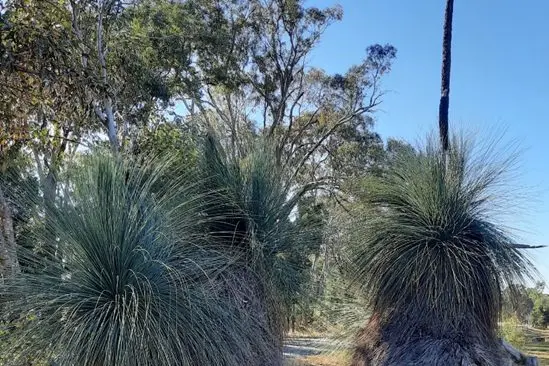
Grass trees (genus Xanthorrhoea) look like they were imagined by a risk taking cartoonist.
They have an unmistakable clump of wiry, grass-like leaves on top of a full heavy skirt (Warby plants) or a blackened, fire-charred trunk (most of the rest of Australia).
Often a massively tall flower spike appears from the crown.
Of all the wonderfully unique plants in Australia, surely grass trees rank among the most recognisable.
The common name grass tree is misnamed.
Xanthorrhoea are not grasses, nor are they trees.
Trees are large, woody plants that have a well-defined main trunk or stem with branches extending upward.
They usually have considerable height, ranging from several metres to tens of metres or more.
Grasses, however, are generally small plants and lack a woody stem.
Our grass trees have trunks made of old leaves and grow up to six metres but with the flower spike included, can extend to eight metres.
These very slow growing plants (1 to 2cm per year) push out an extremely fast-growing (can be 5cm per day!) spike usually in spring which is covered in hundreds of flowers attracting many birds.
Grass trees are distantly related to lilies.
Xanthorrhoea translates to “yellow flow”, referring to the ample resin produced at the bases of their leaves which eventually gathers at the base of the plants.
These incredible plants are found all over Australia.
Our local grass tree (Xanthorrhoea glauca – subs angustifolia or Grey Grass tree) is found as far south as the Strathbogie Ranges and up into southern Queensland but generally just west of the divide.
It is the only grass tree species found in the ACT.
Our special plant has clearly not been studied as much as Xanthorrhoea Australis which dominates much of the rest of Victoria.
High mortality due to burning seems to be a feature which differentiates Xanthorrhoea glauca plants from Xanthorrhoea australis but also their size.
Botanical experts who have visited this area, are really impressed by the size of Warby grass trees (growing vertically up and amazingly horizontally along to five metres) often fully skirted.
So, many five metre plus Xanthorrhoea exist in the Warby Range which may have never been burnt in possibly 400 years.
Grass trees could have been the most useful plant to Aboriginal people.
The resin was the best adhesive known and was used to repair canoes and manufacture spears and other implements.
Dead spikes were very straight, strong and light making them ideal for the main part of fishing spears.
Part of the starchy inner section could be eaten along with the honey from native bees which were attracted to the skirts.
The leaves and hard seeds pods were used as cutting tools.
The always dry skirt material was available for fire making.
No wonder our Warby grass trees are so well known and admired but also in need of protection and they are threatened.