
PHOTO
63891.0
Although Ring-tailed Possums are commonly found in most habitat types throughout the region, they prefer larger areas of forest vegetation where trees typically occur close together, and they are less commonly found in open areas such as farmland.
That said, they can occur at sites in more open country, and also in town parks and gardens, if there are patches of vegetation dense enough for them to move from the canopy of one tree to another.
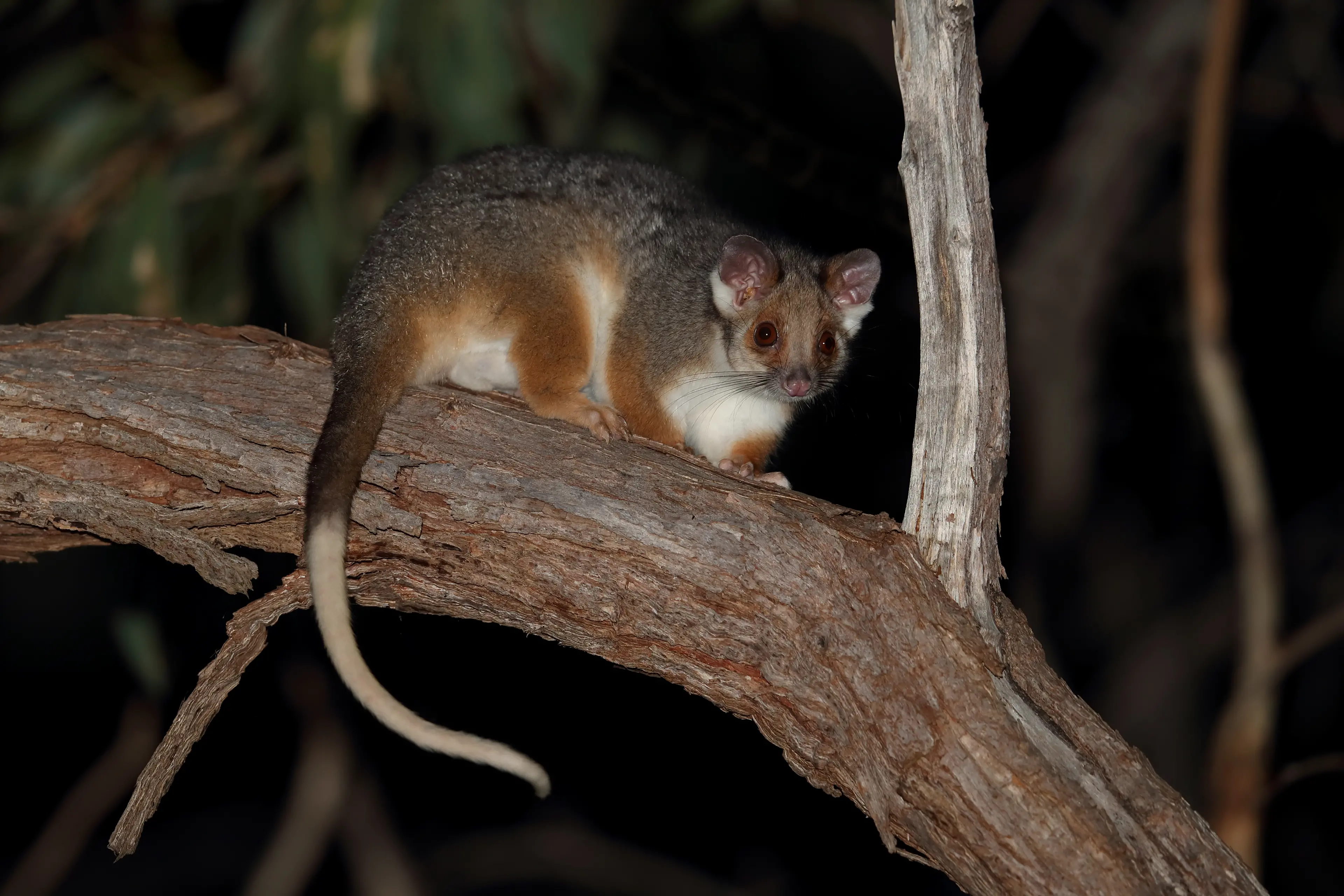
Unlike Brush-tailed Possums, they rarely come to the ground, moving from tree to tree using their tail.
The long prehensile tail has a white tip and it uses it like a fifth limb to climb and jump between connecting branches.
In built up areas these possums traverse backyards using fences and even powerlines to reach food sources.
Ring-tailed Possums are active only at night, emerging from their den site at dusk to forage for food before seeking cover again at dawn.
In some parts of their range, typically in southern Victoria, they construct spherical nests called ‘dreys’, built from woven twigs, grasses, fern fronds, leaves and bark, placed in the fork of a dense shrub or tree.
But throughout northern Victoria, Ring-tailed Possums shelter by day in tree-hollows, which are used by so many native animals highlighting the importance of big old hollow-bearing trees.
Where natural tree-hollows are scarce, Ring-tails will readily use suitably designed nest-boxes.
Leaves, flowers, fruits and buds form the bulk of a Ring-tailed Possums vegetarian diet.
Though the species may consume these foods from a wide variety of trees and shrubs, each individual possum generally has a dietary preference for one or two particular types of food.
For example, one possum might prefer leaves and shoots, whereas another might show a liking for buds and fruits.
In a somewhat extreme kind of way, Ring-tailed Possums extract the maximum amount of nutrients from their food by eating their own droppings, which allows the animal to digest their meal twice.
So, there you go kids, there may well be something worse than eating Brussels Sprouts after all!
Locally, areas of Red Gum forest along the King and Ovens River and associated treed creeklines, and sites in the Warby Ranges, offer good opportunities to see these delightfully cute little animals.
The best way to see them is to quietly walk about at night among areas where there are lots of large old trees with a tall understorey of wattles, such as Silver Wattle.
With a spotlight or bright torch held as close as possible to your eyes, you should eventually come across a Ring-tailed Possum by seeing its bright reflective eye-shine.