PHOTO
55121.0
By Lieutenant Commander John A Thompson
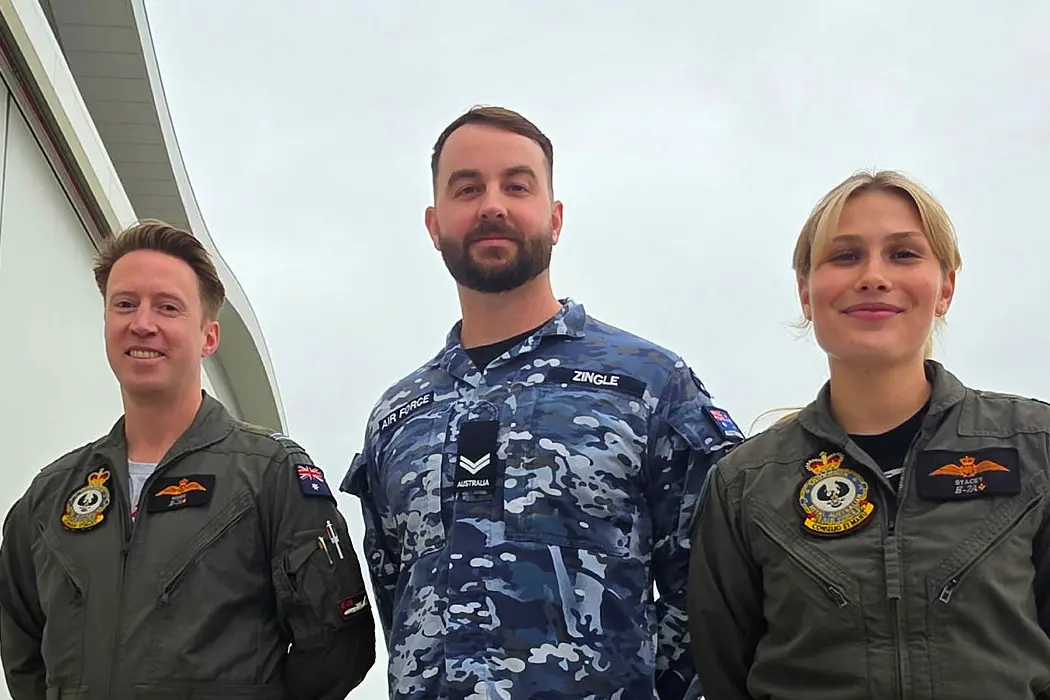
A former Wangaratta resident has been taking to the skies as part of Australia's contribution to NATO's Support and Assistance to Ukraine (NSATU) for the past three months.
As the Royal Australian Air Force’s E-7A Wedgetail aircraft prepared to leave Europe, the North Atlantic Treaty Organisation (NATO) has praised Australia's contribution.
Since July, the aircraft and its crew - including Mission commander Flight Lieutenant Rhett Allen from Wangaratta – have operated out of Poland and been tasked with more than 45 operational missions, with many resulting in the aircraft being scrambled to provide operational air battle management.
Its efforts have been focused on supporting NATO efforts to secure the humanitarian and military assistance for Ukraine, in particular the logistics hubs and ensuring Ukraine receives the assistance provided by Australia and other international partners.
NATO Secretary General Mark Rutte told journalists in Brussels that he highly valued the relationship with Australia.
“Let’s be absolutely clear on this: Australia, New Zealand, Japan and the Republic of Korea – in NATO parlance, the IP4 or the Indo-Pacific Four – we work very closely with them because we acknowledge that the Euro-Atlantic and the Indo-Pacific cannot be seen as two separate theatres,” Mr Rutte said.
“So we have to stand ready. We have to work together. We have to train together … this very practical cooperation is really crucial."
Australia’s Military Representative to NATO, Air Vice-Marshal Di Turton, said the deployment of the E-7A Wedgetail had reinforced Australia’s commitment to standing against Russia’s illegal and immoral war.
“It has also enabled us to demonstrate our interoperability and ability to deploy at range and speed a highly effective capability anywhere in the world,” Air Vice-Marshal Turton said.
The Wedgetail combines long-range surveillance radar, secondary radar as well as voice and data communications systems to provide an airborne early warning and control platform.
During a standard mission, the E-7A Wedgetail can cover more than four million square kilometres, an area the size of almost half of Europe.
It is also capable of extended long-range deployment with in-flight refuelling.
Wing Commander Sam Thorpe, his crew and support team of up to 90 personnel ensured the mission was a success, with valuable lessons to take home.
“We’ve been able to refine our procedures for ground alert and integrated air and missile defence given we’ve been in an environment where there’s a real threat,” Wing Commander Thorpe said.
“It’s enabled us to look at how we can refine our team, fuel management and our ground service equipment to be able to maximise the value we get from the aircraft.”
With the aircraft preparing to leave, the crew were looking forward to heading home.
Mission commander Flight Lieutenant Rhett Allen said he was lucky to be able to fly on the most advanced platform of its type in the world.
“We’ve proven ourselves in multiple parts around the world – it’s survivable and we can deliver any task that is given to us,” he said.
Australia’s Ambassador to Belgium, General (retd) Angus Campbell, said the Wedgetail crew left with their heads held high.
“The opportunity to be here in Europe to assist as a partner with NATO over the last three months has been extremely valuable for our aircrew, maintenance teams and the planners who formed the capability,” General Campbell said.
“This contribution has been deeply appreciated by NATO.”
Australia has committed more than $1.5 billion in support to Ukraine to fight for its sovereignty and territorial integrity against Russian aggression.