PHOTO
71283.0
Australia is renowned for its diverse bush birds, many of them outstanding songsters.
Among the finest is the Pied Butcherbird, whose rich, fluted notes ring through the early morning air to mark its territory.
Both males and females can produce this distinctive call, often from a high perch as a highly synchronised call-and-response, known as an antiphonal duet.
As they sing, the birds throw back their heads, bow forward and stretch with the flow of their melodious notes.
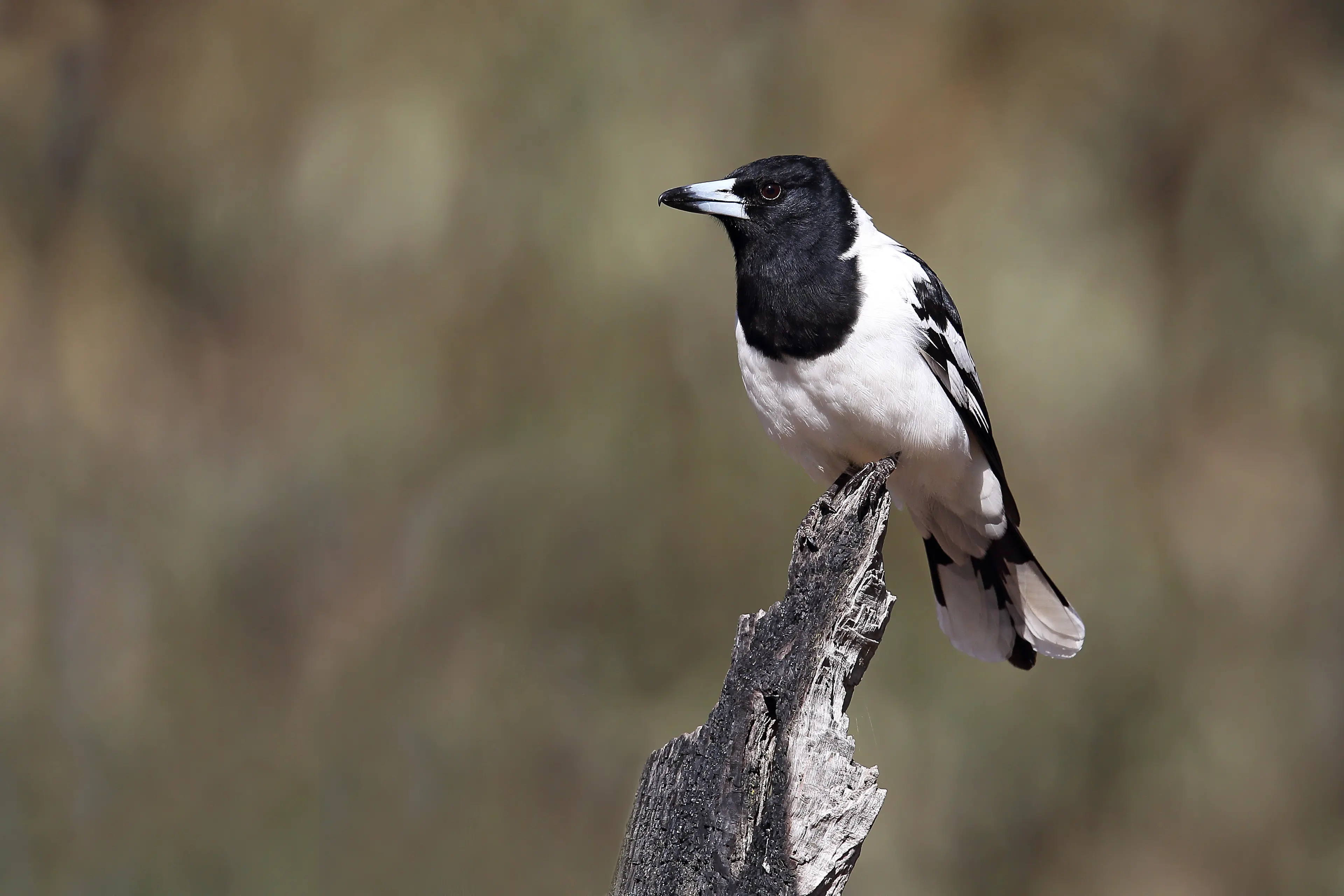
The Pied Butcherbird is a medium-sized black and white bird with a black hood, dark brown eye and a long, hooked, grey and black bill. It has a broad white collar around its neck, a black throat and black legs.
The back is mostly black, with large patches of white on the wings and rump. Both sexes are similar.
Juvenile birds are generally duller than the adults with more brown plumage instead of black
Pied Butcherbirds occur over much of mainland Australia, being more common in the northern and central parts of their range, only reaching the northernmost regions of Victoria associated with the Murray Valley and surrounding floodplains.
For this reason they are also called the Murray Magpie.
They inhabit open woodlands, especially around forest margins and in scattered remnant woodland patches among farmlands.
Locally, they are mostly found on the plains country north of places such as Wangaratta, Springhurst and Chiltern.
Pied Butcherbirds are usually seen alone, in pairs or, after breeding, in small family groups.
As predators, they are often mobbed by smaller birds such as Willie Wagtails, honeyeaters and woodswallows, especially near nesting areas.
Their prey includes small birds, eggs and chicks, small reptiles, mice and large invertebrates such as cicadas.
They typically watch from an exposed branch or post before swooping down to catch prey on the ground, on logs or rocks, or sometimes on tree trunks.
Pairs may hunt cooperatively, with one bird pursuing prey while the other assists.
Larger prey is torn apart with the bird’s strong hooked bill, sometimes after being wedged in a tree fork or impaled on a sharp stick.
Food may also be stored this way and eaten later, a behaviour that gives butcherbirds their name.