PHOTO
71786.0
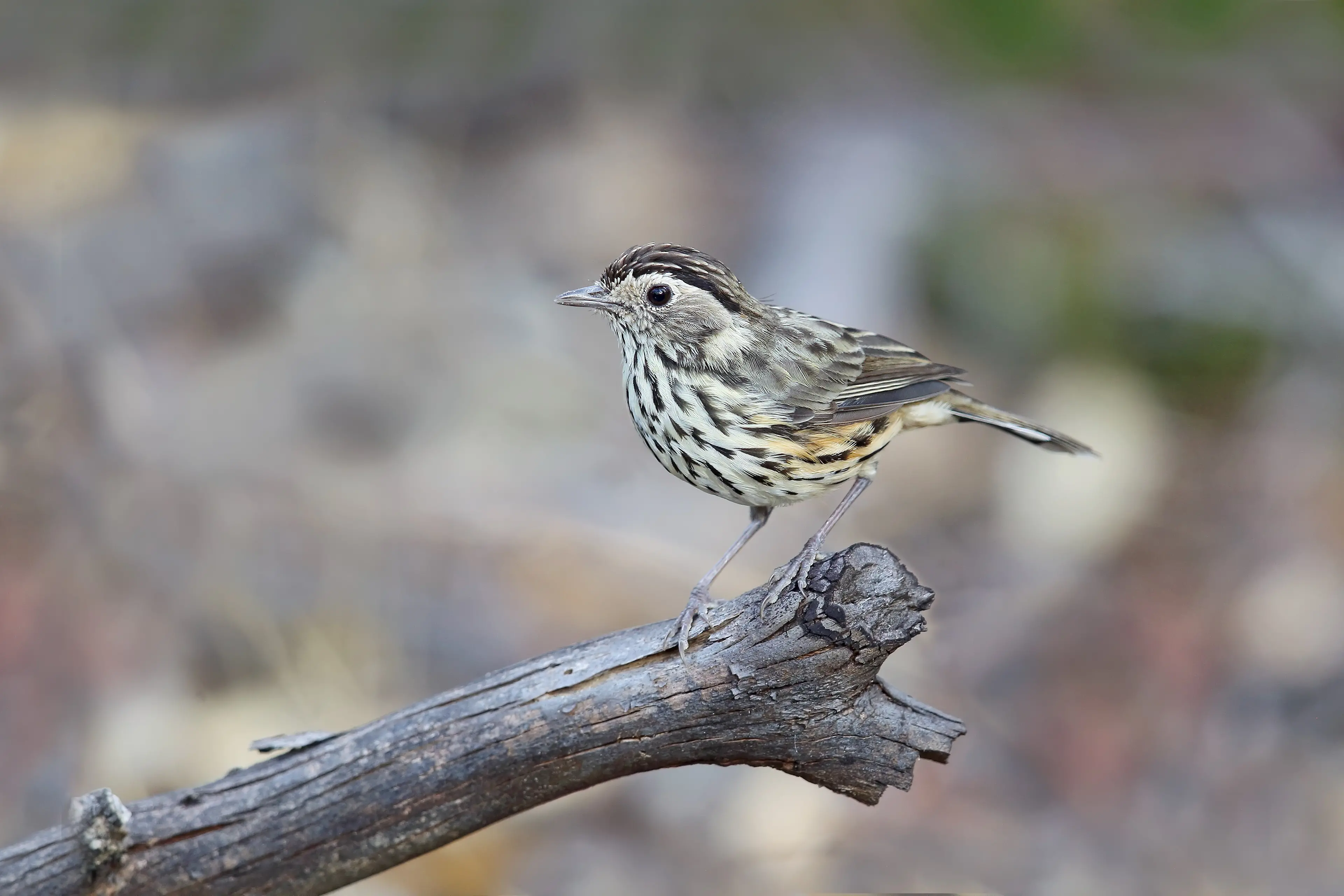
Among the great variety of small brown birds that inhabit our local bushland, the Speckled Warbler is certainly one of the more cryptic and seldom seen species.
They are generally quiet, shy birds that are often overlooked unless the observer is familiar with either their distinctive song, typically given in spring, or their rattly alarm call. They also give a soft contact call which can only be heard from close range.
The colouration and pattern of Speckled Warblers plumage - blotches of darker brown on their back and dark streaks on their pale underside - helps them blend in with their surroundings, typically on the ground amongst areas of short grass, leaf litter and debris.
Speckled Warblers usually occur in pairs, or small family groups after breeding.
Males can be distinguished by their dark brown-black eyebrow, whereas females have a rusty brown coloured eyebrow.
It is common for them to occur in loose flocks with other small insect-eating birds such as thornbills, robins and fantails.
All these species happily co-exist and forage alongside each other by feeding within their preferred niche – Speckled Warblers gleaning insects from the ground surface and low grassy or herbaceous vegetation.
They are very active and alert when foraging, slowly hopping across the ground in search of food.
However, they quickly flee to a nearby tree or shrub if disturbed, bounding from branch to branch uttering a scolding chatter, returning to the ground once the cause has passed.
During spring, pairs of Speckled Warblers form and establish breeding territories, with males regularly singing from exposed perches in order to proclaim their patch.
Their domed grass nests are constructed on the ground, concealed below a small shrub, tussock or fallen leafy branch.
Three-four chocolate brown eggs are laid which take around three weeks to hatch.
Speckled Warblers often play host to the parasitic cuckoos, especially Black-eared and occasionally Shining Bronze-cuckoos.
Their nests are also highly vulnerable to ground predators such as goannas, snakes and foxes.
Locally, Speckled Warblers can be found in many of our larger patches of forest and woodland, such as the Warby Ranges, Killawarra and the Chiltern-Beechworth forests.