
PHOTO
69475.0
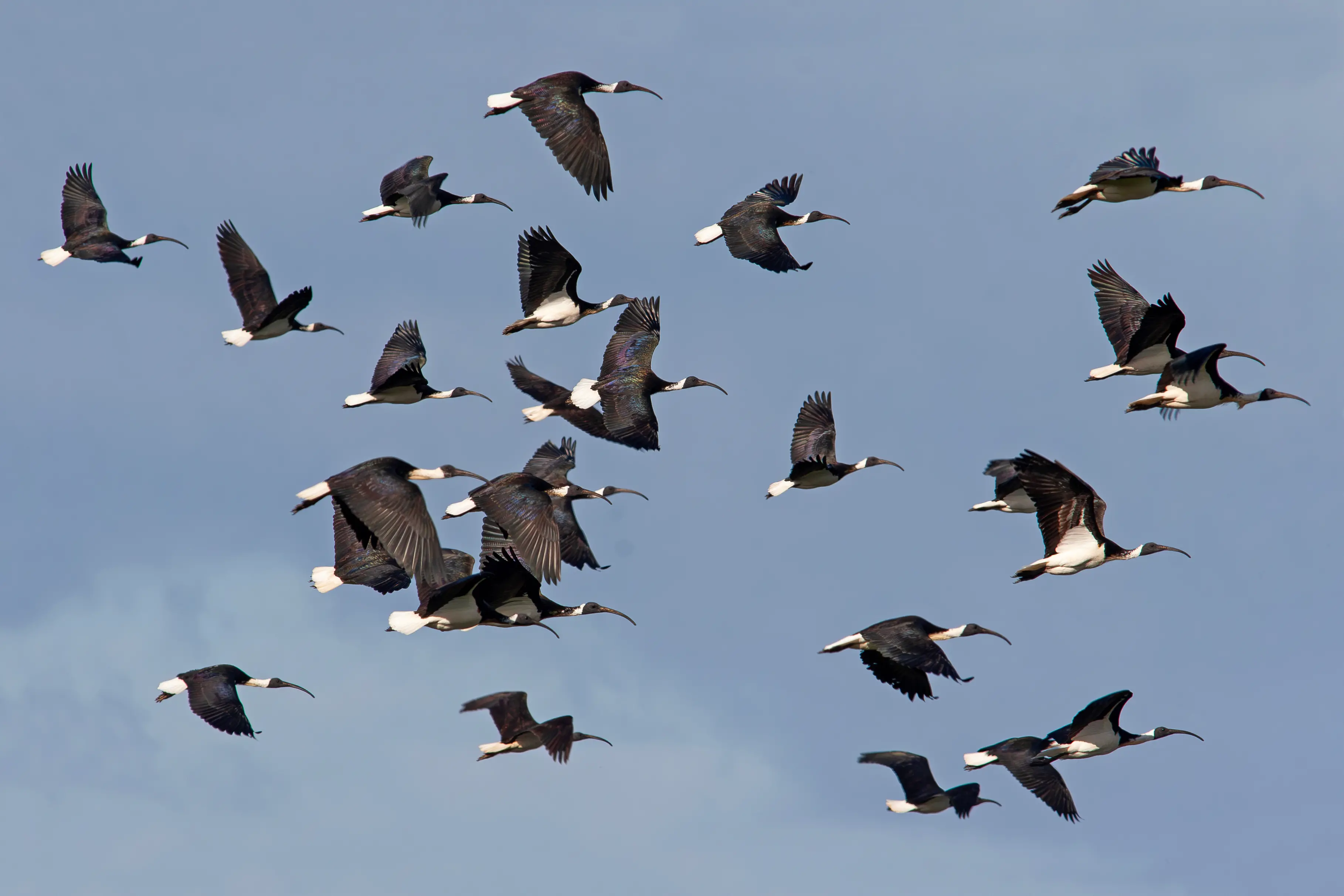
In conversation with a regular reader of the Wangaratta Chronicle, a special request was made to feature the Straw-necked Ibis in this week's column of North East Naturally. Thank you Adrian!
Of the three species of ibis occurring in Australia, the Straw-necked Ibis is the most geographically widespread.
These large gregarious waterbirds are typically found in flocks across much of the Australian mainland and are occasional vagrants to Tasmania.
They are also found in Indonesia, New Guinea, Norfolk Island and Lord Howe Island.
A feature of this bird is its highly mobile and nomadic nature and its ability to fly hundreds or thousands of kilometres between inland sites and the coasts, possibly as regular seasonal movements, and sometimes in response to local environmental conditions.
The longest recorded movement of a Straw-necked Ibis was over 3500 kilometres, from south-western Western Australia to south-eastern Queensland.
Though classed as a waterbird, Straw-necked Ibis are often found far from any surface water.
They are often regarded as the ‘farmer's friend’ for in many districts they aggregate in large numbers, sometimes in their thousands, to feed in paddocks plagued by locusts, grasshoppers and crickets.
Unlike the closely related Australian White Ibis, often nicknamed the ‘bin chicken’, Straw-necked Ibis do not usually scavenge for food around urban parks and rubbish tips.
Rather, they prefer wet and dry grasslands, pastures, croplands and swamp or lagoon margins and they are generally less adaptable than the Australian White Ibis.
The Straw-necked Ibis feeds mainly on terrestrial invertebrates, especially grasshoppers and locusts, but they will also take frogs, small reptiles and mammals.
They forage by probing the mud and groundcover with their long downcurved bill or take prey from the surface of water bodies.
Forming large breeding colonies, sometimes numbering up to 50,000 birds, they are certainly one of the most abundant of southern Australia’s waterbirds.
Often, they nest loosely with Australian White Ibises.
Their nests are often large, trampled platforms of reeds, rushes and sticks over water, often merging to form one continuous platform, and are re-used over many years.
Both sexes build nests, incubate the eggs and feed the young for about two months.
The locations of their major nesting colonies are known thanks to recent research and tracking with satellites.
Locally there are several smaller breeding colonies on wetlands along the Ovens and King rivers floodplains.
Currently there are many Straw-necked Ibis feeding in groups amongst our damp grassland pastures.