PHOTO
In recent years, we’ve observed growing interest in eco-friendly landscaping and garden design. Australian homeowners are swapping out their traditional lawns for more sustainable designs with drought-tolerant plants. Gardening and landscaping with native Australian plants is also coming into the zeitgeist nationwide.
But sustainable landscaping has benefits that go far beyond reducing your carbon footprint. With water-wise landscapes, gardeners create balanced systems that support local biodiversity. You’re not just greening your own garden – you’re greening your entire neighbourhood.
Across Australian regions including here in Wangaratta, it’s an evergreen priority to mitigate drought cycles and implement effective water systems. So how can homeowners do their part and create their own greener, self-sufficient gardens that boast a minimal environmental footprint?
How to set up a water-wise garden: key strategies
1. Install efficient irrigation systems
Smart irrigation systems can help gardeners better monitor their water usage. By installing sprinklers connected up to rainwater tanks, gardeners can make sure their water usage stays sustainable.
Just be mindful of DIY installation, as excavations conducted while installing irrigation systems may result in damage to existing pipes on your property. If you have reason to believe you've hit a pipe, then it's imperative you call a 24hr plumber immediately to reduce risks of water damage to your property.
2. Take advantage of natural drainage patterns
Have water pooling in and around your garden? Swampy soil could be indicative of poor drainage. Thankfully, this issue can be rectified with a little clever landscaping. By observing your garden’s natural drainage pattern, you can make sure the layout of your garden beds is optimised as needed.
For instance, thirstier plants like crop vegetables can be planted in drainage pathways, whereas plants that prefer drier roots can be planted firmly outside drainage patterns. The goal is to design a garden that works with your garden’s organic qualities rather than against them.
3. Work with solar orientation and exposure
The same goes for your garden’s solar exposure. If you have plants that need more solar exposure, they can be planted in areas across your garden that you’ve observed receive maximal sunlight every day.
By combining observations for your land drainage patterns as well as sunlight patterns, you can group your garden plants that have similar water and light needs. And if your garden is too exposed or too dark? Sounds like the perfect opportunity to do some tree pruning.
4. Utilise mulch and compost in your garden soil
Reducing your water consumption doesn’t necessarily have to mean swapping out all your thirsty plants for drought-tolerant ones. For veggie gardeners, you’re guaranteed to always have a few crops that demand more water than others, as many fruiting crops rely on frequent watering to prevent bitterness, bolting, or poor fruit set.
This is where mulching and composting can help dramatically improve the water retention capabilities of your garden soil. On top of helping to prevent weed growth, mulching can also help keep soil nutrient levels balanced, and can even aid in regulating soil moisture and temperature levels. This makes mulching one of the most popular water-wise gardening tips used by home and community gardeners across the country.
You can also enhance soil nutrient levels by adding natural compost, which can be made with your kitchen scraps. For families who are already harvesting veggies in their garden, all your carrot tops, onion skins, and other organic matter can go right back into your garden by way of a well-fed tumbler compost bin.
5. Incorporate native plants suited to your local climate
We’ve touched on this one a bit throughout this guide so far, but the value of native gardening simply cannot be overstated. As plants like eucalyptus trees, bottlebrushes, correa shrubs, callistemon hedges, and even native crops like finger limes are all native to our unique Aussie landscapes, it stands to reason that they’ll likely also be the best fit for your own backyard.
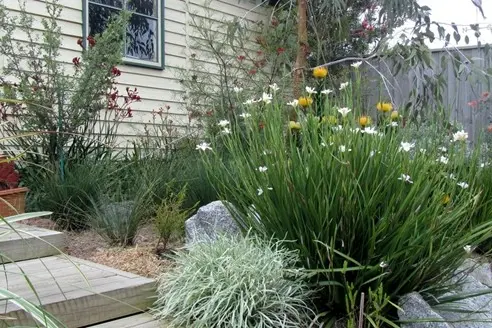
There are even native grass options for gardeners looking to swap out their lawn for a greener alternative. Common native ornamental grass varieties include wallaby grasses, kangaroo grasses, lomandra, knobby club rushes, and other hardy sedges that look fantastic in garden beds filled with tanbark or even loamy, sandy soils.
Native plants can also provide great support for local wildlife. For instance, birds and bees absolutely love flowering grevilleas, banksias, and native daisies. Native wildflowers are also very hardy, which make them great for ground cover that’s not only drought-tolerant but colourful year-round.
6. Use smart gardening tech for environmental monitoring
Gardeners of today have access to a wide variety of smart gardening tech, including soil pH testers and even moisture sensors for automating your irrigation systems. Soil moisture sensors can effectively connect up to your sprinklers to prevent both overwatering and underwatering.
There are a wide variety of other smart devices out there for tech-savvy gardeners to employ, ranging from smart weather stations for detecting changes in your garden’s microclimate, to devices that aid in pest control and pest management as well, like ultrasonic stakes that ward off critters via targeted vibrations. It’s up to individual gardeners to determine what tech investments will be the best for their own greening garden.
Every small step creates a greener garden
Sustainable gardens are more attainable than we think, especially here in Australia with our extensive catalogue of naturally drought-tolerant plants. By taking any of the sustainable gardening measures we’ve outlined above, you can enjoy cleaner, greener gardening, reduce your environmental footprint, and perhaps even save on your water and energy bills as well.
Happy planting!