PHOTO
66582.0
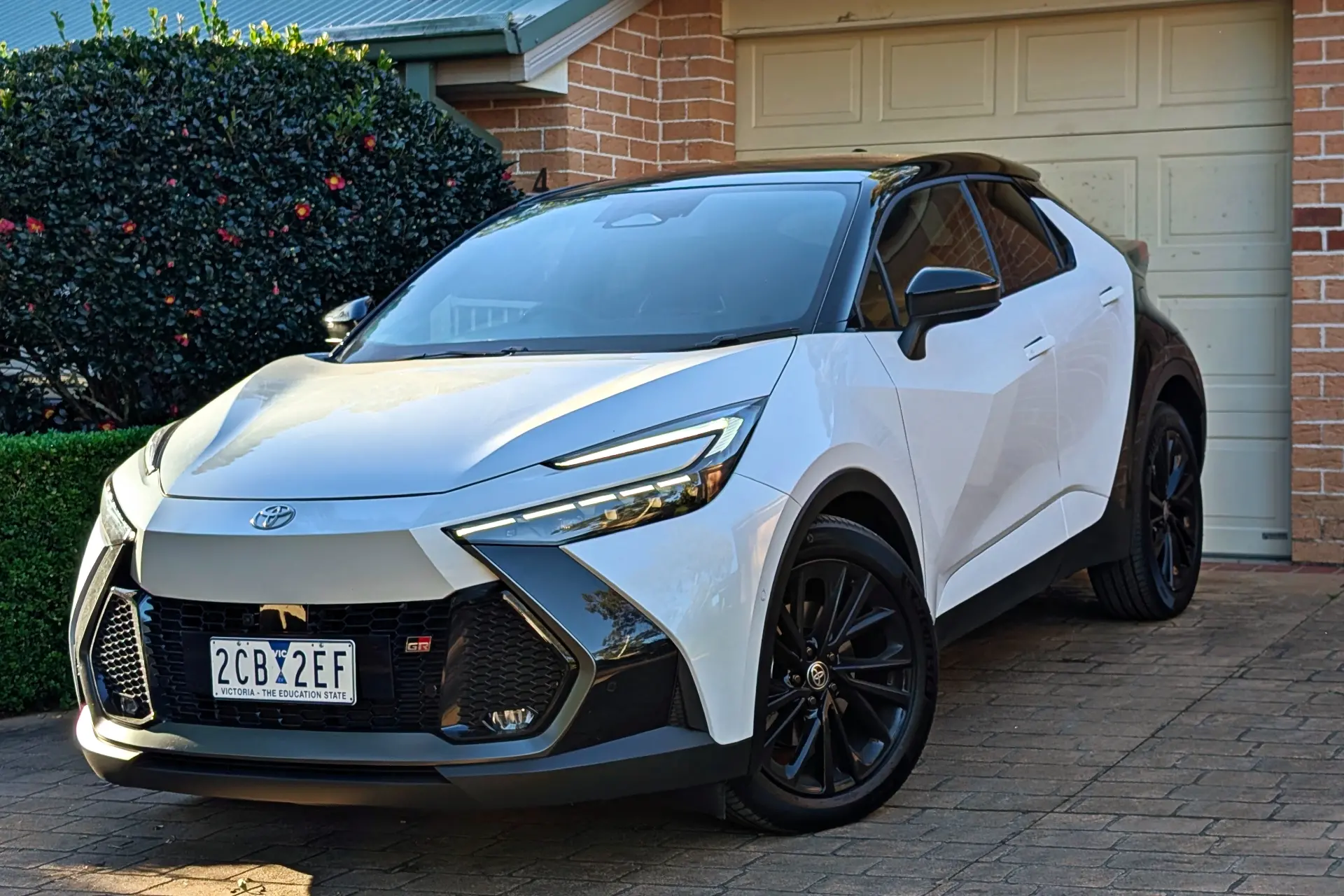
Great to finally catch up with the Toyota C-HR GR Sport.
We missed out on driving this car the first time around when it just got the suspension job.
But it was worth the wait because the GR Sport now gets some extra power, with a larger 2.0-litre based hybrid system.
And it shows, remaining responsive to the throttle even with two adults and a couple of kids on board -- although we weren't surprised when they complained about a lack of legroom in the back.
STYLING
Launched in late 2016 and now in its second generation, a rationalised lineup sees three models, all of them hybrid with a choice of two powertrains and either front- or all-wheel drive.
Adopting Toyota’s new ‘Hammer Head’ design language, C-HR is distinguished by 17- or 19-inch alloys, LED lights with automatic high beam, a rear spoiler plus a grained pattern for the front grille, black bumpers and pillar trim.
Originally priced from $29,990, the price has grown, with the GR Sport added in 2019.
Entry GXL is priced from $46,940 and the flashy, better equipped Koba is priced from $53,890.
Both come with a 1.8-litre four-cylinder hybrid powertrain, together with a 7-speed CVT style transmission and front-wheel drive.
This hybrid set up is shared with many of Toyota's other models, including Corolla, Corolla Cross and the Lexus CT hatch.
Our test vehicle, top of the line GR Sport, is priced from $58,890 plus on-roads, with all-wheel drive and a larger 2.0-litre hybrid.
Two-tone paint adds $775, two-tone plus premium paint $1550 and two-tone plus premium paint and a panoramic sunroof $2700.
Toyota describes the second-generation C-HR as a premium offering.
Inside, the fit out uses a range of recycled materials and no animal-derived products.
Standard kit includes heated sport front seats with combination suede-like and fabric upholstery, powered driver seat with memory, dual-zone climate air with nanoe X air cleaning technology, ambient lighting with colour selection and privacy glass for the rear and rear-side windows.
Unique to the GR Sport is combination suede upholstery with leather accents (both synthetic), GR-branded aluminium scuff plates and floor mats, and a perforated GR Sport steering wheel with heating functionality.
There's also adaptive cruise, a digital rear-view mirror, keyless smart entry and start, auto LED lights and wipers, auto-levelling bi-LED headlights, electronic parking brake, front and rear parking sensors, and a 4.2-inch colour driver display and a powered-operated tailgate.
Koba and GR Sport both get a tyre repair kit in lieu of a spare.
C-HR is offered with the Toyota Warranty Advantage, consisting of a 5-year/unlimited kilometre term with capped-price servicing for the first five years/75,000km (whichever comes first) and each 12-month/15,000km service costs $250.
INFOTAINMENT
Infotainment comes in the form of a 12.3-inch touchscreen, with Bluetooth, voice recognition, wireless Apple CarPlay and Android Auto, cloud-based satellite navigation, and AM/FM and DAB+ digital radio.
Both Koba and GR Sport score premium, nine-speaker JBL audio.
There's also wireless smartphone charging, USB-C and 12V charging ports and a rear USB-C accessory port.
Cloud-based navigation requires a network connection for the latest map, traffic, and routing information.
When connectivity is limited, it uses previously downloaded info to maintain coverage across the entire route.
Specifically, the cloud feature requires an active Drive Connect subscription.
A complimentary one-year subscription includes Safety and Security features, Remote Connect, Multimedia Connect and Driving Insights, accessible through the myToyota Connect app.
SAFETY
Comprehensive five-star safety includes 10 airbags, panoramic view camera, colour head-up display and forward collision warning, brake assist and autonomous emergency braking.
ENGINES / TRANSMISSIONS
Initially the GR Sport was all show and no go, but the previous 1.8-litre hybrid has been replaced by a larger more powerful 2.0-litre unit that produces a substantial 146kW of power in total -- 43kW more than before.
That's a significant increase and, even better and it is impressive that this has been achieved without any adverse effect on fuel consumption, which remains 4.1L/100km for this model.
With a 43-litre tank, it still takes standard 91 unleaded too.
Combined CO2 emissions are listed at 94g/km.
If it helps, the petrol engine produces 188Nm at 4400 rpm and the two electric motors chime in with a combined 290Nm.
DRIVING
In a nutshell, C-HR priorities form over function.
While it's a great looking car that has stood the test of time, the design demands compromise.
For a start, although marketed as a five-seater, rear legroom is tight and it is better viewed as a 2+2 (part-time back seat).
Even then it's a bit of a squeeze and the plunging roofline is problematic.
Settling into the driver's seat it becomes clear it was designed to accommodate a smaller, younger frame -- so older drivers take note.
The back seat meanwhile is claustrophobic, lacks legroom, doesn't have any air outlets and there's no fold down armrest.
The privacy glass also makes it difficult to see out of the back.
The boot is on the smaller side and conceals a tyre repair kit.
The infotainment screen is angled towards the driver, but remains separate units to the instrument cluster.
A digital rear vision mirror is fitted, but is a waste of space.
It's difficult to bring into focus and liable to make you carsick -- we'd ask if it could be deleted?
None of the cupholders will accommodate a sports drink bottle and the small centre cupholders will not accept a thermal mug for tea or coffee.
There's a single USB-C port at the front of the console, with another USB-C port and 12-volt outlet inside the console.
The extra power shows behind the wheel, with greater electrical assistance where it is needed around town.
The car also spends more time in EV mode, thanks to the better battery and electric motor combination.
But this is offset to some extent by the extra weight of two electric motors and all-wheel drive, which pushes the weight up to 1575kg - 85kg more than Koba and a whopping 120kg more than GXL.
The eCVT transmission provides seven steps or simulated gears that provide a sportier drive, but it lacks any way to change gears manually.
There are three drive modes – Normal, Eco and Sport – along with a Custom mode that allows drivers to set up things the way they want it.
That said, you can't change modes quickly and certainly not on the fly.
The only way to do so seems to be via the touchscreen and that requires the car to be in Park.
There is however an EV or stealth mode button located in the centre console, but this is restricted to low speeds.
The petrol engine will kick in if you punch the accelerator too hard.
Based on a revised version of Toyota’s TNGA-C platform, suspension is Mac strut at the front and double wishbones at the rear across the lineup.
Overseas the GR rides on 20-inch wheels, but Toyota decided to with 19s here -- no doubt in recognition of our crappy roads.
Ride and handling are very good however, even on said roads, with grippy Bridgestone Turanza rubber.
Don't go getting the wrong idea, however, because the C-HR even in GR form is still no sports car.
The steering feels rubbery at times and the drive experience is far from engaging.
You need to push it hard to get the best out of the car, but the CVT's ability to deliver the goods is limiting.
Under hard acceleration, the engine becomes harsh and noisy, and sounds a bit like a lawnmower about to run out of fuel.
In the end you'll run out of power before you run out of grip.
We were getting 5.7L/100km after more than 300km behind the wheel, including some quick corners, which is still pretty good.
SUMMING UP
Damn. The C-HR is a car I like the look of but one that always seems to fall short.
It's a hybrid clad in a sporty disguise, short on power, short on space and short on practicality.
Maybe the fully-electric C-HR will be the one that does the trick when it arrives around the middle of 2027?
The letters C-HR stand for Compact High Rider, Cross Hatch Run–about or Coupé High–Rider - in case you're wondering.
RATINGS:
Looks: 8.5
Performance: 7.5
Safety: 8
Thirst: 7.5
Practicality: 5
Comfort: 7
Tech: 7
Value: 6
Overall: 7.1
AT A GLANCE
MODEL LINE-UP
GXL, $46,940
Koba, $53,890
GR Sport, $58,890
Note: These prices do not include government or dealer delivery charges. Contact your local Toyota dealer for drive-away prices.
SPECIFICATIONS: (Toyota GR Sport, 2.0 litre 4-cylinder hybrid engine, AWD, SUV)
ENGINE:
Capacity: 2.0 litres
Configuration: Four cylinders in line, series/parallel, full hybrid
Battery: 0.91 kWh lithium-ion battery
Maximum Power: 146 kW
Maximum Torque: N/A
Fuel Type: Petrol 91 RON
Combined Fuel Cycle (ADR 81/02): 4.1 L/100km
CO2 Emissions: 94 g/km
DRIVELINE: Front-wheel drive hybrid, 7-speed CVT auto
DIMENSIONS, WEIGHT AND CAPACITIES:
Length: 4362 mm
Wheelbase: 2640 mm
Width: 1832 mm
Height: 1564 mm
Turning Circle: 11.6 metres
Kerb Mass: 1575 kg
Fuel Tank Capacity: 43 litres
BRAKES:
Front: Ventilated disc
Rear: Solid disc
STANDARD WARRANTY:
Five years / Unlimited kilometres