PHOTO
LOCAL communities will be honouring those who made the ultimate sacrifice in military service for their country on ANZAC Day including the local sporting clubs.
Wangaratta's Norm Minns Oval will host one of the O&M ANZAC Day matches this Friday when the Magpies clash with Myrtleford in all grades of football and netball.
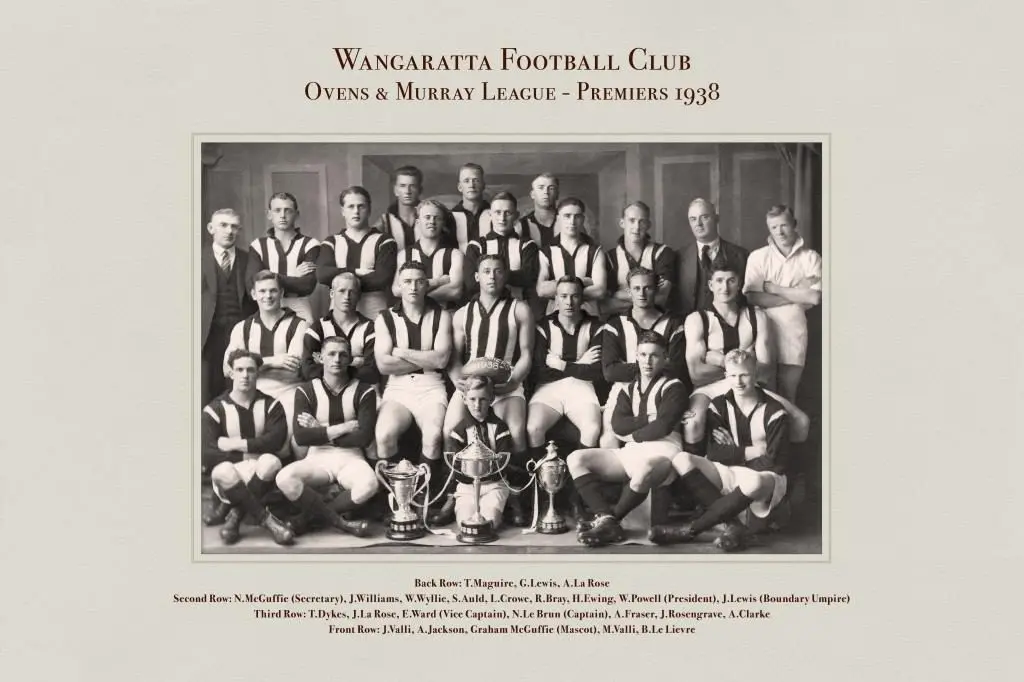
Like most clubs, the Wangaratta Magpies will also be honouring former players this year who died in the service of their country including two premiership players, Bert 'Herbie' Ewing and Norm Le Brun.
They were members of the WFNC 1938 Ovens & Murray premiership team which was coached by Le Brun, and both served and died in WW2 which began the year after their flag triumph.
Le Brun enlisted as a commando in the Second AIF on 26 February 1942, a week after the bombing of Darwin, and he was killed in action, when shot by a Japanese sniper, on 15 November 1944, in New Guinea during the Aitape–Wewak campaign.
In the Aitape sector, there is the Le Brun feature, a steep hill on the Danmap River, and known now simply as Le Brun, who was the first Australian killed in the area.
Herbie Ewing, who served in the RAN from 1925 to 1930, enlisted in the army in January 1941 at age 34 and died on 11 February 1945 on Borneo while being marched by the Japanese from the infamous prison camp Sandakan.
The Sandakan Death March is widely considered to be the single worst atrocity suffered by Australian servicemen during the Second World War.
He was survived by his wife Jean and three young children, Peter, Dorothy, and William.
O&M general manager Kane Arendarcikas said the league was excited to see ANZAC Day football and netball return to Wangaratta for 2025.
"All participants acknowledge the great privilege in representing their clubs on such an important day for the country, as we honour those who have served both past and present," Arendarcikas said.
"Being a Friday fixture, a big crowd is expected with the long weekend providing those who visit the North East region an opportunity to see some high quality community football and netball. “
A life taken too soon
from Stephen Horswell
Herbie Ewing's nephew
HERBERT 'Herbie' Ewing was born in 1907 in Carlton Victoria to a family who had been in Melbourne since 1841, six years after Melbourne was founded.
He was the second child and only son of Herbert and Alice Ewing.
His father worked as a stableman for Myers.
Times would have been tough.
Herbie left school at age 14 and joined the Navy at 18.
His grandparents, parents and older sister had all died by the time he was 20.
His sister Irene was his only immediate family.
He left the Navy at the age of 23, in 1930, just as the Great Depression was getting underway.
In 1932 and 1933, he played football for Euroa including stints as captain and was often mentioned among the best players.
He was next sighted at Booligal, south east of Hay, in 1936 working on a property called Round Box as a station hand for 12 months.
It is said that he moved from Booligal to Wangaratta to play football.
In 1938, at age 31, he met 21 year old Jean Clune (from Avoca) in Wangaratta.
He was working as a rigger on the enormous gold dredge in nearby Eldorado.
In 1939 he was living in Hoddle St near the MCG.
Jean and Herbie married in early 1939 and three children quickly followed.
Herbie had enlisted in the Army in April 1941, aged 34, just about the time Bill was conceived.
He landed in Singapore just two weeks before it fell to the Japanese.
After the fall of Singapore in early 1942, he was shipped to eastern Borneo, along with many others, to build an airfield for the Japanese at Sandakan.
His last PoW communication was an undated typewritten letter from Borneo:
“My Dearest Jean. Five letters received. Am quite well. Pleased to hear all well.
"Your allowance OK. Keep your chin up. Best love Bert.”
In early 1945, the Japanese decided to kill the remaining PoWs by a forced march into the interior of Borneo, to a town called Ranau.
Herbie died when in the first party in the first death march group on 11 February 1945, at the age of 38, as one of the old blokes on the march.
He died of beri beri (it is directly caused by vitamin B1 deficiency) and heart failure which is common with beri beri.
(https://lynettesilver.com/sandakan/the-death-marches/)
His life was taken under brutal circumstances and unnecessarily.
He left behind a destitute wife and three very young children.
His widow Jean remarried soon after the war and had two more children.
They all just got on with life as a new family.
Herbie lived a married life for less than 30 months.
His sons Peter and Bill are in their 80s.
His daughter Dorothy died a few years ago.
He has eight grandchildren and 10 great grandchildren.
Peter Ewing said the family has come to appreciate his commitment to his family and his courage in going to war.
"His motivation for enlisting seems to be securing his family's future as times were still very tough," Peter said.
"Our mother was a most marvelous person who gave us lots of love and affection but didn’t tell us much about our father and remarried after the war to the only person we knew as father.
"My brother Bill and cousin Stephen went to Sandakan together, I was supposed to go as well but emotionally didn’t think I could handle it.
"I do go sometimes go to local Dawn Services with my sons and I love to see my grandchildren wear my father’s medals to those services."
Peter said some of their father's traits were passed onto the following generation.
"Bill was a good footballer playing preseason games with South Melbourne (Sydney Swans before the club was relocated by the VFL to Sydney), and I played football also but my passion was running," he said.
Peter was touched when he learned about the Magpies honouring his father this year along with Norm Le Brun.
"I think the people at the Wangaratta Football Netball Club should be congratulated for this initiative to honour past players who have served their country," he said.
"ANZAC Day is still a very emotive day for me and I hope it will continue to remind people of the futility of war and the ongoing suffering of those left behind."