PHOTO
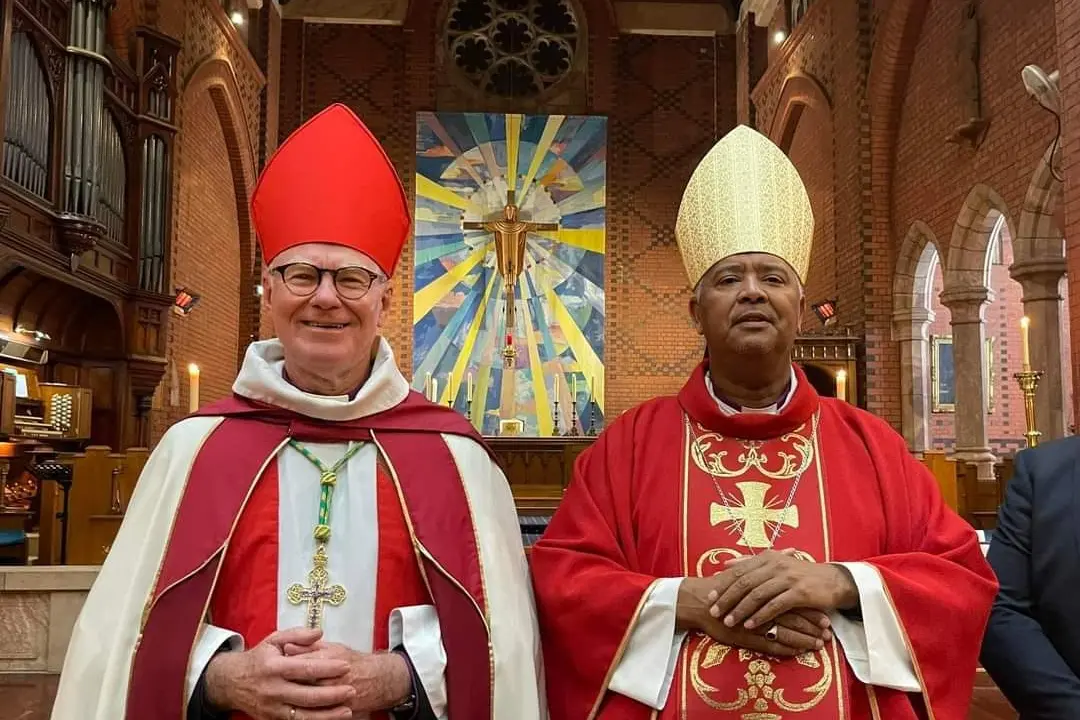
ARCHBISHOP of Melbourne Philip Freier was in attendance at the Anglican Diocese of Wangaratta's 41st synod held in the rural city over the weekend, as issues including the Voice to Parliament referendum and future ministry needs came up for discussion among clergy and laity.
Led by Bishop of Wangaratta Clarence Bester, the gathering was held at the Wangaratta Performing Arts and Convention Centre for the first time since 2019, after being staged for the last two years at Wangaratta's Quality Hotel Wangaratta Gateway due to COVID-19 restrictions.
It kicked off on Friday at WPACC, and continued with synod Eucharist at Holy Trinity Cathedral where Archbishop Freier was guest preacher, followed by dinner, with the weekend ending in celebration of the cathedral's feast of title on Trinity Sunday.
Synod heard from Rev Uncle Glenn Loughry about the Voice to Parliament, as he offered some information about what the coming referendum would mean for the nation.
Those present then voted by significant majority that the diocese "supports the referendum about whether to change the Constitution to recognise the First Peoples of Australia by establishing an Aboriginal and Torres Strait Islander Voice, and encourages support for the change of the Constitution to recognise the First Peoples of Australia by establishing an Aboriginal and Torres Strait Islander Voice".
The 41st synod also unanimously voted to send its congratulations to South Australia's Diocese of the Murray on its historic vote last week to allow for the ordination of women to the priesthood.
In his charge to synod, following the theme 'The God of Transformation', Bishop Bester reinforced the need for "visible, available and present" ministry.
"The development of the church in the early centuries, along with subsequent theological debates, has created an understanding of a church that deals mostly with structural and operational matters," he said.
"We can't avoid administrative matters, but these need to serve God's mission so that, within and outside the church, God's transformational power and the good news of the Gospel are obviously at work bringing about change.
"We need to be the change that we want to see within our world, society and church."
Bishop Bester said it was necessary to develop a ministry that brought transformation, renewal, joy and excitement.
"In as much as we are the gathered community, we also need to be the scattered community so that we find ourselves where the people are and, through our interaction and discipleship initiatives and the sharing of the Gospel within their context, be able to lead others," he said.
He said "intentional conversations" with diocesan parish leadership teams had led to the establishment of a ministry action planning committee, and the introduction of co-operative ministry arrangements.
"There is no doubt, with the ever-challenging financial situations in most parishes and declining numbers of attendees at our services, that this ministry arrangement will have to be set up in more situations," he said.
"This is not a mechanism of managing decline, but an opportunity to re-establish, redesign, redevelop and refocus our ministry and appoint a full-time clergy person covering a wider geographical area.
"If we cannot sustain our ministry and do not want to embrace the cooperative ministry arrangement, full-time ministry will become difficult within the very near future," he said.
Since the last diocesan synod, Bishop Bester said a church at Bethanga had been deconsecrated, and another two churches were expected to follow in coming months.
"There is always a sadness when a worshipping community ceases its operation," he said.
"With the sale of a redundant property, the diocese continues to retain a part of the proceeds, which goes towards the church extension fund."
Bishop Bester proposed that proceeds of sale for the first five churches deconsecrated should be used to explore planting new congregations, or replanting existing ones.
"There is no doubt that there are growing areas within some of our regions, and since we have parishes continuing within these districts, there are still opportunities to develop new ministry units," he said.
"I am already in conversation with a parish and some clergy to consider these possibilities with the appointment of a 'missionary priest'.
"We cannot just manage decline, we need to facilitate growth and identify those areas in the wider diocese where growth can take place.
"This possibility of a specialised ministry might just invigorate our collaborative ministry."
Bishop Bester said diocesan links were being explored with the Diocese of Port Elizabeth in South Africa and the Diocese of Polynesia, part of the Anglican Church of Aotearoa, New Zealand and Polynesia.
"We have made arrangements to invite clergy initially from these dioceses to come on a sabbatical for a period of three months to explore ministry together and learn from each other," he said.
There may also be an opportunity to link with St John's Theological College in Fiji.