PHOTO
63440.0
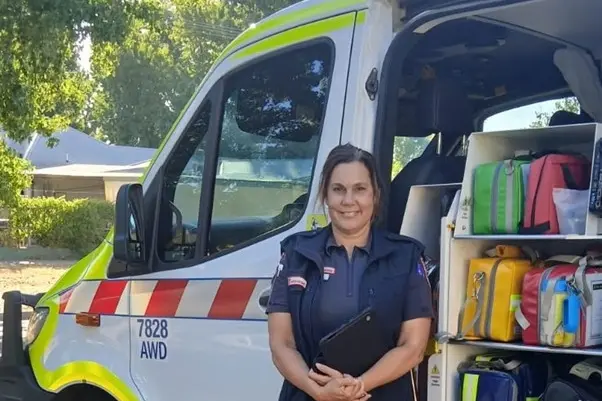
In 1990, Wangaratta paramedic Helen Narayan was part of the second ever cohort of women to join the Victorian ambulance service.
Now, three-and-a-half decades on, she continues to inspire the next generation of Ambulance Victoria (AV) paramedics.
Throughout her 35 years on road, Helen has helped pave the way for emerging female paramedics, taking others under her wing and sharing what she’s learnt.
While her career has had many highlights including appearing on Blue Heelers, being featured on the front page of The Age and Herald Sun for a snow rescue, and assisting celebrities in their time of need, overall what stands out the most is the impact she’s had on her colleagues.
“One of the things I’m most proud of is my work training students for 29 years,” Helen said.
“A lot of students have gone on to do the Mobile Intensive Care Ambulance (MICA) paramedic program, and it’s been very satisfying to see them do so well.
“It’s also incredibly rewarding to show up at a branch these days and see the majority of the paramedics are women.
“It feels like I helped pave the way for them.”
While these days a large portion of AV paramedics are women, it was a different story when Helen first began her paramedicine career.
Helen was working as an orderly in the casualty department at Western General Hospital when she met one of the first female paramedics in the state.
After chatting about the role and receiving encouragement from others close to her, Helen applied for, and was accepted into, the Associate Diploma course at the ambulance training school.
“When I joined, we had no prior clinical knowledge because we hadn’t done a university degree,” she said.
“All our learning was through hands-on scenarios at the training school and hospitals.”
As part of the second cohort of women to enter the field in Victoria, Helen felt pressure to prove she deserved a spot in the once male-only industry.
“I was one of 10 women who made up the second cohort of females and in those days, it was still a trial run to see if we could do the role successfully,” she said.
“People didn’t think we were as capable of doing the job as our male counterparts and it was really mentally and physically tough trying to prove our worth. At jobs we would often be asked if back-up was coming or where the men were.
“Back then we didn’t have the manual handling equipment we do now, so we were required to spend all day lifting patients and heavy equipment, including carrying patients down stairs.
“We’d carry equipment such as the Newborn Emergency Transport Service (NETS) cot that weighed 120kgs, and we would lift it from the floor to the stretcher, and then manually into the aircraft.”
For five years, Helen was the only female paramedic at the St Albans branch.
Despite all the challenges she faced, she felt privileged to be learning from colleagues who would go on to be among the highest-ranked in AV.
In 1996, Helen left the city and moved to Wodonga for four years before moving to Wangaratta, where she has been ever since.
“It was a different time back then with a lot of gender inequality which made the role very difficult,” she said.
“There were also aspects of the job that hadn’t been updated for women, like there not being any maternity uniforms, meaning I had to borrow larger clothes from my male colleagues.
“We also didn’t have the flexible work arrangements we do now, so raising children while doing rotating shift work was difficult.”
Helen has witnessed a lot of change throughout her time at AV, including the introduction of Advanced Life Support (ALS) paramedics, with her completing the qualification in the early 2000s.
She also saw the introduction of new equipment and vehicles; with the first ambulance she used containing two stretchers in the back that had to be manually carried.
Although she faced many challenges, Helen never considered a career change with her passion resulting in her becoming a clinical instructor, as well as taking on roles in the peer support and manual handling departments.
“I always thought of it as a long-term career,” she said.
“I loved the job back then and I still love it now 35 years later.”
With three-and-a-half decades in paramedicine under her belt, Helen’s advice for new paramedics is to always stand up for themselves, look out for their colleagues and remember what made them passionate about the job.
Today, women make up more than half of AV’s operational workforce and board members, with many women holding leadership positions across the organisation such as executive directors, regional directors, area managers, team managers and MICA paramedics.