PHOTO
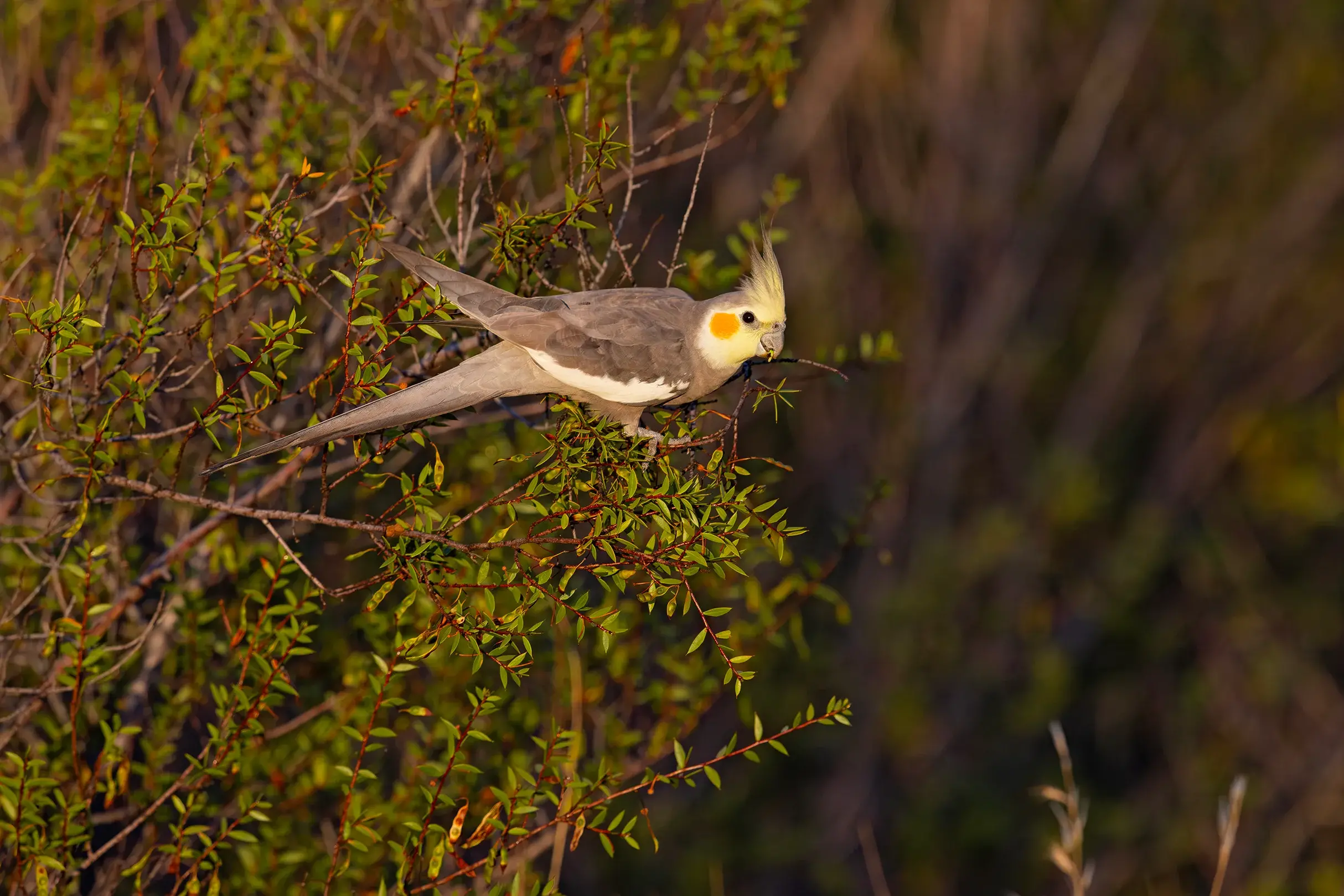
Whether the Cockatiel is a parrot or a cockatoo has been debated for some time.
Their streamlined shape, pointed wings and long slender tail are parrot-like, but they also possess key anatomical traits of cockatoos – a distinctive crest, a gall bladder, a short, rounded tongue, and powder downs on their lower back.
They also lack the structural pigment in their feathers that gives parrots their green, blue or red colours.
Furthermore, female cockatiels have barring on their wings and rump, in much the same manner as Gang-gang Cockatoos, and they have black mottled tails like female black-cockatoos.
For these reasons, Cockatiels are officially regarded as a cockatoo – the smallest and slightest of all 14 Australian species.
Cockatiels are typically birds of the arid and semi-arid interior, being most common in open or lightly timbered country and never far from water.
Though they can occur in Victoria in all months of the year, they are mostly summer visitors and can sometimes occur in large numbers if conditions inland are poor and food is scarce.
In the North East, they occur mainly from October through to February and have been recorded nesting in some years, especially during inland droughts.
They are often found in pairs or small flocks up to five or six birds.
When in numbers, they like to roost communally – another cockatoo-like trait.
They forage primarily on the ground, feeding on seeds of many types of grasses, herbs and shrubs, including weeds such as Capeweed.
They like to drink daily and visit water sources of any type, ranging from small puddles after rain, to dams and river edges.
When resting through the day, or if disturbed from feeding, they often fly to dead trees and perch lengthways on limbs – their grey tones blending with the dry grey timber. When in flight, they are graceful and buoyant, flying with a steady beat of their wings – a distinctive appearance which often helps in their identification.
Though both sexes have a long, wispy crest, males differ from females by having a yellow crest and face and a prominent dark orange cheek patch.
Females have a grey crest with only a slight amount of yellow-white on the face and much paler orange cheek.
The rest of their plumage is smokey-grey, darker above and paler underneath, with bold white shoulder patches which are prominent in flight.
Their calls too are quite distinctive – a warbling 'queel queel', mostly given in flight.
Locally, Cockatiels occur most commonly in farmland areas where there are scattered remnant trees, such as around Winton, Boorhaman, Springhurst and Rutherglen.