PHOTO
In a recent edition of this column, we featured the Spiny-cheeked Honeyeater – a bird usually associated with the Mallee and Riverina regions further west and north of here. Given the ongoing hot and dry conditions, it’s not surprising that another outback wanderer has made an appearance in the district.
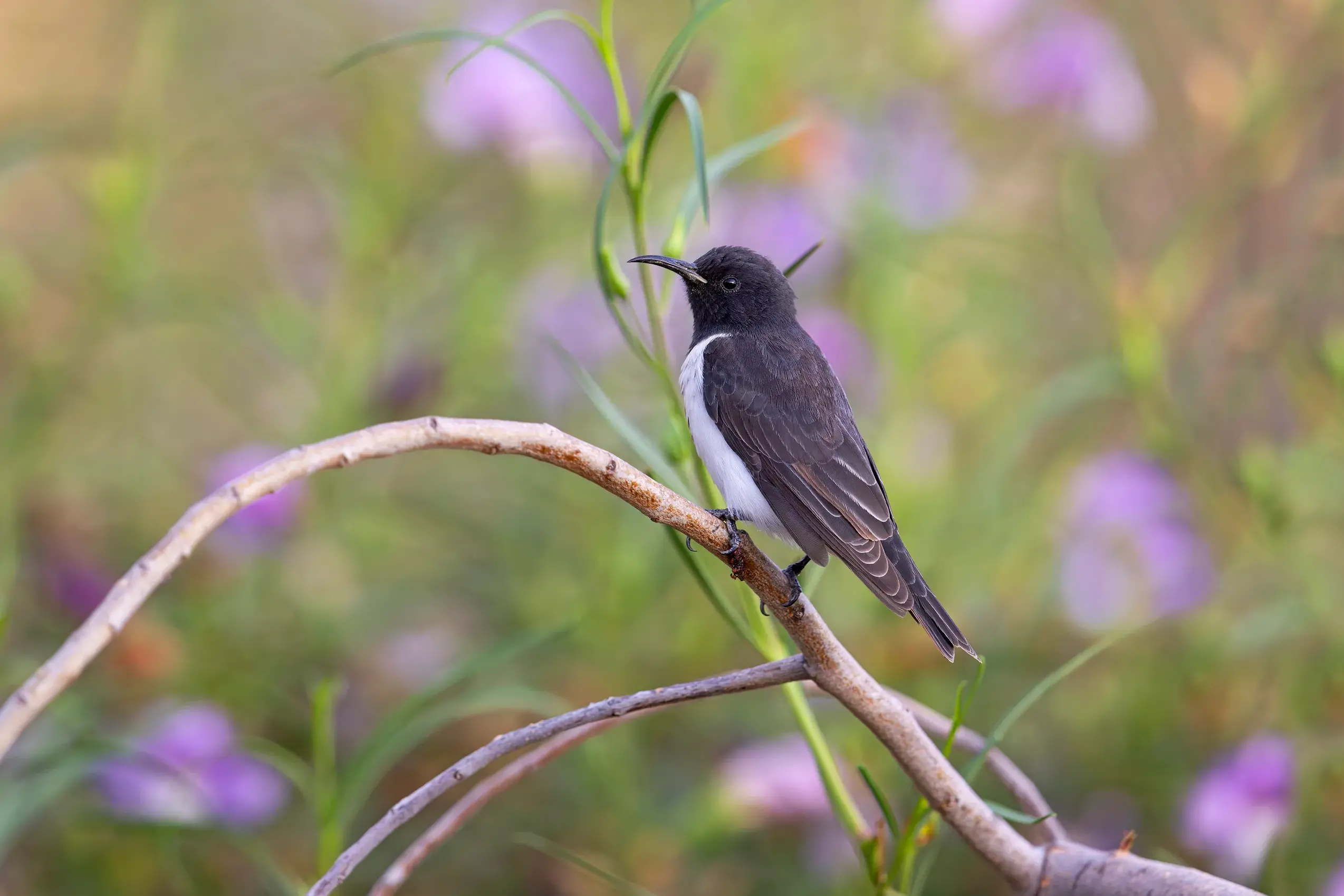
The Black Honeyeater typically occurs in arid and semi-arid shrublands, especially where there are flowering emu-bushes of the genus Eremophila. They are often found alongside Spiny-cheeked Honeyeaters and other inland species such as the Singing Honeyeater, so perhaps the recent arrivals have travelled together from the same location.
Black Honeyeaters are rarely encountered in the north-east, and past records have invariably been during drought conditions inland, much the same as we are currently experiencing. When conditions get tough in their usual outback haunts – prolonged dryness depleting their environment of any insects and nectar, they seek refuge towards the edge of their range, hoping to come across suitable habitat where they can find something to eat. The trouble is, local conditions are hardly so favourable either, but nonetheless these birds have arrived and how long they settle for is anyone’s guess.
During the heatwave of a fortnight ago, a group of no less than five visited a Killawarra property where they were lucky to find the few flowering emu-bushes in the garden. The only other food available was flowers on Fleshy Mistletoe, which appealed to many of the local resident honeyeaters. It has also been reported that a single Black Honeyeater visited a garden on the outskirts of Chiltern, feeding in a planted grevillea. Further afield, birds have been seen outside their usual range at Cobram and Deniliquin, in both cases feeding in flowering mistletoe. Who knows how many Black Honeyeaters are on the move seeking greener pastures, but if these scenarios are anything to go by, we should expect other sightings locally. Keep your eyes peeled on any flowering shrubs in your native garden.
In appearance, the Black Honeyeater is considerably smaller than our other local honeyeaters, even less so than the slightly built and energetic Eastern Spinebill. However, like the spinebill, they have a long slender decurved beak which they use to probe into tubular flowers to extract nectar. Males are conspicuously black and white, but females are much more non-descript in their colouring, being dark grey above and paler below.