
PHOTO
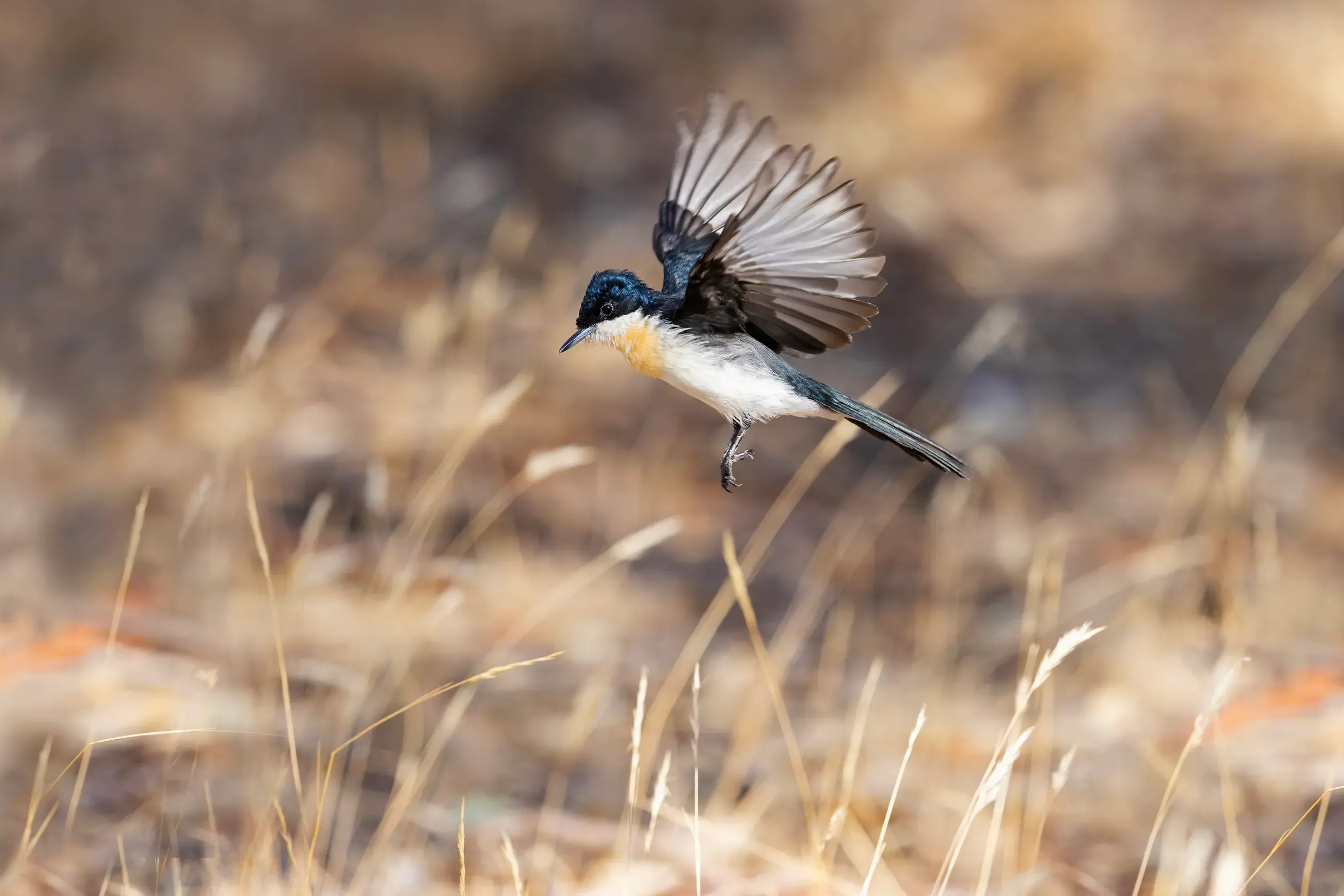
Restless Flycatchers are quirky, small black and white birds that are often mistaken for Willie Wagtails due to their resemblance in overall appearance, size and occurrence within a similar range of habitats.
The Restless Flycatcher differs from the more common Willie Wagtail in that the ‘black’ of the Restless Flycatcher is really a glossy dark blue/black.
They also have white extending from their chin right down their front, whereas the wagtail has a black chin and throat, with white starting from the chest down.
Restless Flycatchers also have a distinctive shape to their head, being somewhat flat-topped with a small crest at the back of their crown.
And unlike the wagtail, the flycatcher lacks a white eyebrow.
Sexes are similar in Restless Flycatchers, but females can be recognised by having a buff-orange wash to their throat.
Restless Flycatchers are fascinating to watch as they go about their business of foraging for insects.
As their name suggests, they are active and fidgety by nature, rarely sitting still and incessantly vibrating their tails up and down or swaying their tails from side to side.
Unlike Willie Wagtails, they do not fan and wag their tails, nor do they run or flutter along the ground when foraging.
Restless Flycatchers mostly catch their prey in flight, usually by hovering or sallying from a low perch.
Typically, they use a fence or stump as a vantage point in which to scan for prey, then they will either pounce or buoyantly chase insects through the air or peck them from low foliage.
Often, they hover around a metre or so above grassy patches in slow looping flights, all the while giving a mechanical grinding call to stir-up insects which are then pursued and captured.
The buzzing scissors-grinder sound provides their other name - the Scissor Grinder bird.
Once food is secured in their bill, they return to a nearby perch to consume their meal.
In addition to their grinding foraging call, this species also gives a piercing two or three syllable contact call, resembling teew teew, which can be heard from some distance.
Though they are recorded locally throughout the year, they appear to be most common during autumn, which may involve birds moving north from areas further south in their range.
During the spring-summer breeding season, Restless Flycatchers establish a territory and both members of a pair construct a nest consisting of tightly woven grass, bark and spiderweb, lined with feathers and decorated with lichen for camouflage.
These nests are usually built on an exposed horizontal branch, usually high above the ground in a tree, often above or near water.
Females lay three eggs and the responsibilities of incubation and feeding the chicks is shared by both sexes.