
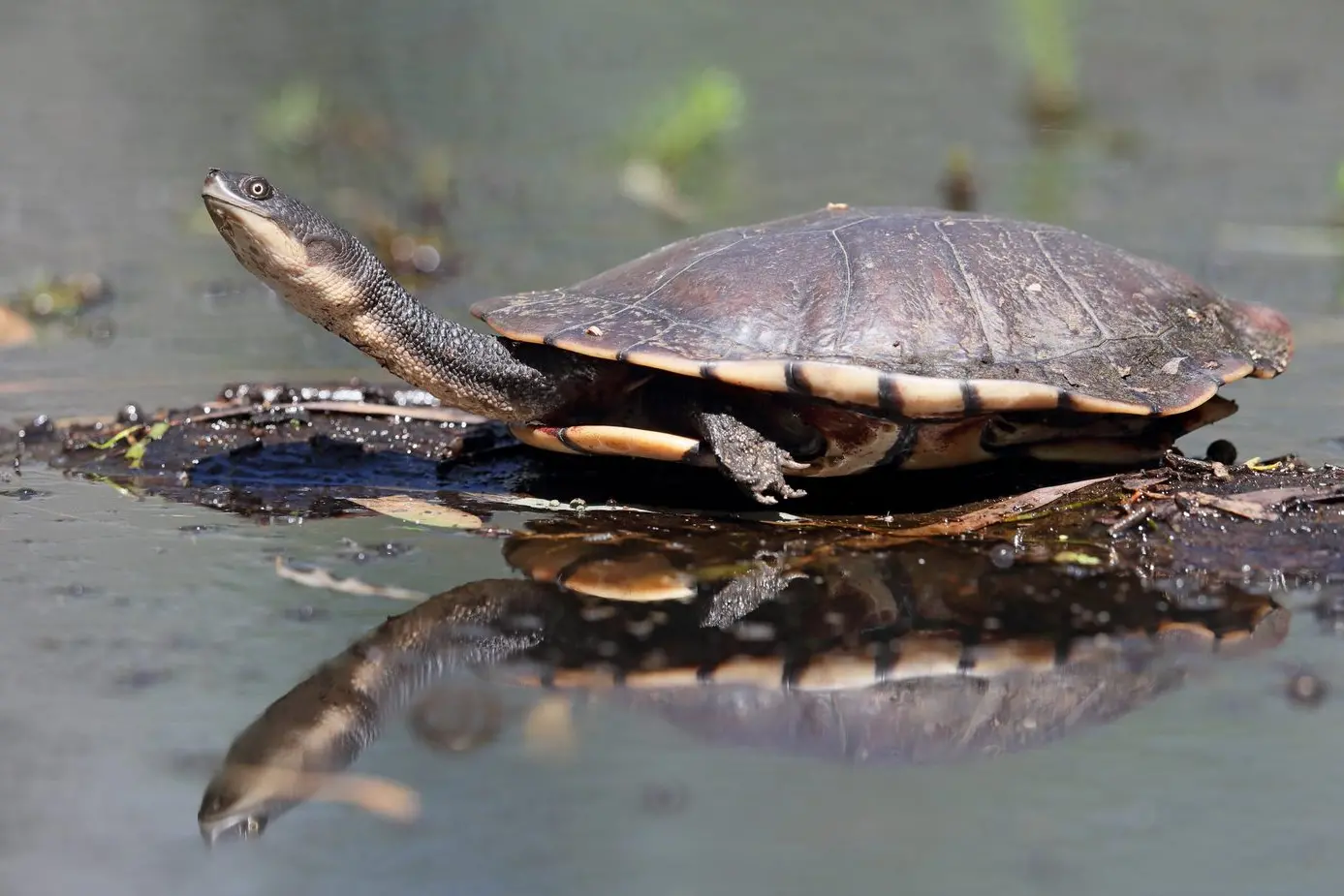
PHOTO
THE Eastern Long-necked Turtle is our most common turtle and can live up to 50 years.
It is also known as the Eastern Snake-necked Turtle.
They have a great defence mechanism for predators with the ability to produce a foul smell from their glands that can be sprayed more than one metre.
During the dry months, Eastern Long-necked Turtles bury themselves in mud or soil in dried up water bodies, protecting them from drought.
These turtles are known to travel very long distances in search of a new home.
The Eastern Long-necked Turtle’s shell can grow up to 25 cm with its neck sometimes as long as the body.
The shell or carapace can vary from a light brown to a dark brown with the lighter-coloured turtles showing the black outlines across the shell.
On the lower part of the shell (plastron) yellow markings can be seen with the black outlines.
Their feet and claws are very strong and are webbed for swimming and tearing apart large food items.
With strong jaws, they can have quite a nasty bite so be sure not to touch or aggravate them.
The Eastern Long-necked Turtles are carnivorous and commonly feed on fish, insects, tadpoles, frogs, yabbies and other crustaceans and have a unique hunting mechanism.
By bending their necks under their shell, they will get close enough to the prey and then strike out as the neck is extended, like a striking snake.
They can be found in many slow-moving water bodies such as swamps, dams and lakes.
They like a soft sandy area with nearby logs or rocks to bask on.
Summer months are the most active for this turtle.
During winter they become dormant residing under leaves or logs.
Sometimes during a dry season the Eastern Long-necked Turtle will go on long journeys to find new and improved water bodies.
This turtle breeds during summer when they are most active.
The males and females will engage in head bobbing as they prepare to mate.
The female will create her nest by digging the earth to form a circular hole with her hind feet in the bank within close proximity to their habitat.
The female will then lay up to 20 eggs in the nest each year.
Eggs incubate for about four months and hatchlings will emerge to take shelter under nearby water.
The colour of the hatchlings can be quite bright and they can have an orange to red underbelly.
Eastern Long-necked Turtles are often encountered on roadways where they are likely to be travelling down from a dam or wetland along a drainage line to a wetter area in dry times or up to dams higher in the landscape to filling dams during wetter times.
If taking them off the road be careful to avoid being bitten and try and tilt them away to avoid their noxious spray.