PHOTO
Many of our bush birds are seasonal migrants to the region, occurring either in the warmer months of spring-summer or the cool climate of autumn-winter.
Leaden Flycatchers are strictly summer visitors to Victoria, migrating from north-eastern Australia and New Guinea, arriving around the start of spring (September-October) and departing at the onset of autumn (March-April).
Like other warm season visitors to south-eastern Australia, Leaden Flycatchers migrate here to breed, establishing territories upon their arrival, nesting and rearing young, then travelling north again for the winter.
Leaden Flycatchers are active, lively birds that feed in the canopy and mid strata of eucalypt forests.
They typically occupy drier and scrubbier habitats than their close relative, the Satin Flycatcher, with which they are sometimes confused.
Locally, Leaden Flycatchers primarily occur on lower slopes and gullies in forested areas, or along red gum lined watercourses in open country.
They are commonly heard and seen along the Ovens and King rivers in and around Wangaratta, and also within gullies and adjacent slopes in forested areas such as the Warby Ranges and the Chiltern-Beechworth forests.
Leaden Flycatchers are insect-eating birds that forage amongst eucalypt foliage and large understorey shrubs such as Silver Wattle, making short darting flights out from a high perch to catch flying insects, or darting between branches to snatch insects from the foliage, branches or trunks.
Prey items consist mainly of small dragonflies, termites, cicadas, beetles, flies, bees and wasps.
Upon alighting on a branch, they often quiver their tail rapidly up and down and raise their head feathers, giving a nervous and fidgety appearance.
All the while, they typically give a loud, pleasant wee-see or two-wee call, interspersed with a buzzing zirrp-zirrp, which is often the first indication of their presence.
Males and females differ in appearance.
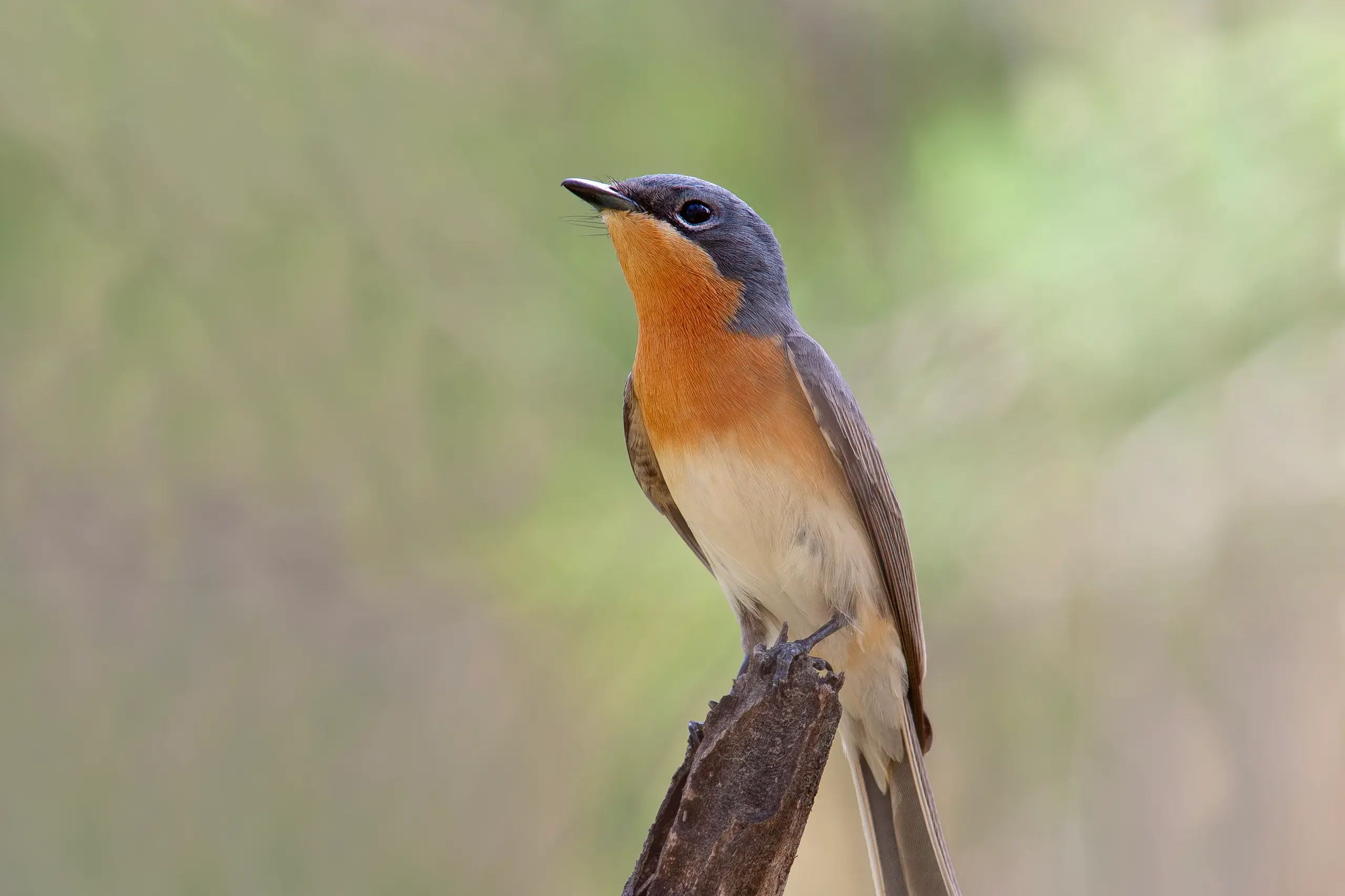
Males are a dull silvery grey with a white breast, whereas females are grey-brown with a rufous-orange throat and chest and a white breast.
Female plumaged birds (which includes immatures) can readily be confused with for the less-common Satin Flycatcher, which is generally darker in tone.
Nests are an elaborate and well-constructed neat bowl of fine bark fibres and dry grasses bound together with cobwebs and decorated with lichen and bark.
They build these on a eucalypt limb, usually high above the ground.
They lay two eggs which take just over two weeks to hatch.
Young fledge in around two weeks and soon become independent and are capable of migrating north as soon as the weather turns cooler.