
PHOTO
Widespread and moderately common throughout the North East, the Peron’s Tree Frog is one of the more distinctive and readily identifiable species of frog in the region.
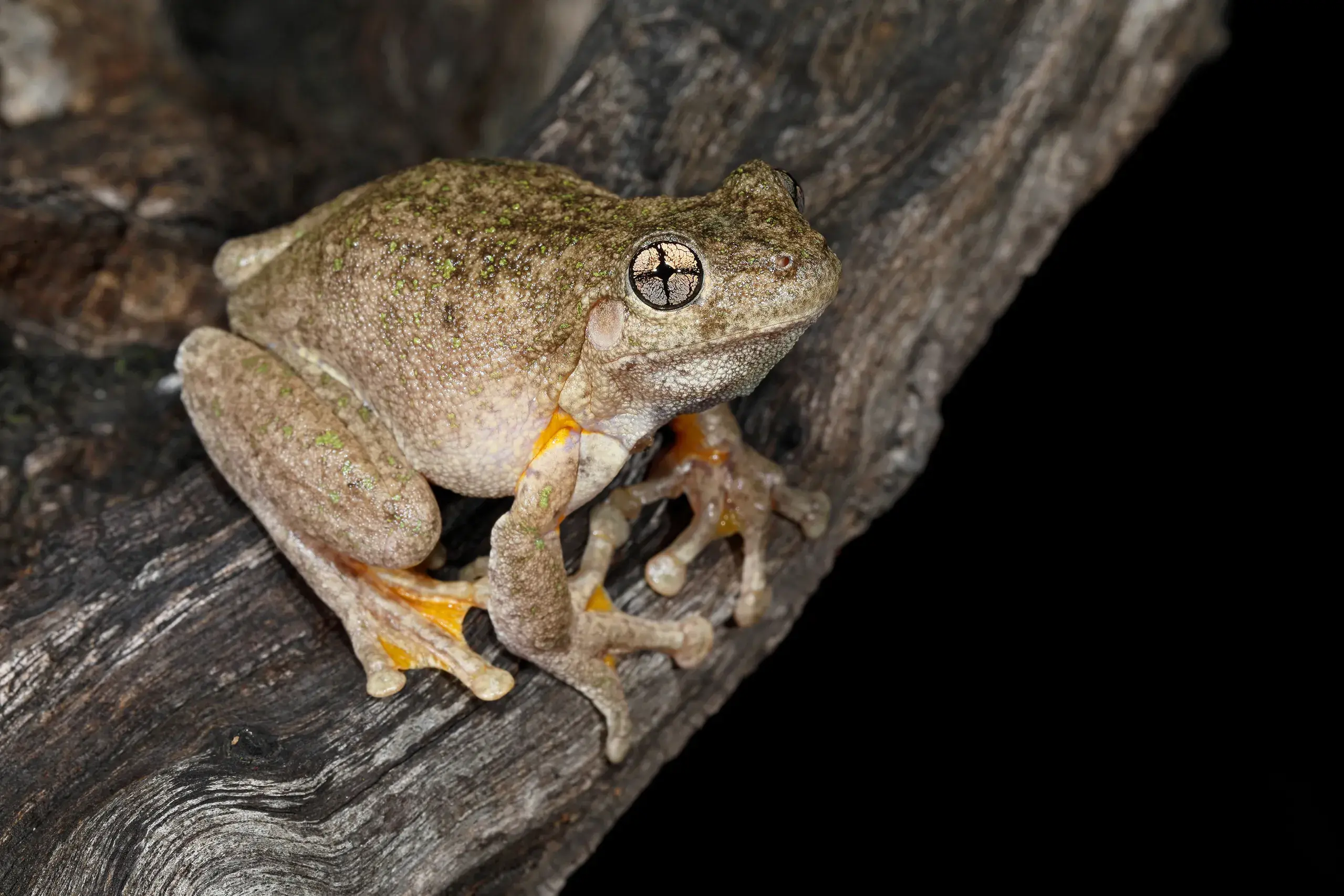
They are typically brownish-grey in overall colour, have small emerald green spots covering their back and they are distinguished from any other frog by their obvious cross-shaped pupil.
Their call, a loud purring cackle, is also very distinctive and is a common nocturnal sound on warm summer nights.
Males give this call either from arboreal substrates or from the ground, to attract a mate.
Though they are most active near water, Peron’s Tree Frogs can sometimes occur in dry forest and woodland far from the nearest water, and they are also associated with human structures and house gardens, being readily encountered hunting prey attracted to lights at night, often clinging to glass windows and doors.
During the daytime, they shelter beneath loose bark, in crevices on trunks and branches of large trees, and among fallen timber.
Around the house, they can also occupy any cool and shady site such as watering cans and pot plants.
They emerge at night to forage on trunks, branches and on the ground, and are especially active in warm and humid weather when insects such as spiders and moths are most abundant.
Like other tree frogs, they are equipped with enlarged pads on the end of each digit, thus they are agile climbers and often reach heights well above the ground.
Breeding occurs after rain during warm spring-summer weather.
Eggs are laid singly or in small clusters attached to submerged leaf litter or vegetation at the edge of shallow ponds, dams, creeklines or billabongs.
Once the eggs hatch, the pale yellow-iridescent green tadpoles are active near the surface where they feed on plant matter.
Locally, Peron’s Tree Frogs may be found anywhere in treed environments, especially close to water, such as around creeks, rivers and dams.
At the moment, they are commonly heard at night along the Ovens and King rivers and around dams and along gullies in the Warby Ranges and nearby areas.