PHOTO
Goannas, also known as monitors, are the largest species of lizards that occur in Australia.
Two species are found in North East Victoria: the more commonly seen Tree Goanna, or Lace Monitor, and the rarely encountered Sand Goanna, or Gould’s Monitor.
Sand Goannas are typically inhabitants of the drier arid and semi-arid parts of Australia and occur at the edge of their range here in Northern Victoria.
Unlike their relative the Tree Goanna, which is equally at home climbing trees as they are on the ground, the Sand Goanna is primarily terrestrial (ground-dwelling) and they very rarely climb trees.
They will, however, scale raised rocks and logs in order to bask.
They shelter in slender burrows which they excavate into the ground at the base of low vegetation or close to a log or rock, but they may also use fallen hollow logs and disused burrows of other animals, such as rabbits.
Active diurnally, especially in the warmest period of the day, Sand Goannas are wide-ranging predators that search for prey around areas of fallen timber, rocky outcrops and crevices, and low shrubby vegetation.
They often dig at spider burrows in search of spiders and contents such as other large invertebrates, smaller reptiles and their eggs, and occasionally small mammals such as mice.
Dead animals, such as road kill, may also be consumed.
They are quite wary and if disturbed, Sand Goannas will run swiftly to cover and hide until danger has passed.
Sand Goannas are oviparous, meaning they lay a clutch of eggs.
A clutch may number anywhere from three to 11 eggs, which females lay in a long burrow dug into the ground or a termite mound, the entrance of which is covered over.
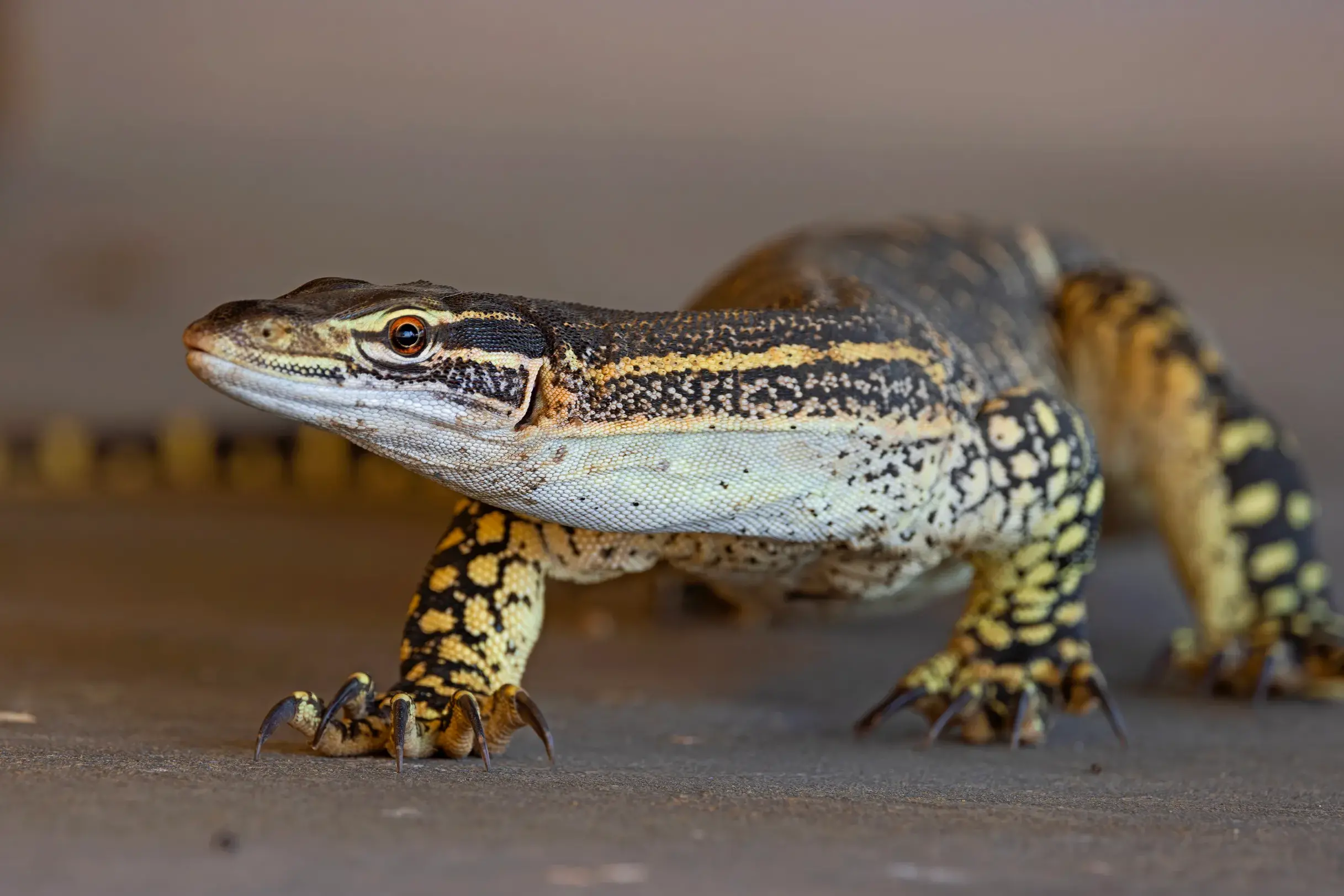
The most reliable way to distinguish the Sand Goanna from the Tree Goanna is their tail pattern.
Sand Goannas have fine bands around their tail and the tip is always pale yellow-cream.
Tree Goannas have a very broadly banded tail.
Furthermore, Sand Goannas have distinctive longitudinal yellowish stripes along their neck extending through their eye - a feature absent in the Tree Goanna.
Locally, Sand Goannas are most likely to be encountered in sandy or gravelly areas such as the Warby Ranges, the Lurg hills and around Chiltern.