PHOTO
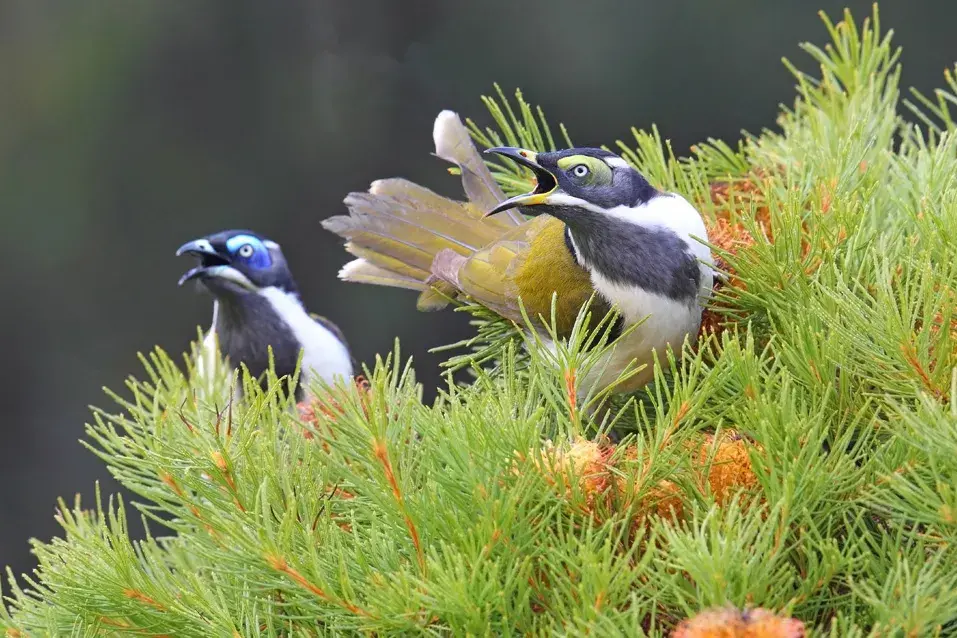
The Blue-faced Honeyeater is a large, bold bird which stands out from other birds because of their brilliant blue patch around each eye.
They feed mostly on insects and other invertebrates, but also nectar and fruit from native and exotic plants in pairs or small noisy flocks of several birds.
They take invertebrates from the trunks, branches and leaves of trees, and probe flowers for nectar.
These flocks tend to exclude other birds from the feeding area, but at times they do feed in association with other species such as Noisy Miners and Little Friarbirds.
Like many honeyeaters, this species is often pugnacious, chasing competitors away from food sources, and mobbing, swooping or harassing potential predators to protect their nests.
The Blue-faced Honeyeater is a large black, white and golden olive-green honeyeater with striking blue skin around the yellow to white eye.
The crown, face and neck are black, with a narrow white band across the back of the neck.
The upperparts and wings are a golden olive green, and the underparts are white, with a grey-black throat and upper breast.
The blue facial skin is two-toned, with the lower half a brilliant cobalt blue. Juvenile birds are like the adults but the facial skin is yellow-green and the bib is a lighter grey.
In our region the Blue-faced Honeyeater are mostly found in open forests and woodlands close to water and are often seen in orchards, farm lands and in urban parks, gardens and golf courses.
The Blue-faced Honeyeater forms breeding pairs, and may sometimes be a cooperative breeder, where immature birds help the main breeding pair to feed nestlings.
Most of their nests are made on the abandoned nests of other birds including Grey-crowned Babbler, Noisy and Little Friarbird, Noisy Miner, Red Wattlebird, Australian Magpie and Magpie-Lark.
Sometimes the nests are not modified, but often they are added to and relined.
If a new nest is built, it is a neat round cup of rough bark, linked with finer bark and grass.
Both the male and female tend the young birds, sometimes with the assistance of helpers.
The fledglings remain with the parents for some time after fledging.
At present small groups of Blue-faced Honeyeaters are in our urban gardens feeding noisily on plants including planted banksias, grevillea and other large flowering plants.
Their noisy, varied calls, including a repeated, penetrating 'woik'; 'weet weet weet' and softer 'hwit hwit' made when flying can make them easier to identify.