PHOTO
68997.0
The Little Pied Cormorant is one of the most common cormorants and is often seen perched in trees overhanging waterways, wetlands, and farm dams.
They live in both fresh and salt water and may gather in large flocks where fish are abundant.
Along inland streams, wetlands, and dams, however, they are more often seen alone.
Although Little Pied Cormorants will catch fish, they more often take freshwater yabbies and other crustaceans which are captured by deep underwater dives with both feet kicking outward in unison.
The prey is brought to the surface or back to the nearby bank, where the claws of the yabby are shaken free before its body is eaten.
As well as yabbies they feed on a wide variety of aquatic animals, insects and fish.
Freshwater shrimp makes up a large part of their diet in the cooler months.
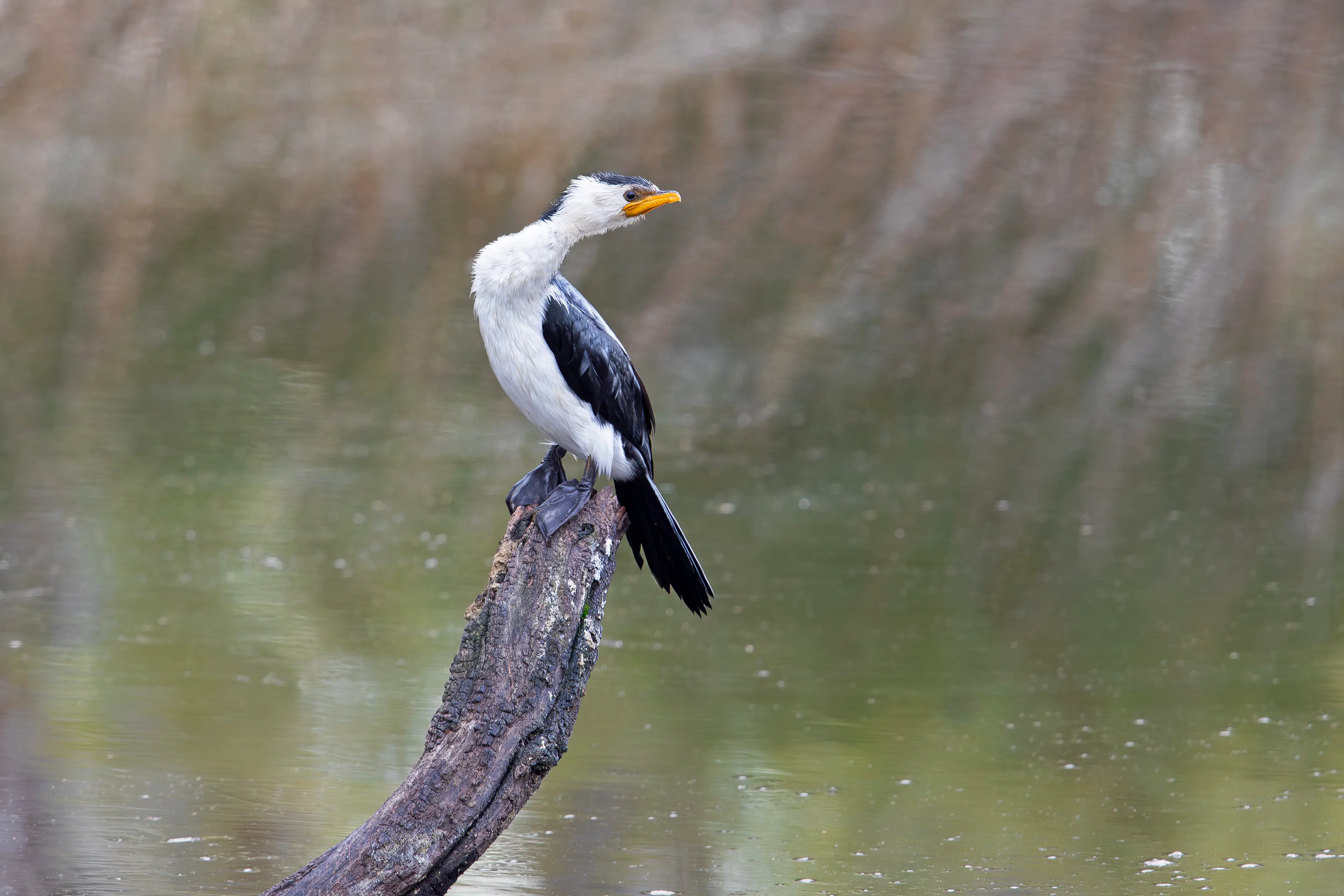
The Little Pied Cormorant is black above and white below.
The face is dusky and, in adult birds, the white of the underside extends to above the eye.
Immature birds resemble the adults except there is no white above the eye.
As with all cormorants the end of the bill is hooked, presumably to catch wriggling, slippery fish.
The Little Pied Cormorant resembles the Pied Cormorant, but it is easy to see the difference due to its smaller size and proportionately shorter bill.
These birds breed either in colonies often in large redgum swamps or, less commonly, in single pairs.
The nest is a flat platform of sticks, lined with green leaves and is usually placed in a tree which is overhanging or submerged in water.
Both adults share in egg incubation and care of the young.
Breeding usually occurs following spring flood periods when wetlands have filled and promise plentiful food during the following months.
The reason that cormorants stand with their wings spread, drying their wet wings after diving is due to having feathers that become easily waterlogged, enabling them to dive deeper by preventing air bubbles from getting trapped underneath their feathers.
However this makes flying difficult, so, they need to dry out their feathers to enable flight.