PHOTO
62953.0
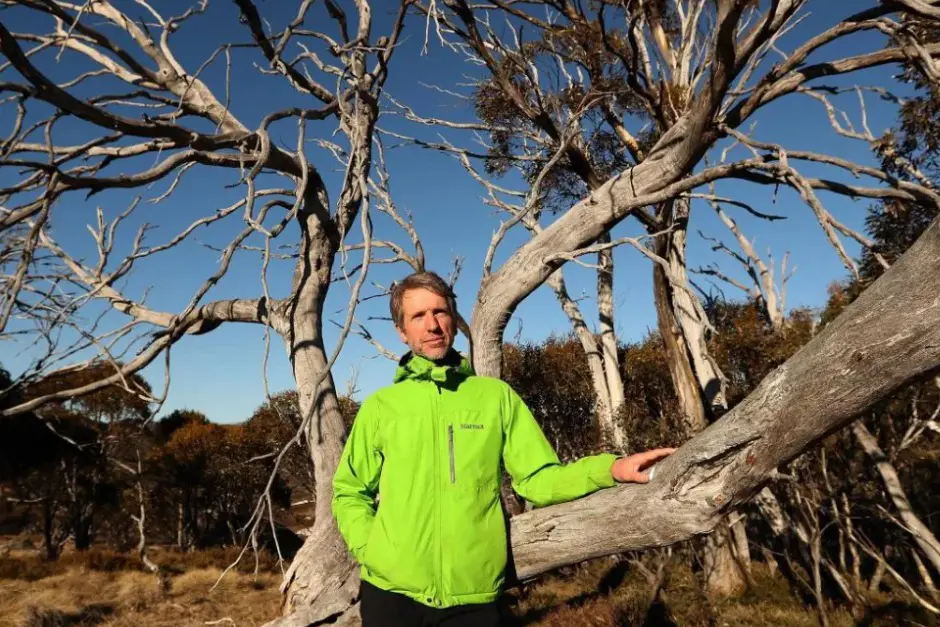
The ghostly guardians of Australia's high country are dying en masse and it could have profound consequences for the nation's largest river system.
A voracious wood-boring beetle is rapidly destroying the snow gum forests of the Australian Alps, as climate change creates the perfect conditions for them to thrive.
Scientists are working hard to find a solution but warn the dieback could rob the stressed Murray-Darling Basin of more water, creating problems for farmers and wildlife well beyond the mountains of Victoria, NSW and the ACT.
Dr Matthew Brookhouse, from the Australian National University, is a leading expert on native long-horned beetle behind the crisis and will address the 2026 Snow Gum Summit in Jindabyne on March 14 and 15.
He said many Australians don't realise snow gums play an outsized role in capturing and feeding water into the Murray-Darling Basin.
“Something like 30 per cent of the basin’s annual flow comes from these high-yielding areas at high elevation," Dr Brookhouse said.
"If you diminish the capacity of those areas to yield water by taking away tree cover … you are losing significant amounts of water."
Less water in the system could affect everything from food production to wildlife abundance in low-lying wetlands.
Using temperature-based models, researchers have found the beetles - Phoracantha mastersi – are now emerging much earlier in summer than they did historically.
In the past, they typically emerged from their pupation chambers inside the wood of snow gums around late February.
But in recent years that's happened as early as December.
That means they now have a much longer window to mate, lay eggs and attack trees.
The only factor that influences their emergence is temperature.
“This is not a minor issue that’s playing out locally," Dr Brookhouse said.
"This is now occurring across every subalpine area from Mount Buffalo in Victoria, to Kosciuszko, and the Brindabella Range in the ACT.
“The insects hit these trees again and again until they die.
"At higher elevations these are the only trees that can survive the harsh conditions, so that puts everything that depends on them in danger as well.”
For example, other researchers have shown critically-endangered mountain pygmy possums eat Bogong moths.
Researchers have also found snow gum pollen on Bogong moths, suggesting the trees may be a food source during the insect’s alpine migration.
Dr Brookhouse said the challenge now was to find a landscape-scale solution and there might be a natural one that’s also native to Australia - parasitoid wasps or other insects that attack beetle eggs.
He’s already working to trap candidate insects and understand which ones might be effective but it’s an enormous task not yet happening in enough locations.
Dr Brookhouse wants all levels of government to properly understand what’s on the line and the need for greater funding to find and implement solutions.
Farmers and wildlife managers also need to grasp the broader impacts of snow gum loss.
“What we’re doing at the moment is deploying eggs in traps and running sentinel surveys to attract parasitic wasps that might already exist in the landscape,” he said.
“That's our best chance but we need to ramp up work across broad parts of Australia to find them.
"Achieving it will rely on ongoing partnerships across universities, parks and forest management agencies, as well as private industry and the community.”
The second Snow Gum Summit is being hosted by Friends of the Earth Australia on Ngarigo Country in Jindabyne on 14 and 15 March.
Speakers will discuss other threats including changing fire regimes due to climate change.
For more information visit www.melbournefoe.org.au/snow_gum_summit_program_2026.